
COLLISION REPAIR
Collision Diagnostics, Pre-Scans & Post-Scans
A modern vehicle can store information about faults that cannot be identified by looking at exterior collision damage.
Diagnostic scanning can provide information that supports repair planning before work begins and helps identify remaining or newly present faults after repair and reassembly.
What Is a Pre-Repair Scan?
A pre-repair scan communicates with supported vehicle modules to identify diagnostic trouble codes and other available system information before repairs progress.
Depending on the vehicle and collision, this information can help the repair team understand systems that may need additional diagnosis, inspection or repair consideration.
What Is a Post-Repair Scan?
A post-repair scan occurs later in the repair process and can help identify diagnostic faults that remain or appear after components have been repaired, replaced or reconnected.
A scan is a diagnostic tool—not a standalone certificate that every aspect of a repair is correct.
Scanning and Calibration
Scanning communicates with vehicle systems and retrieves information.
Calibration is a separate procedure used to establish or verify the aiming, positioning or learned values of certain systems when required.
A vehicle can require scanning without calibration, calibration after particular repairs, or both depending on manufacturer requirements.
Related Repair Guidance
Start With History and Physical Findings
Tell the shop which warnings or symptoms appeared after the impact and which existed before it. The impact location and physical condition help interpret electronic information. A code by itself does not prove that the collision caused a failure, and a component named in a description is not automatically the part to replace.
Diagnosis connects the information with vehicle-specific tests. Wiring, connectors, power supply and module communication can all be relevant. Ask what establishes the cause before assuming a scan creates a complete repair plan or a reliable list of replacement parts.
What a Pre-Repair Report Can Document
A pre-repair scan records available information before work progresses. It can identify systems needing further investigation and provide a useful starting record. Collision damage can also prevent safe or complete communication. The limitation should be understood rather than treating missing systems as proof that they have no problems.
Ask which modules responded, what the report showed and which findings affected planning. The scan does not independently inspect hidden panels, verify structural dimensions or measure wheel geometry. Those questions still require their own assessment when relevant.
Communication and Tool Coverage
Electronic systems communicate over vehicle networks, and damage can interrupt a connection or supply. A tool may retrieve information from one system while another is unavailable. Tool coverage and vehicle condition therefore affect what a report can establish. The words “scanned the vehicle” do not describe every detail of that coverage.
Ask whether any system was inaccessible and what further diagnosis was needed. The correct next step may involve addressing a damaged connection or following a vehicle-specific test. A communication fault does not automatically establish a failed module.
Post-Repair Findings and Separate Setup Operations
After repairs and reconnection, a post-repair scan can help identify remaining or newly present faults. Findings should be interpreted and addressed under the appropriate procedure. Simply erasing a code does not fix its cause. Some faults become detectable only after certain operating conditions are met.
Calibration, programming and initialization can be separate operations even when the scan tool participates. Ask which tasks apply and what records distinguish them. A report with no detected codes is useful information, but it does not establish the whole physical repair. I-CAR’s scanning and calibration explanation describes their separate purposes. At handoff, match each supplied record to the operation it actually documents.
Discuss diagnostic coverage before the visit
The collision repair process includes pre- and post-scan stages. Ask the selected shop which diagnostic tools and arrangements apply to your vehicle. These support the repair conversation alongside physical inspection and repair information. The vehicle, equipment coverage and findings determine which operations are relevant; the names do not establish that every system on every vehicle is supported.
Call New Orleans at 504-309-3092 to discuss your vehicle’s needs. Confirm specific diagnostic arrangements with either selected location rather than assuming the same equipment inventory at Luling.
Go Deeper Into Your Repair Questions
More Answers in This Repair Topic
Diagnostic information alongside physical inspection
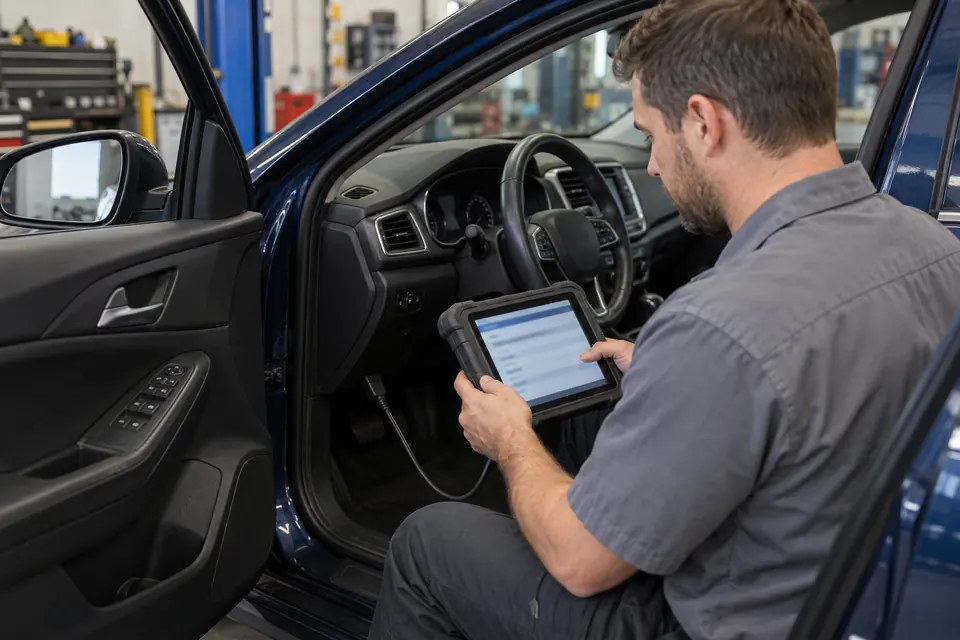
Generated illustration of diagnostic scanning. It is not a scan report and does not establish a completed diagnosis or calibration.