
BOUDREAUX’S COLLISION · REPAIR EDUCATION
Stored, Pending and Current Fault Information
Scan reports can categorize fault information differently, and the meaning depends on the vehicle and tool. A stored record may describe an earlier event; a current condition may require different follow-up. Labels should be interpreted using the relevant system information rather than a universal rule.
Illustration: Stored, Pending and Current Fault Information
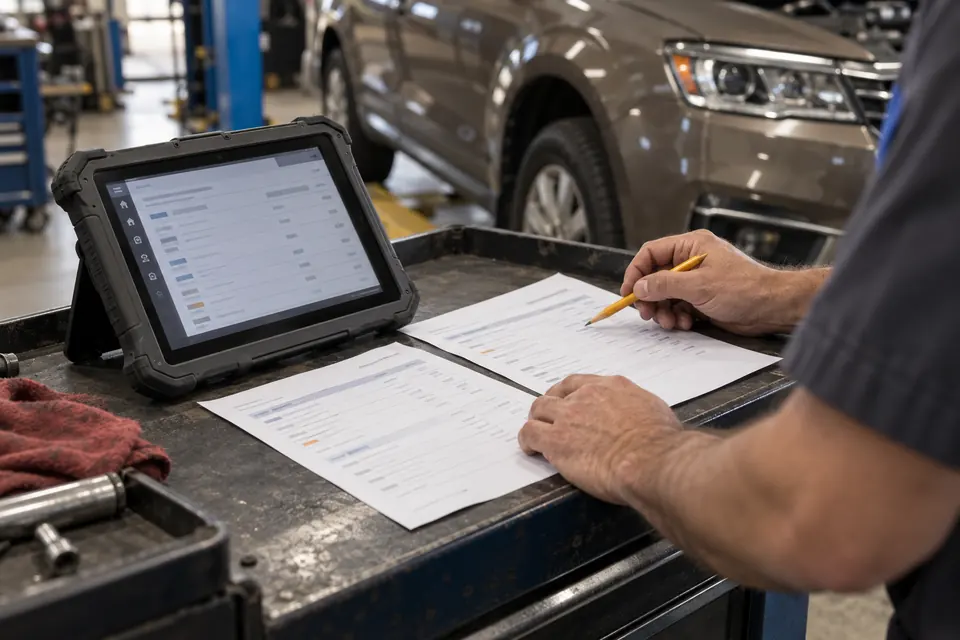
Generated illustration of reviewing diagnostic records. Actual fault labels and their meaning depend on the vehicle, tool and recorded conditions.
What to Clarify for Your Vehicle
Ask how the reported status relates to the impact, symptoms and required tests. Clearing the record does not establish that its cause was corrected. A useful explanation connects the code, supporting observations and the next diagnostic decision.
Fault status provides context
Diagnostic reports may distinguish current, stored, pending or other fault states. The exact labels and their meaning depend on the system and tool. A current condition and a previously recorded event are not automatically the same finding.
A stored entry can be relevant even when a warning is absent. A pending entry may require further evaluation under the applicable diagnostic instructions. The status helps frame the investigation, but does not by itself identify a damaged component or establish when the condition began.
Timing and repair stage matter
A fault can relate to an existing problem, the collision, a disconnected component during repair or another condition. Comparing information before work and after reassembly can help the repairer understand the sequence, but only if the reports and conditions are documented.
For example, a fault associated with a deliberately disconnected component should be assessed again when the assembly is restored. Simply deleting the entry does not demonstrate that the underlying condition has been corrected.
Reviewing the explanation rather than counting codes
Ask which findings required diagnosis, which were explained by the repair stage and how the relevant conditions were resolved. A report with fewer entries is not automatically better evidence than a report that clearly documents the investigation.
Keep copies of the reports and any explanation of unresolved findings. Tell the shop about warning messages that existed before the collision. Accurate history helps prevent an existing concern from being silently folded into the collision scope or a new concern from being dismissed without assessment.
Further repair information
Related Guidance
Read four fields together, then ask what they establish
Keep the system name, code, reported status and report date together. A code without its status loses context; a status without the identified system is equally incomplete. Ask the provider how this vehicle and tool define the exact label shown on your report.
A history-related label is not necessarily a timestamp for the first occurrence. A current label does not independently prove that the collision caused the condition. A pending label should not be translated into a universal replacement instruction. The applicable diagnostic information determines how the entry is interpreted.
Save the original report or supplied copy rather than rewriting the labels into your own categories. If the wording is unclear, note the question beside the record. That preserves what the tool actually reported while allowing the technician to explain its significance.
Compare the observation timeline with the report timeline
Your symptom history and the report history are related records with different roles. Write down what you noticed, when you first noticed it and whether it existed before the collision. Keep the date of each scan separately. A report obtained later does not show everything that happened between those dates.
For example, an owner may remember a warning before the impact while a later report lists information from the same system. That history is useful context, not proof that the current concern is unchanged. The provider still needs to compare the actual entry, observed behavior and relevant findings.
Ask which entries affect the proposed work, which are explained by the repair stage and which remain under investigation. A temporarily disconnected component during repair may provide context for an entry, but the completed plan still needs the appropriate later assessment. Comparing code counts alone loses those distinctions.
Use the handoff to resolve status questions
At pickup, ask about the entries that mattered to the repair plan. Which condition was diagnosed, which operation addressed it and what later record documents the result? If an entry remains, ask how its status and significance are being explained and what follow-up is agreed.
Keep pre-repair and later reports with their dates and the final scope. A report with fewer entries may reflect a different stage or recorded state; the explanation is more useful than a comparison of totals. Separate scan findings from any calibration, programming or other completion record.
Do not erase codes merely to see whether a warning disappears. Share earlier resets or battery disconnections if they occurred, and describe a new warning accurately if it appears later. Preserving that sequence gives the provider useful context for the next assessment.