
BOUDREAUX’S COLLISION · REPAIR EDUCATION
What a Clear Diagnostic Scan Cannot Prove
A report with no detected codes does not independently verify body dimensions, wheel alignment, every calibration or every physical component. A scan checks supported electronic systems within its capabilities and conditions.
Illustration: What a Clear Diagnostic Scan Cannot Prove
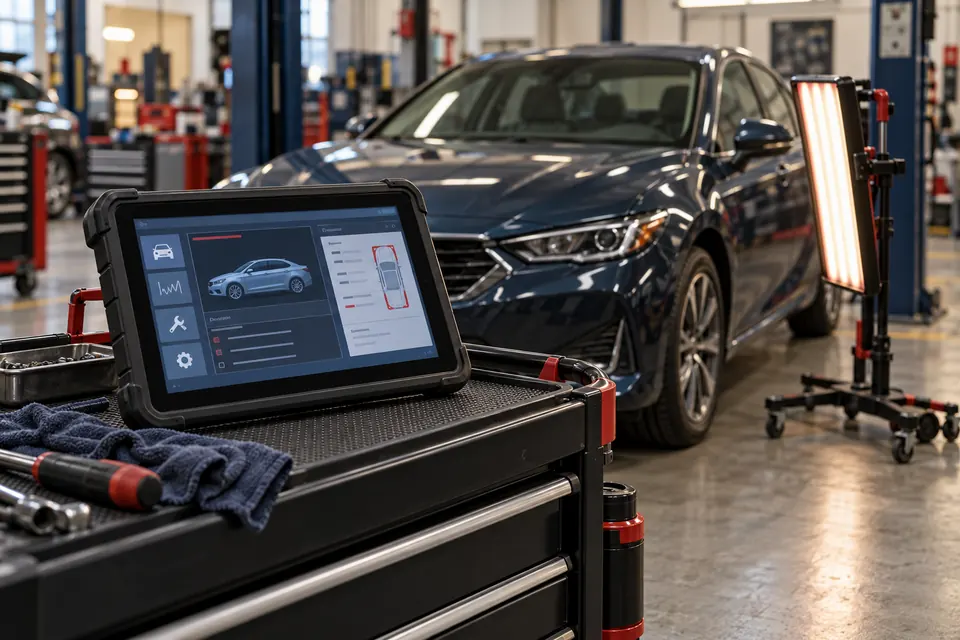
Generated educational illustration: scan scope separate inspection. Not an actual customer repair, diagnostic result, staff member or Boudreaux’s facility.
Does a clear scan mean the entire vehicle is repaired correctly?
A report with no detected codes does not independently verify body dimensions, wheel alignment, every calibration or every physical component. A scan checks supported electronic systems within its capabilities and conditions.
Some faults require specific operating conditions to appear, and some systems may not communicate. Calibration requirements can exist without a stored code. Ask which systems were covered, whether any limitation was noted and what other checks the repair required.
How This Fits Into the Repair Plan
Ask what the scan reached and what other relevant work the repair required. Keep electronic findings distinct from physical inspection, structural measurement, alignment and calibration records.
Related Repair Guidance
Read the scope of the result before using the word clear
A diagnostic summary needs context about the vehicle, systems reached and stage of repair. Ask what the clear result actually refers to. A brief no-fault label should not be treated as an assessment of every physical, structural and electronic question.
Tool coverage and access matter. A system that was not reached has not supplied the same evidence as an accessed system with a reported result. Ask whether any relevant system remains unavailable or whether a limitation needs another assessment.
The absence of a reported diagnostic code does not independently establish component condition. A damaged panel, mounting area or mechanical part may need a different inspection. Ask which physical findings and applicable requirements support the complete repair plan.
If you observe a warning or unavailable function despite the summary, describe it. Do not discard the observation simply because a report appears clear. The actual concern and the tool result need to be considered together under the relevant vehicle information.
Related reading: ADAS Damage Without a Warning Light and Post-Repair Diagnostic Verification.
Separate scanning from other required operations
A scan and calibration or initialization are different tasks. Ask which applicable requirements follow from the vehicle and actual work, and what relevant record shows the completed operation. A no-code result is not automatically documentation of required aiming or setup.
Structural measurement, wheel alignment and physical inspection also answer different questions. Ask what each relevant result establishes rather than treating electronic status as a substitute for dimensions, component condition or wheel geometry.
Programming or configuration may be separate from code reading where an electronic component is replaced or otherwise addressed. Clarify the proposed operation and requirement. A physically installed part and a clear scan should not be assumed to explain every required setup step.
If a remaining concern is earlier or unrelated to the collision, ask how it is distinguished and what next step is proposed. A final collision record should remain understandable without implying that every known vehicle issue was repaired under one scope.
Use a clear scan as one explained part of completion
At handover, ask which stage the report represents and which relevant operations it follows. An initial scan is useful information but is not automatically final verification after completed work. Keep the vehicle identity and stage with the result.
Discuss any remaining limitation or follow-up with the shop. If a system was unavailable or a requirement is not yet resolved, ask what action addresses it. A general summary should not quietly convert an unanswered question into a verified conclusion.
For a later concern, record the timing and circumstances and contact the repairing shop before resets or component changes. Keep the original report so the new observation can be compared with the earlier result without assuming the same conditions were assessed.
Boudreaux’s can discuss the actual scope and available records. The useful completion explanation states what was checked, what the result supports and what other relevant work was performed. An empty code list alone does not describe the entire repair.
Questions About What a Clear Diagnostic Scan Cannot Prove
Technical Reference
I-CAR: collision diagnostic task definitions. Manufacturer requirements for the exact vehicle control the repair method. A reference link does not imply Boudreaux’s certification or affiliation.