
BOUDREAUX’S COLLISION · REPAIR EDUCATION
Fault Code Freeze-Frame Information
Some systems retain operating information associated with a fault event. Where available, this information can help a technician understand conditions when the fault was recorded. It is one piece of diagnostic evidence, not an automatic explanation of collision causation.
Illustration: Fault Code Freeze-Frame Information
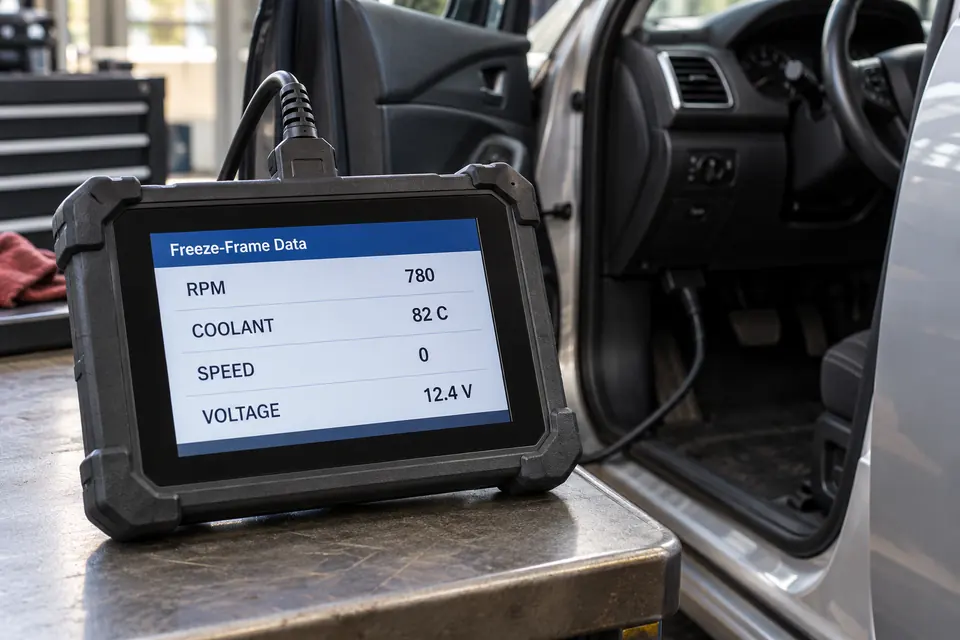
Generated educational illustration: fault code freeze frame. Not an actual customer repair, diagnostic result, staff member or Boudreaux’s facility.
Read the record’s identity before interpreting its values
Start with the module name, the full fault-code description and the scan date. Then ask which event record belongs to that code. A number without its unit, system or operating context is easy to misread. The scan date identifies when the information was retrieved; it should not be substituted for the time the fault began.
Separate a stored snapshot from live data. Live values describe what the tool is reading now. A saved snapshot describes the conditions recorded for a supported event. Ask which screen or exported page you are looking at before comparing two readings from different stages. Different systems may supply different fields, and a report may provide no usable event record for the concern being assessed.
A useful explanation names the finding and its limits: “this module reported this condition; this record provides this context; this test is still needed.” That is more informative than “the computer says the part is bad.” Preserve available reports before an authorized procedure alters stored information. If the car could not communicate at intake, ask when diagnostic access became possible and identify that later scan accurately.
A snapshot can help describe a fault event
Freeze-frame or similar recorded information may capture operating conditions associated with a diagnostic event. Availability and the data included depend on the vehicle system and tool. It is supporting information rather than a complete recording of everything that happened.
The repairer may use that context alongside fault status, physical inspection and the owner’s description. A data snapshot alone should not be treated as proof that the collision caused the fault or that one component must be replaced.
Preserving information before changing the condition
Clearing faults, disconnecting power or performing certain procedures can affect stored information. When practical and consistent with the repair instructions, relevant information should be captured before it is changed. That supports a more traceable diagnostic process.
An owner’s observation also matters. Whether a warning appeared immediately after the impact, during a later drive or only after a jump-start provides context that a report may not contain. Record the sequence without guessing at a technical cause.
What to request when diagnosis is disputed
Ask what information supported the diagnosis and whether any relevant snapshot data was available. If it was not available, that limitation should be understood rather than filled in with assumptions.
A useful repair explanation connects the observed symptom, diagnostic findings and corrective work. It should distinguish a documented fact from an inference. Keep the explanation with the repair records, especially if further evaluation is required after the vehicle is reassembled.
Further repair information
Related Guidance
A snapshot answers a narrower question than a video
Think of a diagnostic snapshot as a limited set of values associated with a recorded condition, when the system supports that information. It is not a dashcam recording, a complete trip history or a guaranteed accident timestamp. Before drawing a conclusion, ask which system supplied the record, which fault it relates to and whether the technician found it relevant to the reported symptom.
For example, an owner may notice a warning after a rear-end collision and later bring the vehicle for assessment. A report can contain information captured under conditions different from those at the moment of impact. The useful diagnostic question is how that record fits the symptom history and other findings. The owner should not treat the first unfamiliar value as proof that the crash damaged a particular part.
A missing snapshot also needs a careful explanation. It may reflect the information available from that system or the limitations of the check, rather than proof that no concern exists. Ask what evidence was available and what additional assessment is proposed. Keeping that distinction clear prevents a missing data item from becoming an invented conclusion.
Build a chronology the technician can actually use
Write a short sequence: the impact, the first observed warning, any later starting difficulty, transport and subsequent attempts to use the vehicle. If a jump-start, battery replacement or earlier service occurred, include it. Do not add precise times you cannot remember. Identify uncertainty openly so the technician can compare the recorded information with a reliable owner account.
Ask that the diagnostic explanation distinguish the observation, the interpretation and the proposed next step. A report may show a recorded condition while testing is still needed to identify its cause. If more work is proposed, request the reason for that work and how it will be authorized. This is a practical record-keeping task, not an invitation to operate a scan tool or clear information yourself.
At delivery, keep any available relevant report with the repair documents and ask about unresolved findings. If a symptom returns, describe the new occurrence with its conditions. The earlier record may be useful context, but it should not be reused as a diagnosis for every later event. A clear file shows what was observed at each stage and what was actually done in response.
Questions about recorded fault information
Example: a warning noticed after transport
Imagine a warning appears when the vehicle is started after a tow. The owner remembers the tow and the warning but has no continuous record of the intervening period. An available fault snapshot could add context to the diagnostic discussion, yet it should not be described as a video of the tow or proof of a particular handling error. The useful request is for the technician to explain what the record supports, what remains uncertain and which next test addresses the reported condition. This is an educational example, not a report of a Boudreaux’s customer vehicle.