
Illustration: Why the Paint Code Is a Starting Point
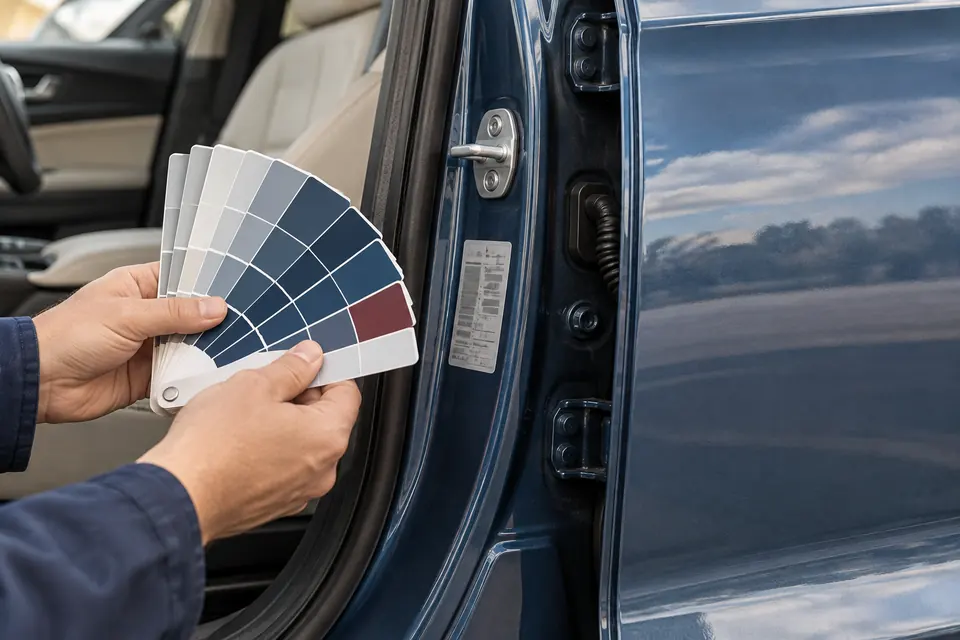
Generated educational illustration: paint code identification context. Not an actual customer repair, diagnostic result, staff member or Boudreaux’s facility.
Does the paint code guarantee a perfect match?
The paint code helps identify the manufacturer’s intended color. It does not replace comparison with the existing finish, particularly for effect colors or vehicles with previous refinishing.
The process may consider formula variants, substrate, application and a spray-out sample. A color that looks close under one light may look different under another. Ask how the formula will be checked on the actual vehicle before the repair area is refinished.
How This Fits Into the Repair Plan
Connect the accurate code with the finish actually present, including earlier paintwork. Ask how the selected matching information was compared and which surfaces and layers are included in the estimate.
Related Repair Guidance
Use the code as identification information
The manufacturer paint code is useful information for a refinish conversation, but it is not the complete assessment of the finish currently on the vehicle. Ask how the code connects to the actual surface and supported matching work.
Share the code accurately where known. If it is unclear or unavailable, ask which identification step is needed rather than guessing. A broad color name or altered character should not silently become certainty about the proposed formula or operation.
Earlier repairs, replacement panels or coating changes can matter to the current finish. Describe known history and uncertainty. An original code does not independently document the appearance or condition of every adjoining surface today.
Do not use a decoder result, chart or internet image as a complete finish diagnosis. These can supply identifying context while the actual vehicle still needs the relevant comparison and applicable product information.
Related reading: Automotive Paint Matching After Collision Repair and Surface Preparation Before Collision Refinishing.
Connect identification to the actual refinish plan
Ask how the code and available matching information are considered against the vehicle. Where relevant options or variants exist, the supported choice should follow the actual comparison rather than a universal assumption based only on the code.
Surface condition and preparation are separate questions. A repaired area and a supplied replacement panel can have different starting requirements. Ask how the scope addresses each rather than treating color identification as proof that every preparatory operation is identical.
If blending or adjoining work is proposed, clarify the panels and layers involved. Color matching and clearcoat application are different operations. A code line should not conceal the complete installed refinish scope.
If further assessment changes the plan, request the dated revision and reason. Ask whether it concerns identification, surface condition, preparation, selected color information or adjoining work. Keep the explanation with the current estimate.
Review the result beyond the identifying label
At handover, discuss visible finish with the shop on the actual vehicle and identify the relevant light and viewing position if a concern exists. Ask what operations were completed and which care instructions apply. A correct-looking code on a document does not describe every surface result.
For a later concern, record the panel, timing and conditions and contact Boudreaux’s before polishing, coating or other alterations. The observation needs assessment rather than a conclusion that the code alone proves the cause or remedy.
Ask about applicable follow-up terms for the actual work where needed. A general code reference or another product’s promise does not establish a universal agreement for every finish. Keep the final scope and relevant instructions together.
If estimates use different color descriptions, ask what each means for the actual vehicle and surfaces. The comparison should follow the supported preparation and finish operations, not only a shared everyday color name or material price.
Questions About Why the Paint Code Is a Starting Point
Technical Reference
PPG: identifying a refinish color formula. Manufacturer requirements for the exact vehicle control the repair method. A reference link does not imply Boudreaux’s certification or affiliation.