
Illustration: Surface Preparation Before Collision Refinishing
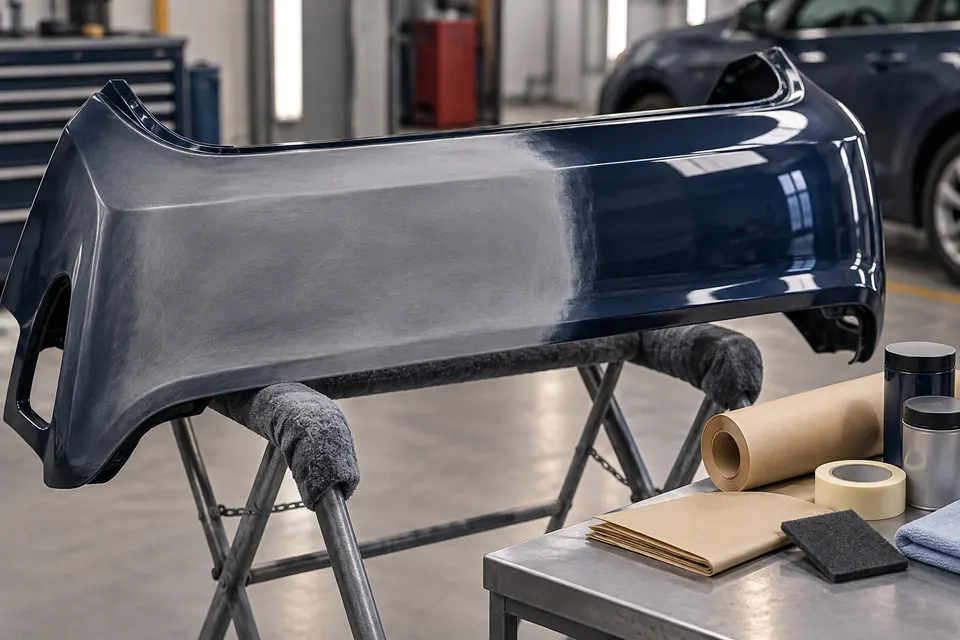
Generated educational illustration: refinish surface preparation materials. Not an actual customer repair, diagnostic result, staff member or Boudreaux’s facility.
Why does preparation affect the finished paint?
Preparation creates the surface on which the new coating will depend. Cleaning, repairing, sanding, compatible undercoats and masking all serve different purposes.
A finish defect can originate below the visible color layer. Substrate and product-system requirements determine the process; preparation should not be reduced to simply covering damage with paint. Ask what preparation is needed for the repaired area and how surrounding parts will be protected.
How This Fits Into the Repair Plan
Identify each starting surface and the preparation it requires, then clarify masking and other protection separately. Keep any newly discovered coating condition with the revised scope.
Related Repair Guidance
Identify the starting surface
Surface preparation follows the actual substrate and coating condition, not simply the size of the visible damage. Ask whether the proposal concerns a repaired existing area, bare material, a supplied replacement coating or another surface condition. These can present different requirements before the visible finish is applied.
Share known earlier paintwork, corrosion or products applied to the area. Distinguish facts from uncertainty about the coating history. A surface that looks original does not independently establish every layer or preparation question beneath it.
Material identity matters too. A similarly colored metal and plastic component should not automatically be treated as the same starting surface. Ask which applicable vehicle and paint-system information supports the preparation for the identified part.
Do not sand, strip or apply a generic product to test the condition before assessment. Such changes can obscure useful information or create another surface question. The supported operation should follow the actual findings and applicable instructions.
Related reading: Primer and Undercoats in Collision Refinishing and Refinishing Repaired vs Replacement Panels.
Read preparation as part of the installed scope
A main paint line may not explain every preparatory operation. Ask which relevant surfaces, edges, adjoining areas or supplied pieces are included and how they connect to the supported work. A broad refinish description can otherwise leave the actual scope unclear.
A replacement component arriving coated is not automatically the completed finish. Ask how its supplied condition and applicable preparation requirements are assessed. The part configuration and the final installed refinish operation are different questions.
If a condition changes after access or preparation, request the specific finding and revised scope. Ask whether it relates to earlier coatings, the current repair or the supplied component. Keep these explanations distinct rather than treating every discovered surface issue as identical collision damage.
Protection and relevant concealed treatments can have separate purposes from the exterior finish. Ask how the actual requirements are represented in the plan. Gloss alone cannot independently document every substrate, seam or coating decision.
Keep the preparation result connected to the finish
At pickup, ask what preparation and refinish operations were completed and which care instructions apply to the actual products and work. The exterior appearance is useful to review without treating it as proof of every underlying operation.
If a later mark, peeling area or other concern appears, record the location, timing and circumstances and contact the repairing team before alterations. Scraping, polishing or applying another coating can make the original condition harder to assess.
Ask about applicable follow-up terms for the actual repair where needed. A product name or another supplier’s promise does not establish a universal guarantee. Keep the final scope and relevant instructions with the record.
Boudreaux’s can discuss the actual vehicle, surface and supported plan. The useful decision follows the established condition and relevant information rather than a generic claim that every damaged panel needs identical preparation.
Questions About Surface Preparation Before Collision Refinishing
Technical Reference
PPG: identifying a refinish color formula. Manufacturer requirements for the exact vehicle control the repair method. A reference link does not imply Boudreaux’s certification or affiliation.