
BOUDREAUX’S COLLISION · REPAIR EDUCATION
Automotive Paint Matching After Collision Repair
A paint code identifies a color family, but matching the vehicle’s existing finish can also require evaluating variants, appearance and application. Metallic and pearl colors can look different as the viewing angle changes.
Illustration: Automotive Paint Matching After Collision Repair
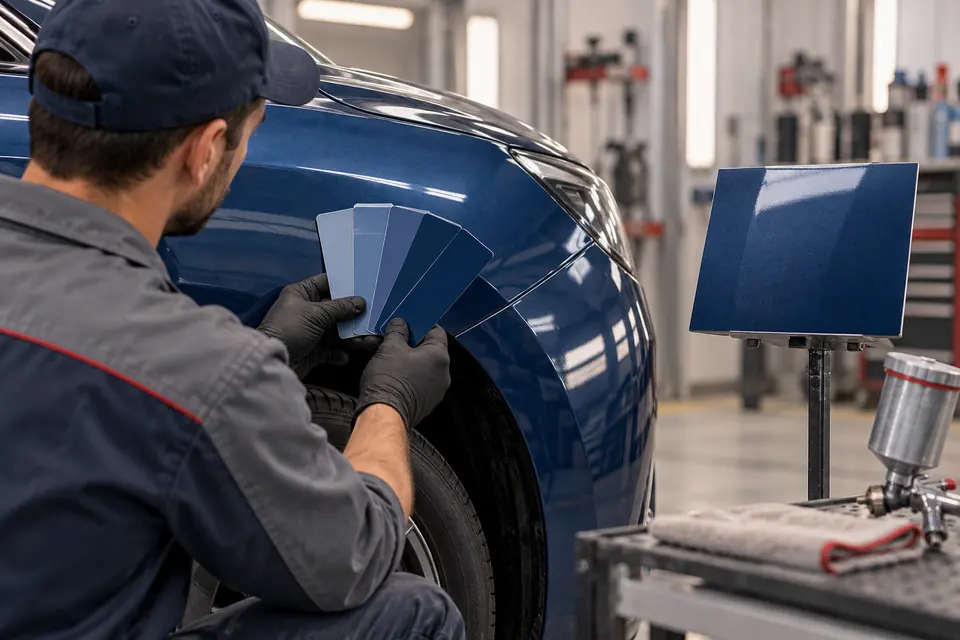
Generated educational illustration: paint match vehicle comparison. Not an actual customer repair, diagnostic result, staff member or Boudreaux’s facility.
Is the paint code enough to match my car?
A paint code identifies a color family, but matching the vehicle’s existing finish can also require evaluating variants, appearance and application. Metallic and pearl colors can look different as the viewing angle changes.
A test spray-out can help compare a proposed formula with the vehicle before refinishing. Blending may create a gradual color transition where a hard edge would be visible. Ask how the existing color is evaluated rather than treating the paint code as a guarantee of an exact visual match.
How This Fits Into the Repair Plan
Connect the proposed color comparison with the actual surfaces and finish history. Ask how the color choice relates to preparation, any adjoining work and the final panel scope.
Related Repair Guidance
Match the discussion to the actual vehicle finish
Paint matching needs the identified vehicle and the finish that is actually present. A color name or photograph alone does not establish every relevant formula, variant or surface condition. Ask what information and comparison support the proposed refinish work.
Share the paint-code information where known and mention earlier repairs or coating changes. Distinguish facts from uncertainty about the history. A code can be useful identification without documenting the current appearance or condition of every adjoining panel.
Describe the panels being compared and the conditions where a difference is visible. Light, viewing position and reflections can affect the observation. An overall view and closer photograph can help the conversation without becoming a complete diagnosis of the actual finish.
Do not polish, coat or otherwise alter an unfamiliar surface to choose a color remedy. The actual condition and applicable product information should guide the supported operation. Clear observations are more useful than an improvised correction selected from another repair image.
Related reading: Automotive Color Variants: Why One Paint Code Can Have Options and Why the Paint Code Is a Starting Point.
Understand how color questions connect to scope
Ask how the relevant color or variant is assessed for the actual vehicle and what comparison supports the choice. The owner does not need to select a formula or spraying technique to request an understandable explanation of the finish plan.
If adjoining work or blending is proposed, ask which surfaces and layers are involved and why. Color matching, preparation and clearcoat application are different parts of the scope. A broad paint label can leave the actual operations unclear.
A repaired existing panel and a replacement panel can start with different surface conditions. Ask what supported preparation applies to each. A supplied coating does not independently establish that a replacement is already the completed refinish or that every related operation is identical.
If assessment changes the proposal, request the dated revision and reason. Ask whether it changes the surface condition, preparation, color operation, adjoining work or verification. Keep the explanation with the estimate rather than relying only on a new total.
Review appearance and follow-up in useful conditions
At pickup, discuss visible finish with the shop on the actual vehicle and identify the panels and viewing conditions. Ask what work was completed and which care instructions apply. A phone image and a real surface can appear different, so the observation should remain grounded in the vehicle.
If a concern develops later, record the location, timing, light and circumstances and contact the repairing team before altering the finish. Applying a new product can complicate assessment of the original observation. A visible difference does not identify every layer or cause by itself.
Ask for applicable follow-up terms for the actual repair where needed. A paint-maker example or another supplier’s promise does not establish a universal agreement for every finish. Keep the final scope and relevant instructions together.
Boudreaux’s can discuss the actual vehicle and supported finish plan. A general guide should not be read as a promise of identical appearance on every screen or under every light. The useful result is an explained assessment and operation for the actual surfaces.
If two estimates describe paint work differently, ask whether they include the same panels, preparation and layers. A similar color label does not establish equivalent installed scope. Clear operation descriptions make the comparison more useful than treating the material charge or visible damaged spot as the entire refinish decision.
Questions About Automotive Paint Matching After Collision Repair
Technical Reference
PPG: identifying a refinish color formula. Manufacturer requirements for the exact vehicle control the repair method. A reference link does not imply Boudreaux’s certification or affiliation.