
Illustration: What Collision Damage Photos Cannot Show
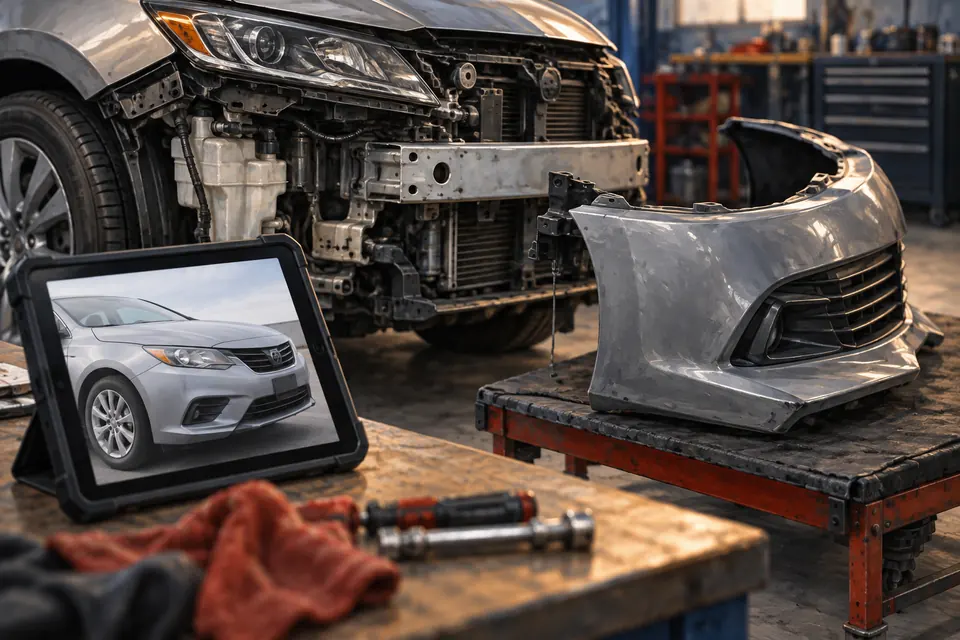
Generated educational illustration. Not an actual customer repair, transport handoff or Boudreaux’s facility.
Why can a photo estimate differ from an inspection?
Photos show visible surfaces and can help start an estimate. They cannot reliably establish the condition of concealed reinforcements, internal components, reference dimensions or every electronic system.
An in-person assessment may still need access, measurement or diagnosis. A clear photograph of a bumper cover is not a view of the parts behind it. Ask which conditions remain unconfirmed and what further inspection is needed before treating the photo estimate as the complete scope.
Turn an unseen area into a specific inspection question
Instead of asking whether the pictures show everything, identify what remains concealed. A bumper-cover image leaves a question about the assemblies behind it; a closed door hides parts of its attachments. Ask which area needs physical access before its condition can be described.
Keep the answer in three parts: what is visible now, what remains unevaluated and what assessment would answer the remaining question. An uninspected area should not be recorded as either damaged or unaffected merely because an exterior image looks reassuring.
Related Repair Guidance
Know which question the photograph can answer
An exterior picture records the view presented to the camera. It can identify a visible damage area and give the shop context for the first discussion. It does not show every component behind installed covers, trim or panels, and it does not establish every condition of the vehicle.
A close view and a wide view answer different visual questions. The close view can show a detail while the wide view identifies its position. Neither automatically supplies the information that would come from physical access, measurement or diagnosis when those are relevant.
For a hypothetical bumper-area request, a clear cover picture can show visible damage while an attachment behind it remains unevaluated. The useful next question is what access or inspection would address that attachment. The picture should not be treated as proof that the concealed component is damaged or unaffected.
Explain any missing view or uncertain history in ordinary language. Accuracy is more useful than a confident guess. The shop can then distinguish the visible record from a specific question that remains open.
Match the concern to the kind of evidence it needs
A photograph can document a visible crack, gap or message. A physical inspection addresses access and component condition. Reference measurements address dimensional questions. Diagnostic assessment investigates electronic concerns. Ask which question each proposed operation is intended to answer.
For example, a dashboard photo preserves the wording of a warning, but it does not identify its cause. A picture of a wheel shows its appearance, but it does not supply an alignment report. Share observations without converting them into an unverified diagnosis.
Finish concerns also need context: lighting, reflections and image processing affect what a screen displays. Use an image to locate the concern, then discuss direct comparison when needed. None of these limitations means a photo is useless; each defines the question it can support.
Compare the initial view with the later finding
Keep the first picture set with its date and the estimate version based on it. If later access reveals another condition, ask the shop to identify the newly accessible area and the corresponding change in scope. That makes a revision understandable without assuming the first photographs were wrong.
Clarify any authorization needed for further access before disassembly. Do not remove a cover, crawl beneath the vehicle or move damaged parts to make a photo request more complete. Explain the missing view and let the shop coordinate assessment.
For Boudreaux’s, contact the New Orleans or Luling location handling the request. Ask what information is still needed and whether a visit or transport arrangement is appropriate. A larger collection of exterior pictures cannot settle every concealed condition.