
Illustration: Parking Sensors After a Collision
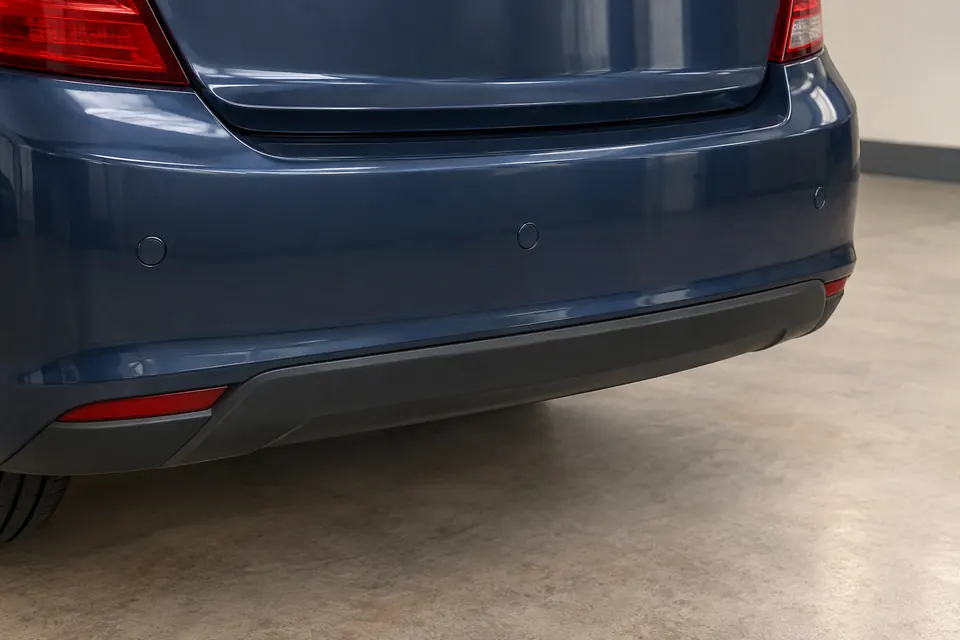
Generated educational illustration: parking sensor bumper detail. Not an actual customer repair, diagnostic result, staff member or Boudreaux’s facility.
Are parking sensors the same as ADAS radar?
Parking assistance can rely on sensors held in specific positions in a bumper or body panel. Damage to the sensor or mounting can affect operation even if the outer panel is repaired.
Parking sensors are not necessarily the same system as radar-based driver assistance. Repairs should identify the actual equipment and follow its requirements. Ask whether mounts, wiring and any required setup were checked rather than assuming a visual inspection of the sensor face is enough.
How This Fits Into the Repair Plan
Identify the actual parking-assistance arrangement, then clarify sensor, holder and wiring findings. Ask which checks follow the completed operation without assuming every system uses radar or identical setup.
Related Repair Guidance
Name the fitted component and the observed behavior
A parking-assistance concern may involve a sensor, attachment, related component or displayed information. Ask which fitted arrangement applies to the vehicle. The everyday phrase parking sensor does not establish one universal configuration or repair requirement.
Describe the location and behavior: a warning, unexpected indication, unavailable feature or visible displacement gives different starting information. Mention earlier concerns or accessories near the area. The observations guide assessment without diagnosing the part from the display alone.
Ask what can be seen with the adjoining cover or trim installed and whether further authorized access is needed. A small exterior mark does not show every attachment. Keep the concealed question explicit if the initial estimate cannot settle it.
Do not drive close to an obstacle or deliberately approach a person to test the system. A parking-assistance response is not a substitute for a supported diagnostic procedure. Share observations from normal use and discuss the appropriate assessment.
Related reading: Bumper Collision Repair and Plastic Bumper Repair and Replacement.
Separate sensor condition, panel work and applicable setup
The proposed repair should identify the actual affected component and method. Ask what supports repair or replacement and how the relevant attachments are addressed. A general bumper operation should not be assumed to explain every parking-assistance concern.
If panel repair or refinishing is proposed near the sensor area, ask which applicable requirements govern it. The actual vehicle and product or repair information should determine the scope. Avoid assuming universal paint-thickness or repair-distance limits.
Some fitted systems can have specific checks or setup requirements after particular operations. Ask what applies to your vehicle rather than assuming every parking sensor needs the same calibration or that none ever require related work.
Scanning, physical inspection and required setup are different tasks. A clear electronic summary does not independently document every attachment or applicable operation. Ask which relevant result supports each part of the completed scope.
Follow the parking-assistance question through completion
When access changes the plan, request the dated revision and the finding behind it. Ask whether it concerns the sensor, attachment, adjoining work or relevant setup. Keep those descriptions clear so a new total can be connected to the actual operation.
If a replacement source changes, clarify part identity, compatibility and any related requirements. A similar exterior appearance is not the complete suitability explanation. Keep the approved description with the current estimate.
At pickup, discuss any remaining unexpected warning or unavailable function with the shop. Ask which relevant physical and assistance operations were completed and what record or explanation is available. One successful displayed response should not be treated as universal proof of all requirements.
If a concern appears later, record the location, timing and circumstances and contact Boudreaux’s before resets or sensor changes. Do not approach obstacles deliberately to collect more symptoms. The actual vehicle and repair record can guide a useful next assessment.
Questions About Parking Sensors After a Collision
Technical Reference
I-CAR: bumper-cover repair with ADAS. Manufacturer requirements for the exact vehicle control the repair method. A reference link does not imply Boudreaux’s certification or affiliation.