
Illustration: Why ADAS Calibration May Be Needed After a Collision
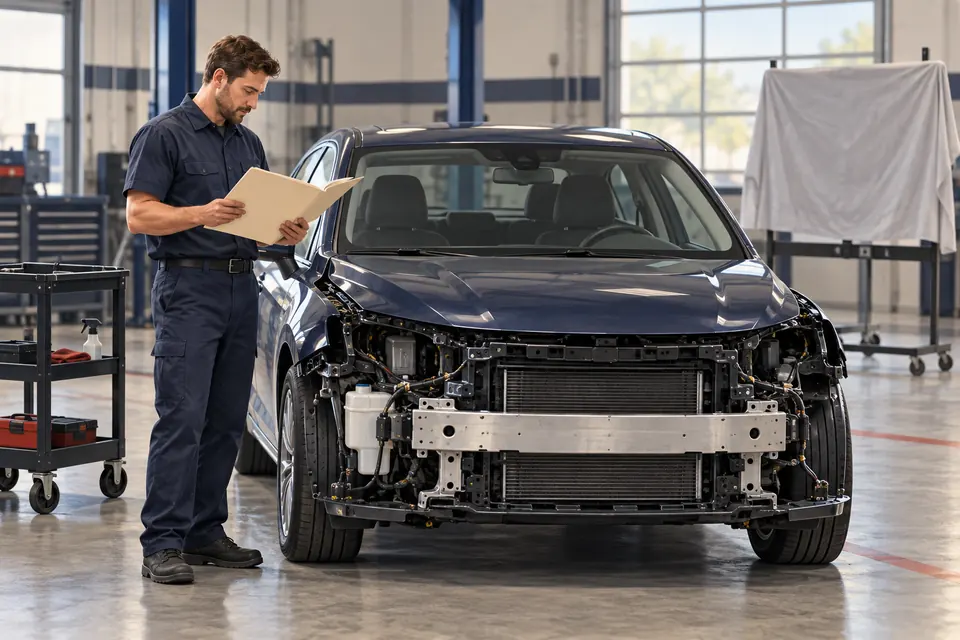
Generated educational illustration: calibration prerequisite repair sequence. Not an actual customer repair, diagnostic result, staff member or Boudreaux’s facility.
Can an intact sensor still need calibration?
Calibration may be required when an affected sensor, mounting area or vehicle reference condition is changed by damage or repair. Requirements are vehicle- and operation-specific.
A camera or radar can be intact and still have a procedural setup requirement. A clear dashboard or scan does not override that requirement. Ask which repair triggered the procedure and which prerequisites apply; do not assume every calibration method is performed in-house at either Boudreaux’s location.
How This Fits Into the Repair Plan
Ask the estimator to identify the affected system, the operation that triggers the requirement and the prerequisite that controls its place in the sequence. That connects a calibration line to the actual repair rather than to a general statement about modern vehicles.
Related Repair Guidance
Identify the reason for calibration in this repair
Ask which installed system is involved and which damage or repair operation makes calibration relevant. The answer should connect the requirement to your vehicle and the work being proposed. A statement that modern cars have sensors is useful background, but it does not explain a specific estimate line.
An inspection may need to consider the sensor, its housing, its mounting area and adjoining work. A sensor can remain physically intact while the applicable procedure still requires a setup operation after certain work. The condition of the component and the procedural requirement are different questions.
Give the shop the year, model, VIN and known equipment changes. Share the warning history, including messages present before the collision. These details support identification and diagnosis; they do not allow an owner to determine a calibration requirement from a dashboard message alone.
If the requirement is still being researched, ask what decision is pending. It is better to identify that open question clearly than to interpret a provisional estimate as proof that the entire electronic scope has been settled. Request an update point and keep the answer with the current repair-plan version.
Prerequisites help explain the order of work
A required calibration has to be considered within the repair sequence. Ask which relevant work or checks must be completed first under the applicable procedure. The point is to understand the dependency, not to obtain a generic set of setup instructions that may be wrong for your vehicle.
For a hypothetical repair near a sensor mounting area, the shop may first need to resolve the physical condition and the permitted repair before completing the later setup and verification. Reversing that explanation can leave an owner thinking the setup settles the earlier physical question. The example illustrates sequencing and does not describe a particular customer’s vehicle.
Static and dynamic are terms you may see in calibration discussions, but a vehicle’s procedure determines the appropriate method and conditions. Do not assume that driving the vehicle normally performs every required calibration, or that a target-based setup is the method for every system. Ask what method applies and what completion information will be provided.
If another provider is involved, clarify who arranges the operation, how the vehicle moves between stages and how the result becomes part of the repair record. This is a practical scheduling question. It should be answered for your job rather than inferred from the name of the equipment or the location nearest your home.
Know what the completion record does and does not establish
Ask for an explanation of the calibration status and any record supplied with the repair. Identify the vehicle, affected system, operation and date. A scan report and a calibration record can be different documents because they describe different work; keep each with the corresponding explanation.
An attempted operation is not necessarily a completed one. If the task could not be completed, ask what prevented completion and what remains to be resolved. Discuss vehicle status and handling with the shop before assuming it is ready for normal use. Do not treat an unexplained status line as an all-clear.
At pickup, refer back to any electronic concern you described at intake. Ask how it was investigated and what follow-up applies if a warning returns. After pickup, record new observations and contact the repairing location. Avoid deliberately challenging a driver-assistance system in traffic to create a demonstration.
Confirm calibration arrangements with your selected Boudreaux’s shop. This page explains owner questions and the distinction between findings, requirements and completion. It does not claim coverage for every brand or that identical calibration services are performed in-house at both New Orleans and Luling.
Questions About Why ADAS Calibration May Be Needed After a Collision
Technical Reference
I-CAR: calibration terminology and methods. Manufacturer requirements for the exact vehicle control the repair method. A reference link does not imply Boudreaux’s certification or affiliation.