
Illustration: OEM Position Statements vs Repair Procedures
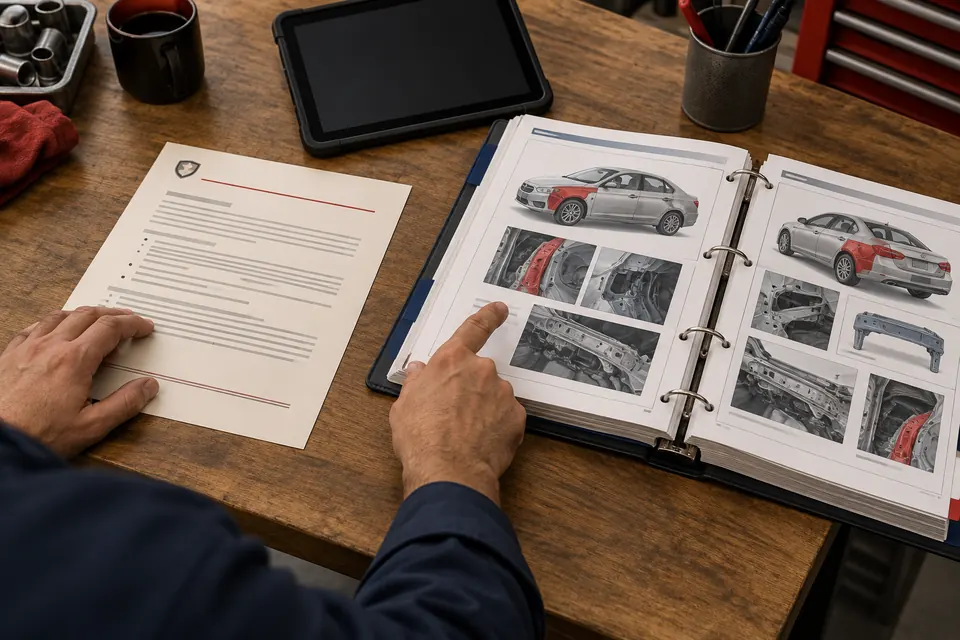
Generated educational illustration: manufacturer statement detailed information. Not an actual customer repair, diagnostic result, staff member or Boudreaux’s facility.
Is a position statement the same as a repair manual?
An OEM position statement communicates a manufacturer’s guidance on a topic such as scanning or parts. The detailed repair manual supplies vehicle-specific instructions and conditions.
A broad statement can help identify a requirement, but it may not contain the steps, dimensions or joining method for a particular repair. Both should be considered in context. Ask which current information supports the operation on your model and what details come from the repair procedure.
How This Fits Into the Repair Plan
Identify the document’s purpose, vehicle applicability and the operation it supports. A broad requirement can explain why work is needed while the detailed instruction governs how that component is handled.
Related Repair Guidance
Understand what each information type is for
A manufacturer position statement can explain an official requirement or policy about a category of work. A vehicle-specific repair procedure provides the relevant operation information for an identified vehicle and component. The documents can support related decisions without being interchangeable.
Ask which statement or instruction applies to the proposal and how it connects to the actual vehicle. A broad statement about a subject should not be treated as the complete step-by-step procedure for every model or component.
Vehicle identity, construction and fitted equipment matter to selecting the applicable information. A similar-looking component or shared model-family name does not independently establish that another procedure applies. Ask which actual identification supports the scope.
Using manufacturer information is also different from manufacturer certification. This page does not establish participation in an unverified certification program. Ask about any specific current credential separately if it matters to your repair decision.
Related reading: OEM Procedures vs Certification and OEM Collision Parts: What the Term Means.
Connect the requirement to the proposed operation
Ask which part of the information supports the component, method, related operations or verification in the estimate. A useful explanation connects the requirement to the scope rather than citing a manufacturer name as universal proof.
If a search tool or summary helps identify where information exists, distinguish that reference from the complete applicable instruction. A summary can be useful background without containing every requirement needed to perform the operation.
If the information does not settle a question, ask what research or clarification is needed and when an update is expected. Do not select an improvised method solely because a general document lacks a visible answer. Keep the technical decision provisional until the relevant information is established.
If research changes the proposed operation, request the dated revision and the applicable reason. Ask whether it changes the component, replacement method, related work or verification. The new total should be accompanied by a reviewable scope explanation.
Keep claim review and completion distinct
Where insurance is involved, the manufacturer requirement and the claim decision are different subjects. Ask the shop about the supported technical work and the insurer about its actual review. Approval or payment does not turn a broad statement into the detailed procedure or replace the applicable requirements.
At pickup, ask how the final component descriptions and completed operations relate to the supported plan and which relevant records are available. An exterior image can show appearance without explaining every joining, protection or verification requirement.
Ask for a clear operation-level explanation; an owner need not obtain an entire proprietary manual to understand the proposed scope. For later questions, keep the final estimate and relevant explanation together. Use the component and operation names when contacting Boudreaux’s. A generic phrase such as OEM compliant may need clarification if you cannot tell which requirement it describes.
Questions About OEM Position Statements vs Repair Procedures
Technical Reference
I-CAR Repairability Technical Support. Manufacturer requirements for the exact vehicle control the repair method. A reference link does not imply Boudreaux’s certification or affiliation.