
Illustration: OEM Collision Parts: What the Term Means
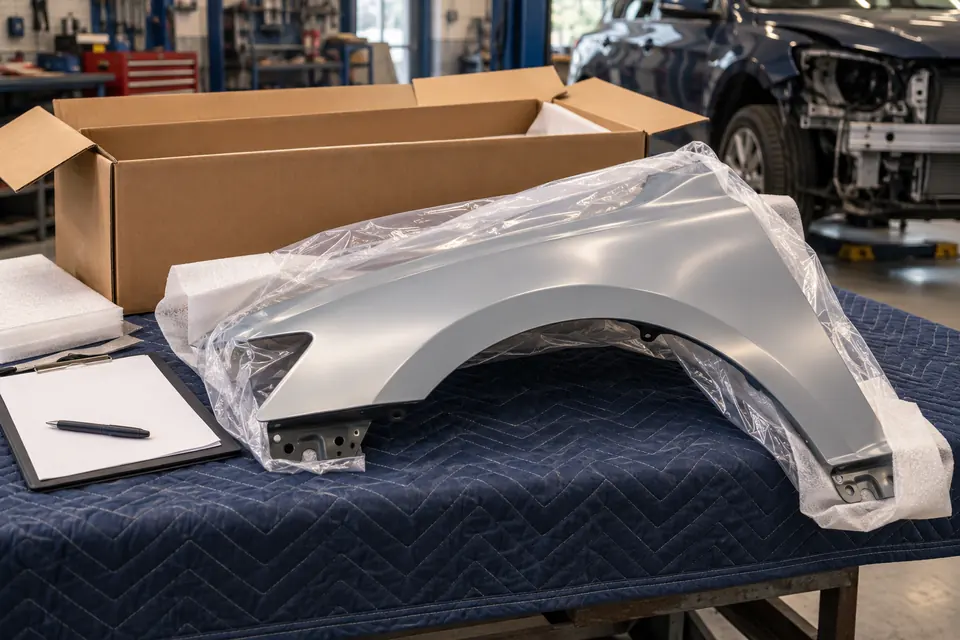
Generated educational illustration: parts identification sealed delivery. Not an actual customer repair, diagnostic result, staff member or Boudreaux’s facility.
Does an OEM part eliminate every other repair consideration?
OEM parts are supplied by or for the vehicle manufacturer. The label describes their source; the repair plan still needs the correct part for the vehicle and the required installation operations.
Parts choice may be affected by availability, policy terms, fit and manufacturer requirements. Ask about the source and part identification in the estimate. An OEM panel alone does not prove that all joining, refinishing or calibration requirements have been completed.
How This Fits Into the Repair Plan
Ask which actual component and supplied configuration are proposed under the source label. Keep compatibility, receiving condition and the complete installed operation visible in the same estimate discussion.
Related Repair Guidance
Identify the source and the supplied component
OEM means original equipment manufacturer. In a collision-parts estimate, the source label still needs a clear component description. Ask which exact component, supplied configuration and source are proposed for the actual vehicle.
Source category and condition are different questions. If a description is unclear about whether a part is new or used, ask for clarification. A manufacturer-related label alone should not be treated as the complete account of condition, history and installed scope.
Compatibility needs actual identification. A similar shape or vehicle-family name does not independently establish that a supplied component fits the relevant configuration and requirements. Ask what information supports the proposed part.
The part price is also different from the completed installed repair. Ask which access, attachments, protection, refinishing and relevant checks belong in the scope. A main component line may not describe every supported related operation.
Related reading: OEM and Aftermarket Parts in Insurance Repairs and Aftermarket Crash Parts: Questions for Vehicle Owners.
Connect the part to the repair requirements
Boudreaux’s uses OEM parts for structural and suspension components. Ask how that policy maps to the identified estimate lines and discuss any unresolved claim or payment responsibility separately.
The applicable vehicle information should govern the operation using the identified part. Ask which method and related requirements apply. A source label does not, by itself, establish every joining, setup or inspection instruction.
If a component has fitted equipment or a relevant mounting role, ask which compatibility and setup questions follow from the actual work. The scope should identify the relevant operation instead of assuming that a familiar part name settles every system requirement.
If availability changes the proposal, request the revised description and explanation. Ask whether the source, condition, supplied configuration or related operations changed. Keep the approved part identity with the current estimate rather than relying on the earlier label.
Where insurance is involved, distinguish the supported technical proposal from coverage and payment review. Ask the shop about the operation and the insurer about its actual decision. This page does not promise that every OEM part is covered under every policy or claim.
Review the final source and installed scope
At pickup, ask how the final parts description matches the completed work and which relevant records are available. The exterior appearance alone cannot explain the source, condition or every concealed attachment of an installed component.
Ask about applicable part and repair terms if warranty or follow-up is a concern. A general OEM label does not establish a universal guarantee or the terms for every supplier and operation. Keep the actual explanation with the repair record.
For a later concern, identify the component and circumstances and contact Boudreaux’s before altering the area. A symptom does not establish that the part source caused it, and an education page cannot diagnose the actual component from an image.
Questions About OEM Collision Parts: What the Term Means
Technical Reference
I-CAR Repairability Technical Support. Manufacturer requirements for the exact vehicle control the repair method. A reference link does not imply Boudreaux’s certification or affiliation.