
Illustration: OEM vs Aftermarket vs Recycled Collision Parts
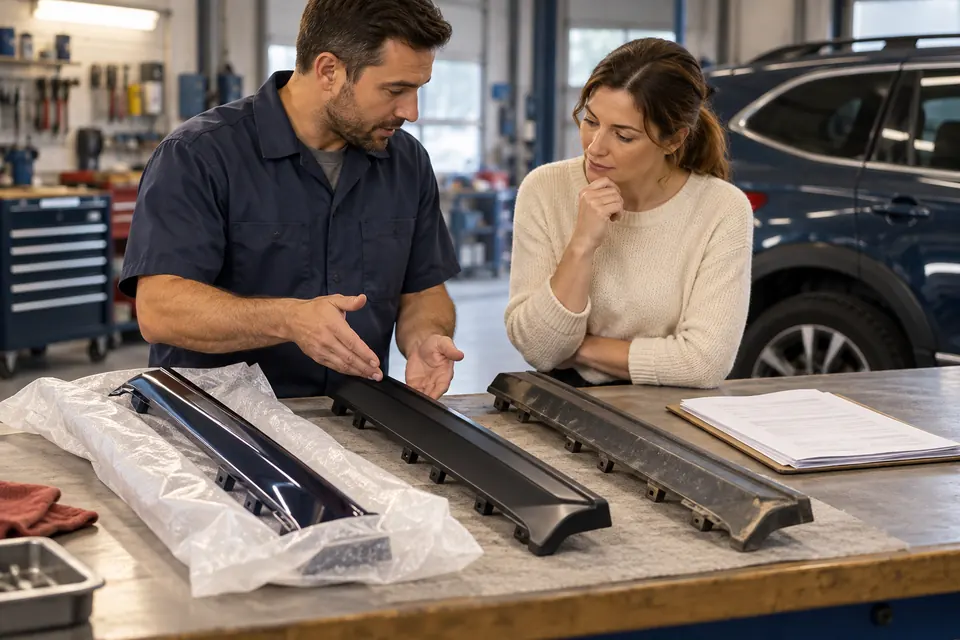
Generated educational illustration: replacement parts source condition review. Not an actual customer repair, diagnostic result, staff member or Boudreaux’s facility.
How are OEM, aftermarket and recycled parts different?
OEM, aftermarket and recycled describe different parts sources. The repair discussion should identify the source, condition and compatibility alongside the installation requirements.
No source label eliminates the need to follow the proper repair method. Availability, policy-related decisions and required written disclosures can also matter. Ask how parts are identified in the estimate and which requirements apply to your vehicle instead of treating all replacement parts as interchangeable.
How This Fits Into the Repair Plan
Compare the identified part, source, supplied condition and associated installation work. An availability update can change a proposed item; ask how the revised item affects the supported scope before authorizing it.
Related Repair Guidance
Read source, condition and fit as three questions
Start with the replacement part named in the estimate. Ask where it comes from, whether it is new or used, and how compatibility with your vehicle is established. Those questions provide more information than treating one source label as a complete description of the proposed repair.
OEM identifies a manufacturer source. Non-OEM aftermarket identifies a source outside the vehicle manufacturer. Recycled or salvage identifies a used part taken from another vehicle. Ask the estimator to explain any other abbreviation in the estimate rather than guessing from a price or a short code.
Compatibility involves the actual vehicle and component. Similar-looking parts can differ by configuration, equipment or revision. Provide the VIN and disclose known changes so the parts discussion is tied to the vehicle being repaired. If a part is still being identified, ask which detail needs confirmation before ordering.
Condition matters separately from identification. A source description does not tell you whether an arriving item has been inspected or whether an assembly includes everything needed for the job. Ask what has been confirmed and what will be checked when the item arrives. This gives a clearer picture of the decision than comparing source names alone.
Keep Louisiana disclosure and payment questions clear
Louisiana law requires written advice when non-OEM aftermarket crash parts are specified or used in the circumstances covered by R.S. 51:2424. Where an insurer intends such parts, the estimate must identify them and include the required disclosure. You can read the statutory disclosure provision and ask which estimate lines it concerns.
The disclosure question and the payment question are distinct. Request a clear explanation of the parts listed, then ask the insurer about coverage and any disputed price difference under your claim. Do not assume that asking for a different source automatically changes what an insurer has agreed to pay.
Before approving a change, ask for the revised estimate and an explanation of any amount you may be responsible for. Keep the dated version and your questions together. If the insurer’s answer is unclear, ask for its reasoning in writing and use the Louisiana Department of Insurance’s consumer resources for policy or claim questions.
This information helps you locate the relevant disclosure and ask informed questions. It does not determine coverage or resolve a disagreement for your particular claim. Avoid relying on a broad online statement that all source changes are always paid or always denied.
The replacement part is only one part of the repair scope
Ask what installation work goes with the selected component. Attachments, adjoining operations, refinishing and required checks can be relevant even when the main replacement part has been identified. The estimate should make the proposed scope understandable rather than leaving you to infer the entire job from a part description.
For a hypothetical example, two quotes might list a replacement assembly while differing in what is included with it and what work is proposed around it. Comparing the main part price alone would miss those differences. Ask the estimator to explain the source, supplied condition and associated operations before treating the quotes as identical.
If the ordered part changes, ask why and whether that affects the installation plan, cost or schedule. An availability problem may lead to a proposed alternative, but an alternative still needs to be evaluated for the vehicle and work. Request the revised description before approving the decision.
Boudreaux’s uses OEM parts for structural and suspension components. Ask how that policy applies to the identified estimate lines; discuss coverage and any disputed price difference separately with the insurer. Bring these questions to the Boudreaux’s location handling the repair. New Orleans or Luling can discuss the actual estimate, the current parts status and the next decision. This page does not promise a particular source for every repair, an unconfirmed parts warranty or identical availability for all vehicles.
Questions About OEM vs Aftermarket vs Recycled Collision Parts
Technical Reference
I-CAR Repairability Technical Support. Manufacturer requirements for the exact vehicle control the repair method. A reference link does not imply Boudreaux’s certification or affiliation.