
Illustration: One-Time-Use Parts in Collision Repair
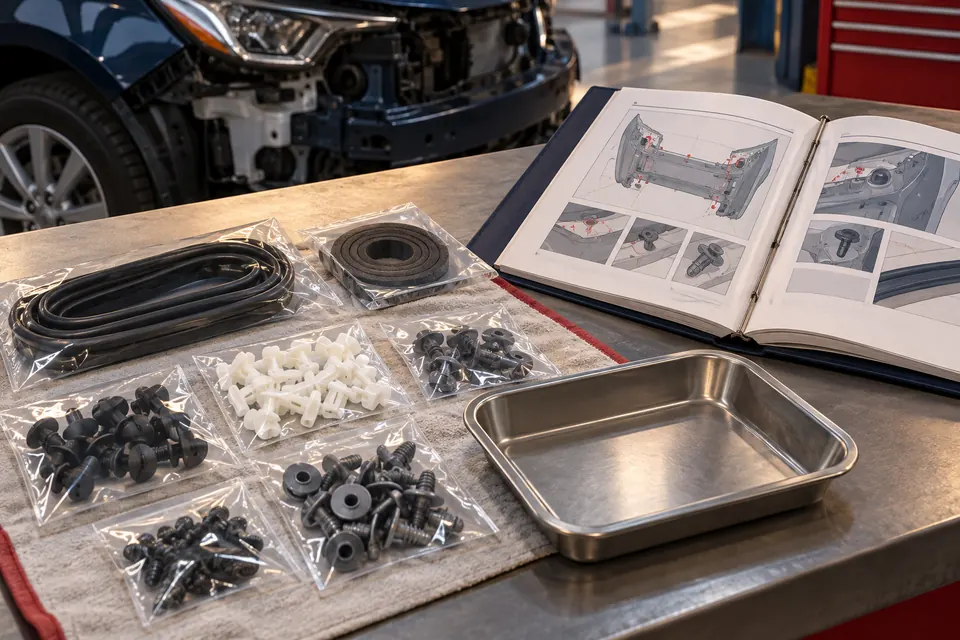
Generated educational illustration: replacement hardware requirement review. Not an actual customer repair, diagnostic result, staff member or Boudreaux’s facility.
Why replace a fastener that looks undamaged?
Some fasteners, clips, seals or other components must be replaced after removal under the vehicle maker’s instructions. Looking undamaged is not proof that a one-time-use part may be reused.
Such parts can appear during teardown or while accessing another repair area. The plan should account for them even if they were not the main impact component. Ask which parts are designated for replacement and how those requirements are documented.
How This Fits Into the Repair Plan
Identify which removal or operation creates the replacement requirement, which related items come with the supplied assembly and what remains separate. Keep that explanation with the current parts plan.
Related Repair Guidance
Appearance does not establish permission to reuse
A one-time-use requirement comes from the applicable information for the identified part and operation. I-CAR’s one-time-use parts and fasteners overview explains this information question; the actual vehicle requirements still control the operation. A clip, fastener or another component can look intact while still having a replacement requirement after the specified event. Ask which instruction applies rather than judging reuse solely by appearance.
The vehicle and exact part matter. Advice for a similar fastener on another model should not be transferred automatically. Ask the estimator to identify the relevant component, operation and replacement requirement for the actual vehicle.
A small item can be part of a larger supported repair scope. The fact that it costs less or is less visible than the main panel does not make its applicable requirement optional. Ask how the relevant hardware or related part is represented in the plan.
Do not remove and reinstall unfamiliar components to test whether they remain reusable. The supported procedure should guide access and installation. An owner’s useful question is which requirement and part identity support the proposed replacement.
Related reading: Parts Authorization and Insurance Repair Planning and Required Inspections After a Collision.
Read the supporting parts scope
A main replacement assembly may not include every required attachment or related component. Ask what is supplied and which items remain separate. A broad parts line should be clarified where you cannot tell whether the relevant hardware is included.
If disassembly identifies another required part, ask whether the addition follows newly established damage, the actual removal operation or a specific replacement instruction. These are different explanations. Keep the reason with the dated estimate rather than describing every added item as hidden damage.
Part identification and availability also matter. If an alternative is proposed, ask how compatibility and the applicable requirements are addressed. A similar size or an available generic item does not independently establish that the supported scope is unchanged.
Where insurance is involved, separate the technical requirement from claim review. Ask the shop about the supported operation and the insurer about its actual decision. Clarify unresolved approval or payment responsibility before proceeding with a changed scope.
Keep the requirement connected to completion
At pickup, ask how the final parts description relates to the completed operation and which relevant records are available. A smooth exterior cannot show every concealed attachment. The useful explanation connects the identified part and requirement to the actual scope.
If a new noise, fit or operation concern appears later, record the location and conditions and contact the repairing shop before changing hardware. An education page cannot diagnose the cause from the symptom, and an improvised replacement can obscure the original finding.
Boudreaux’s can discuss the actual vehicle and supported parts plan. Use the component name and estimate date when asking for clarification. A generic list from another repair is not the definitive one-time-use inventory for yours.
Questions About One-Time-Use Parts in Collision Repair
Technical Reference
I-CAR Repairability Technical Support. Manufacturer requirements for the exact vehicle control the repair method. A reference link does not imply Boudreaux’s certification or affiliation.