
BOUDREAUX’S COLLISION · REPAIR EDUCATION
Aftermarket Crash Parts: Questions for Vehicle Owners
Aftermarket crash parts are sourced outside the vehicle manufacturer’s original parts channel. Owners should understand which estimate items use them and what fit, compatibility or procedure concerns may apply.
Illustration: Aftermarket Crash Parts: Questions for Vehicle Owners
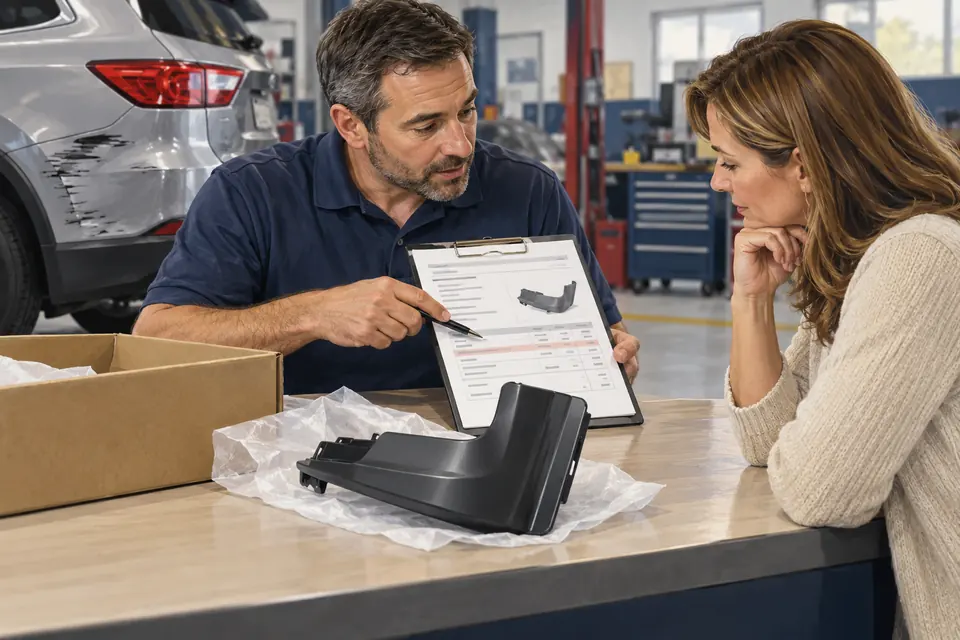
Generated educational illustration: aftermarket estimate line review. Not an actual customer repair, diagnostic result, staff member or Boudreaux’s facility.
How can I identify aftermarket parts in an estimate?
Aftermarket crash parts are sourced outside the vehicle manufacturer’s original parts channel. Owners should understand which estimate items use them and what fit, compatibility or procedure concerns may apply.
A parts-source discussion is separate from the labor required to install and refinish the part. In Louisiana, non-OEM crash-part disclosure requirements are addressed in state law. Ask for the estimate’s parts identification and written disclosure rather than assuming all replacements come from the same source.
How This Fits Into the Repair Plan
Identify the proposed non-OEM part and applicable written disclosure, then discuss compatibility, supported installation and payment as separate questions. A short source abbreviation is not the whole proposal.
Related Repair Guidance
Ask for the actual part proposal rather than a blanket label
An aftermarket part discussion concerns a source category, but the actual component and supplied configuration still need identification. Ask what part is proposed for the vehicle and what information supports its suitability in the repair plan.
Avoid treating every aftermarket component as identical, whether favorable or unfavorable. The relevant vehicle, part, findings and applicable requirements need consideration. A broad source label alone is not a complete technical assessment.
Condition, compatibility and installed scope are separate questions. Ask what is supplied, which pieces or attachments remain separate and how the configuration fits the actual vehicle. Similar exterior shape does not independently establish every relevant requirement.
A part price is not the complete installed repair. Ask about access, fitting, protection, refinishing and relevant checks associated with the proposed operation. Compare detailed scopes rather than treating the main component price as the entire decision.
Related reading: OEM and Aftermarket Parts in Insurance Repairs and Louisiana Non-OEM Crash-Part Disclosure.
Keep technical requirements and claim decisions distinct
Louisiana R.S. 51:2424 addresses written advice about the non-OEM aftermarket parts use it covers. When an insurer intends such crash parts, it also addresses identifying each part and supplying the prescribed estimate disclosure. Ask which lines and notice apply to your estimate.
Boudreaux’s uses OEM parts for structural and suspension components. Ask how that policy maps to the identified estimate lines and discuss any unresolved claim or payment responsibility separately.
The applicable repair information should guide the operation. Ask which requirements govern the identified part and work, including any relevant system or mounting role. A source category does not replace the detailed instruction for the vehicle.
If fitted equipment or a relevant mounting area is associated with the component, ask which vehicle-specific compatibility and related-operation requirements apply to the complete installed scope.
Where insurance is involved, ask the insurer about the actual claim decision and the shop about the supported technical scope. Coverage, owner preference and applicable requirements are different subjects that need a clear conversation. Do not assume a claim line settles every suitability question.
If the proposal changes, request the dated revision and the reason. Ask whether it changes source, configuration, related operations, verification or responsibility. Clarify unresolved approval before work proceeds rather than relying on an earlier broad description.
Review the approved component and completed work
At pickup, ask how the final part description corresponds to the approved scope and which relevant records are available. Visible appearance alone cannot establish the source or every attachment and technical operation associated with the component.
Ask for applicable part and repair terms if warranty or follow-up is a concern. A general source category does not establish a universal guarantee, and another supplier’s promise is not automatically the agreement for your repair.
If a later concern appears, record the location and circumstances and contact Boudreaux’s before altering the component. The observation needs assessment; it should not automatically be attributed to the source label without supporting findings.
Questions About Aftermarket Crash Parts: Questions for Vehicle Owners
Technical Reference
Louisiana R.S. 51:2424 — non-OEM crash-part disclosure. Manufacturer requirements for the exact vehicle control the repair method. A reference link does not imply Boudreaux’s certification or affiliation.