
Illustration: Louisiana Non-OEM Crash-Part Disclosure
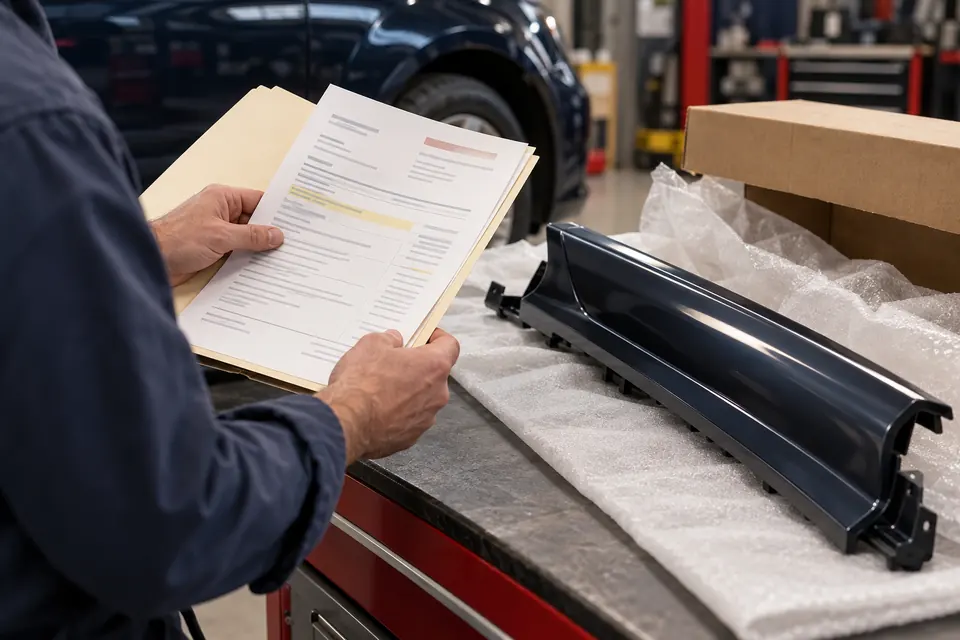
Generated educational illustration: written parts disclosure review. Not an actual customer repair, diagnostic result, staff member or Boudreaux’s facility.
What should an estimate disclose about non-OEM crash parts?
Louisiana R.S. 51:2424 addresses written notice when non-OEM aftermarket crash parts are specified or used. It also describes disclosure language on or attached to the insured’s estimate.
Review the estimate for the identified parts source and ask for the applicable disclosure. The law’s disclosure requirement should not be confused with a blanket promise that all parts will be OEM or that every disputed item must be paid. For a particular dispute, consult the official statute and qualified advice.
How This Fits Into the Repair Plan
Connect the written identification and disclosure to the actual part in the current estimate. Review suitability, applicable terms, authorization and insurer payment as their own questions.
Related Repair Guidance
Understand the written-disclosure question
Louisiana Revised Statute 51:2424 addresses written notice for non-OEM aftermarket crash parts in the circumstances it covers. It also addresses clear identification of each such part in an insurer’s written estimate and the specified disclosure accompanying the insured’s copy. Use the official statute for the exact requirement.
Ask which estimate lines identify the proposed parts and what their source descriptions mean. A broad unfamiliar abbreviation can leave the actual component unclear. The useful conversation identifies the part rather than assuming one overall aftermarket label explains every line.
The required disclosure discusses the source of warranties for the replacement parts. Ask for the applicable terms for the actual part and repair. A disclosure document does not establish a universal guarantee or describe every supplier and operation’s terms.
Do not expand a crash-part disclosure rule into an assumed rule for every unrelated product or claim question. Identify the actual component and arrangement and ask the responsible party which requirement applies.
Related reading: OEM and Aftermarket Parts in Insurance Repairs and Parts Authorization and Insurance Repair Planning.
Keep disclosure separate from suitability and authorization
Written source identification and technical suitability are different questions. Ask the shop what findings and applicable vehicle information support the proposed part and operation. A disclosure does not independently establish compatibility, repairability or every setup requirement.
Coverage and payment review are another separate subject. Ask the insurer about its actual claim decision and unresolved responsibility. This page does not promise that a preferred alternative will always be paid for or that disclosure settles every policy issue.
If the part or source changes, request the dated revision and current description. Ask whether configuration, condition, related operations or verification changed. Keep the relevant written information with the current estimate rather than relying on an earlier label.
If the proposal is unclear, ask what information resolves the question before treating the scope as final. A document should make the actual part choice reviewable rather than require the owner to guess at the component or source.
Use the estimate and official resources together
Keep the written estimate, relevant disclosure and applicable terms together. Identify the current version when discussing a question with the insurer or shop. A source document is more useful when it is connected to the actual component-level scope.
If a disclosure or identification question remains disputed, use current Louisiana Department of Insurance resources and the official statute. Preserve relevant communication and ask the responsible party to explain the actual decision. This page does not decide an individual dispute.
At pickup, ask how the final parts description corresponds to the agreed proposal and which relevant records are available. A finished exterior cannot independently identify every source, condition or concealed attachment associated with the repair.
For a later concern, record the component, timing and circumstances and contact Boudreaux’s before alterations. The source label or disclosure alone does not diagnose the cause of a new symptom.
Use the Louisiana Department of Insurance auto resources for current consumer information.
Read the official Louisiana Revised Statute 51:2424 disclosure provision for its exact text and scope.
Questions About Louisiana Non-OEM Crash-Part Disclosure
Technical Reference
Louisiana R.S. 51:2424 — non-OEM crash-part disclosure. Manufacturer requirements for the exact vehicle control the repair method. A reference link does not imply Boudreaux’s certification or affiliation.