
Visit Our New Orleans Shop
New Orleans, LA 70113
504-309-3092
Our New Orleans location is on Earhart Boulevard. Call the shop before arranging your visit or vehicle drop-off so you can discuss the damage, the information available and the next step.
Directions to New Orleans · New Orleans facility information · Compare both locations
Collision Repair Starts With the Vehicle
Visible dents, damaged panels and paint are only part of the collision-repair conversation. The vehicle and impact determine what needs closer inspection, which parts can be repaired and what additional operations may be required.
Both Boudreaux’s Collision shops provide collision/body repair and paint/refinishing. Tell us what happened, which areas were affected and whether you have an insurance estimate. The first conversation helps organize the next step; it does not replace an inspection.
Explore collision and auto body repair · Understand paint and refinishing
Measuring, Diagnostics and Repair Information
The New Orleans shop has structural repair equipment, Spanesi Touch 3D measuring and alignment capability.
The described collision process includes pre- and post-scan stages, parts verification and applicable manufacturer instructions. Ask the team about the exact tools and arrangements for your vehicle. These resources help build a plan around the vehicle and documented damage. They do not mean every repair needs the same operations.
Structural measurements, scanning, alignment, steering-angle resets and calibration considerations depend on the vehicle, damage and applicable repair requirements.
Spanesi structural measuring · Vehicle scanning · Wheel alignment · ADAS calibration
The New Orleans shop exterior
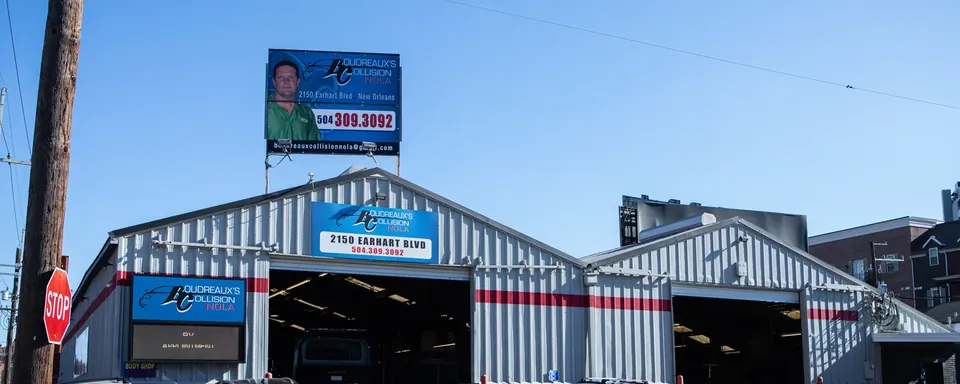
Owner-supplied archive photograph of the New Orleans shop facade and sign at 2150 Earhart Boulevard. Contact the team for current receiving arrangements.
Prepare for Your Estimate
Have your vehicle year, make, model and VIN available, along with a description of the accident and any claim information you have received. Photos of the whole vehicle and closer views of damaged areas can help begin the conversation.
Photos show visible conditions, but they cannot guarantee a final price or identify everything behind a bumper or panel. Inspection, access or teardown may uncover additional damage and repair requirements.
If you are concerned about leaking fluids, damaged wheels or tires, loose components or warning lights after a collision, discuss transport with the shop. Do not assume the vehicle is safe to drive from its appearance alone.
Request an estimate and upload damage photos · Towing and accident recovery guidance
Repair the Vehicle, Not Just the Estimate
An insurance estimate may be written before all damage is visible. Once the vehicle is inspected or damaged parts are removed, the documented repair needs can differ from the first estimate.
A supplement records additional repair items identified during that process. Keep the shop and insurer informed, save the paperwork and ask questions about any changes to the plan.
Insurance and estimate help · Repair Education · From accident to delivery
Plan your New Orleans assessment
The New Orleans shop is at 2150 Earhart Boulevard, New Orleans, LA 70113. Before arriving, call 504-309-3092 to confirm the purpose of the visit and receiving arrangement. An initial inspection, a scheduled drop-off and a tow arrival are different events; identifying which one you need helps the team prepare.
Bring the year, make and model, the current estimate if you have one and the claim reference when applicable. A short description of what changed after the collision is useful: a new warning message, an opening that will not latch or a noise that was not there before. Keep pre-existing symptoms separate.
If the vehicle cannot be driven safely, confirm the destination before arranging transport. Provide the exact Earhart Boulevard address to the tow provider and discuss loading concerns with that provider. Do not assume an unconfirmed after-hours drop-off is available.
What to ask about measuring and diagnostic resources
The confirmed New Orleans facility information includes the measuring, structural, alignment/frame and diagnostic resources described here. Equipment is a resource used to answer a repair question; the presence of equipment does not mean every vehicle needs every operation.
Ask what the proposed check will establish. Structural measurement, wheel alignment and electronic scanning produce different kinds of information. A measurement can address reference dimensions, while a scan concerns electronic system information. Ask how the result relates to the damaged area and which follow-up remains.
If a particular procedure is important to your vehicle, confirm it directly with the shop. This page does not assert every manufacturer certification, every calibration capability or a guaranteed outcome for every model. A clear vehicle-specific conversation is more useful than a broad equipment label.
Keep the repair discussion easy to follow
Ask the team to distinguish confirmed findings from items that still need access or research. If the estimate changes, request the reason for the change and the affected operation. Save the current version alongside the first estimate so a later question can be tied to the right document.
For a useful progress update, ask what stage the vehicle is in and what remains before the next stage. Parts arrival, body work, refinishing, reassembly and verification are different milestones. A change in one can affect the sequence without automatically determining a new completion date.
At handoff, review the work explained by the shop and ask what care instructions or records apply. If a concern appears afterward, report the exact observation and when it started rather than attempting to diagnose it through a website article.