
Illustration: Can Bumper Repair Affect ADAS Sensors?
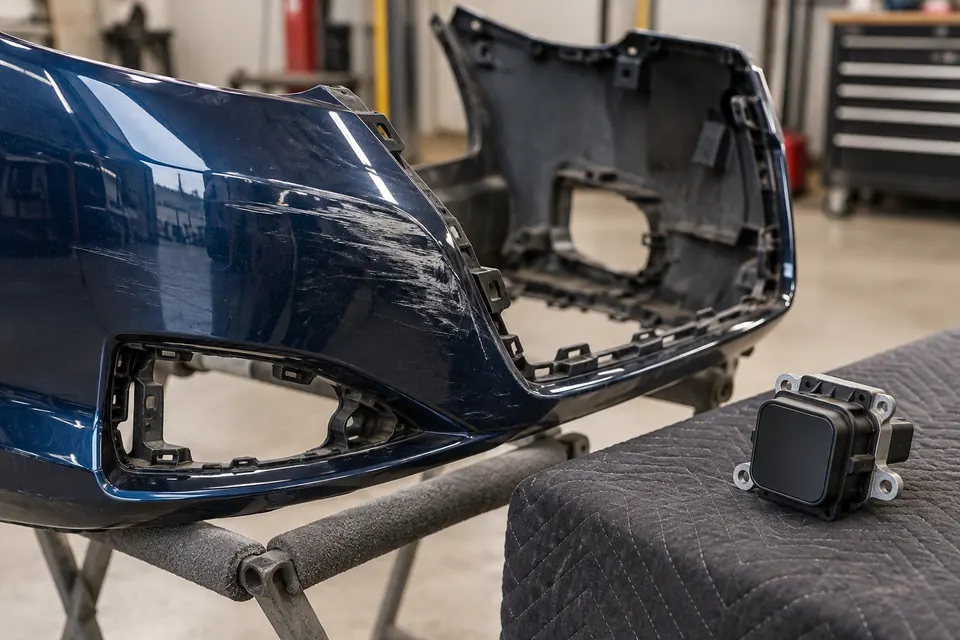
Generated educational illustration: bumper cover and sensor mount context. Not an actual customer repair, diagnostic result, staff member or Boudreaux’s facility.
Can bumper-cover repair affect a radar or sensor?
A bumper-area repair can affect sensors, their mounts or materials in front of them. The actual sensor equipment and manufacturer restrictions determine what needs inspection or setup.
The visible cover is different from the reinforcement and mounting components behind it. Paint or plastic repair in a sensor zone may have restrictions. Ask which equipment is present and how the proposed repair addresses its requirements instead of assuming every bumper operation has the same calibration needs.
Read three connected parts of the bumper proposal
- Visible cover: identify the damaged surface and the proposed repair, replacement or finish work.
- Related component or mount: ask which installed sensor and adjoining area were assessed and what finding supports each operation.
- Applicable system work: ask which diagnostic or setup requirement follows the actual vehicle and physical scope.
If the proposal changes, keep the revised area and reason visible in the dated estimate. An attractive finish, an intact-looking component and a documented system operation answer different questions in that complete plan.
Related Repair Guidance
The bumper area includes more than its visible cover
A bumper cover, the components behind it and the vehicle’s installed sensing systems are separate parts of the assessment. Some sensors are visible in the cover; others operate from behind it. Tell the shop about the vehicle’s equipment and warning history, but let the inspection establish which components and systems are actually present.
A dent or scrape on the cover does not describe the condition of a sensor mount. Conversely, an apparently intact sensor does not settle whether its mounting position or adjoining area was affected. Ask the estimator to identify the system near the repair and explain how its location relates to the damage.
Owners often use parking sensor and radar interchangeably, but those terms can describe different systems. Ask which system the estimate concerns rather than assuming the visible circular feature in a bumper accounts for all nearby equipment. The vehicle identity and installed options help the shop select the relevant information.
If you noticed a new warning after the impact, record its wording and timing. Also disclose earlier warnings and known bumper repairs. That history helps the investigation without proving which component caused the concern. Avoid taking the cover apart or deliberately testing assistance behavior in traffic to obtain more information.
Why a cosmetic-looking operation can have sensor-zone restrictions
Where radar operates through material in front of it, the repair and refinishing requirements can matter to more than appearance. Manufacturer information can restrict work in particular bumper areas or specify requirements for materials and coating. The permitted approach must be researched for the actual vehicle and sensor zone.
There is no single paint-thickness figure or repair radius that an owner should apply to every bumper. Current manufacturer guidance differs between systems and vehicles. An instruction quoted for a different model is background information, not permission to perform the same repair on yours. Ask which applicable information supports the proposed treatment in the affected area.
For a hypothetical example, an exterior scrape might be close to a radar-related area behind a cover. The cosmetic assessment and the sensor-zone assessment then need to be connected. The question is not simply whether the scrape can be made smooth; it is whether the proposed operation meets the relevant restrictions. This is an illustration, not a repair instruction or a Boudreaux’s case record.
Ask how previous refinishing or uncertain repair history in that area will be considered. Share records you have, and say when you do not know. Do not assume an existing finish proves the next coating operation is appropriate. The shop must evaluate the relevant information rather than relying on appearance alone.
Review the complete bumper-area plan
Ask the shop to distinguish the cover work, inspection of mounting or adjoining components and any required diagnostic or setup tasks. These can appear as different estimate lines because they address different questions. A line labeled bumper repair does not independently document every sensor-related operation.
If the plan changes from repair to replacement, request the reason for that decision. It may concern the physical damage, an applicable restriction or another finding. Keep the dated revision and the explanation together so the change is understandable when you compare it with an earlier photo estimate.
Where calibration or another check is required, ask what work must be complete first and how the result will be documented. Scanning, calibration and checking a physical mount are not interchangeable tasks. Request a clear next milestone if part of the assessment remains unresolved.
Discuss the arrangements with the Boudreaux’s location handling the vehicle. New Orleans and Luling can confirm the receiving plan and proposed operation; this guide does not promise that every specialist sensor task is performed in-house at both shops. Bring your equipment information, warning observations and earlier bumper-repair records to that conversation.
Questions About Can Bumper Repair Affect ADAS Sensors?
Technical Reference
I-CAR: calibration terminology and methods. Manufacturer requirements for the exact vehicle control the repair method. A reference link does not imply Boudreaux’s certification or affiliation.