
Illustration: Static ADAS Calibration: What It Involves
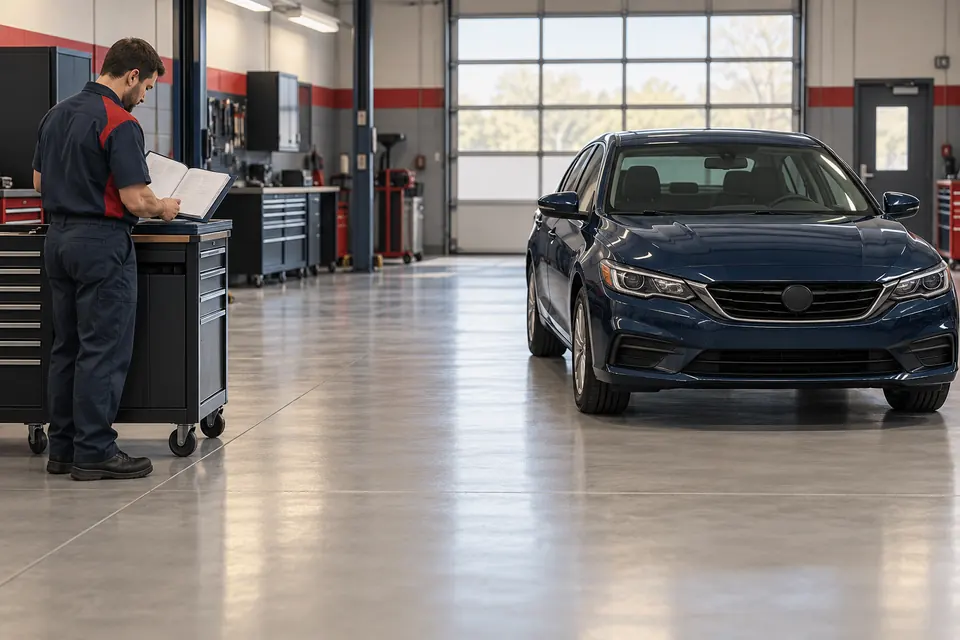
Generated educational illustration: static calibration planning workspace. Not an actual customer repair, diagnostic result, staff member or Boudreaux’s facility.
What makes a calibration “static”?
Static calibration is performed with the vehicle stationary using the targets, tools and setup specified for the system. It is different from simply connecting a scan tool and clearing codes.
The procedure can have requirements for space, surface conditions, tire pressure, loading and target placement. Those prerequisites vary. Ask which static procedure applies and what setup requirements were met; do not infer that a target frame alone guarantees a completed calibration.
How This Fits Into the Repair Plan
Connect the stationary procedure to the identified system and triggering work. Ask which vehicle and workspace prerequisites remain and how completion is recorded.
Related Repair Guidance
A stationary procedure still has specific requirements
Static calibration refers to a procedure performed with the vehicle stationary under applicable requirements. It is not simply parking near a target or running a generic scan. Ask which fitted system and vehicle-specific instruction determine the proposed operation.
Equipment, setup and vehicle prerequisites need to fit that instruction. The owner should ask how the requirement is identified rather than choose target placement or measurements from an online example. A procedure for another model is not the instruction for every stationary calibration.
The reason for the operation also needs explanation. Ask which component, mounting-area event or repair operation creates the requirement. A broad statement that the vehicle has ADAS does not, by itself, identify the particular task in the estimate.
Do not move sensors or mount improvised targets to test the system. The supported procedure and actual vehicle information should guide the work. An owner’s useful role is understanding the required operation and its relevant result.
Related reading: Static vs Dynamic ADAS Calibration and ADAS Calibration Documentation.
Clarify prerequisites and related repair work
Ask what relevant repairs or assessments must be completed before the stationary operation. Physical component condition, mounting position and any applicable geometry questions are distinct from the calibration result. The sequence should follow the supported plan rather than a universal list.
A scan may be part of the overall assessment, but scanning and calibration are different tasks. Ask what each relevant result establishes. A clear code summary is not automatically documentation of the stationary operation.
Some fitted systems or vehicles may have a different method or a combination of requirements. Ask which actual instruction applies. Static should not be selected merely because it sounds more convenient, and dynamic should not be treated as a universal alternative.
If a prerequisite remains unresolved, ask which finding or operation resolves it and when an update is expected. Keep the issue explicit in the scope rather than assuming a stationary attempt completes the requirement under any conditions.
Ask for an explained stationary-calibration result
At pickup, ask which system and operation were addressed and which relevant record is available. Vehicle identity, purpose and result help connect the document to the final scope. A general diagnostic receipt may need clarification if several separate tasks were involved.
If the method or scope changed, keep the dated revision and the requirement behind it. Ask whether the change concerns component identity, prerequisites, the calibration method or verification. This explains the work more clearly than an isolated new total.
Where insurance is involved, separate the technical requirement from claim review. Ask the shop about the applicable operation and the insurer about its actual decision. Clarify any remaining authorization or payment question before changed work proceeds.
If an assistance concern appears later, record the conditions and contact Boudreaux’s before resets or deliberate road tests. The actual repair and operation record helps discuss the appropriate next assessment without assuming every new concern has the same cause.
Questions About Static ADAS Calibration: What It Involves
Technical Reference
I-CAR: preparing the vehicle for calibration. Manufacturer requirements for the exact vehicle control the repair method. A reference link does not imply Boudreaux’s certification or affiliation.