
BOUDREAUX’S COLLISION · REPAIR EDUCATION
Caster Changes After a Collision
Caster is part of steering geometry and is evaluated under the vehicle’s alignment specifications. A changed reading can lead to inspection of relevant components and mounting relationships. The correct interpretation depends on the vehicle and other findings.
Illustration: Caster Changes After a Collision
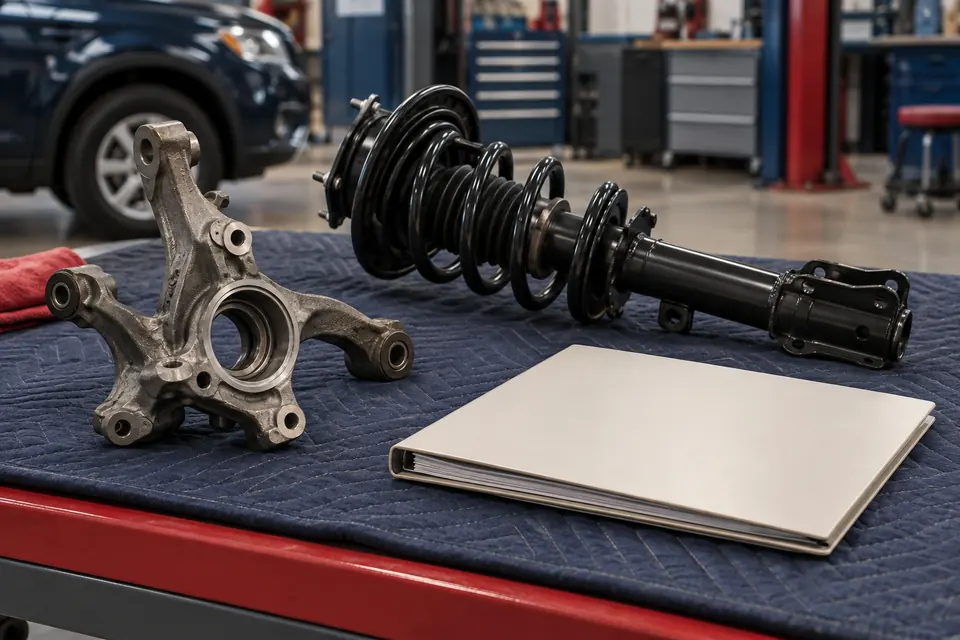
Generated educational illustration: caster steering axis context. Not an actual customer repair, diagnostic result, staff member or Boudreaux’s facility.
What to Clarify for Your Vehicle
Ask whether the concern involves adjustment, a damaged part or structural assessment. Do not diagnose the repair from a printout alone. The shop should explain how the reading relates to the impact and the allowed correction method.
Caster concerns the steering axis
Caster describes the steering-axis angle viewed from the side. It is distinct from wheel tilt and toe. The specified range and available adjustments depend on the vehicle design. A changed reading can help guide an investigation into steering or suspension geometry.
The number alone does not identify the damaged component. Physical inspection and other measurements may be needed to understand the condition after a collision.
Use symptoms as history, not as a diagnosis
Tell the shop about a new pull, unusual steering return or a changed wheel position, including when you first noticed it. Those observations help frame the inspection but do not establish that caster is the cause.
Ask what explained any abnormal reading and whether related mounting or structural concerns were evaluated. At handoff, keep the measurement record with the final repair scope. A steering adjustment should not be assumed to repair a bent component.
Example: a steering complaint with an abnormal caster reading
Imagine a vehicle has a new steering-return concern after an impact and an alignment assessment records a caster value outside its specified range. That result can help guide investigation. It does not identify a particular component without the relevant inspection and comparison.
The shop should explain which condition supports the proposed repair and how the final assessment will address it. If a mounting or structural concern is suspected, ask how it will be evaluated separately from a routine adjustment. Not every vehicle has the same adjustment provisions.
Describe when the steering concern began and whether it existed before the collision. Keep the before-and-after record where available. If an explanation focuses only on one number, ask how it connects to the physical findings and observed symptom. This gives the owner a traceable repair explanation without requiring a guessed caster setting or an assumption that every handling concern can be solved by the same alignment operation.
Further repair information
I-CAR: collision-related alignment considerations
General background and manufacturer examples do not replace current applicable information for the actual vehicle and operation.
Related Guidance
Trace the proposed operation to a documented finding
If the proposal includes component work, ask what inspection supports it and what later measurement or check applies. A changed reading can guide assessment without identifying the damaged component by itself. If another evaluation is needed, ask what question remains and which stage addresses it.
Tell the shop about previous suspension work or known modifications. The information helps establish the actual vehicle configuration without proving that earlier work caused the present concern. Share available records privately and label a prior recommendation differently from work that was actually performed.
At delivery, retain available before-and-after results with the final scope. If an ordinary steering concern remains, report the timing and conditions and ask for review. Do not make abrupt steering or emergency maneuvers to evaluate it. A clear follow-up is more useful than requesting another adjustment based only on an unfamiliar number.