
Illustration: Wheel Alignment and ADAS Calibration
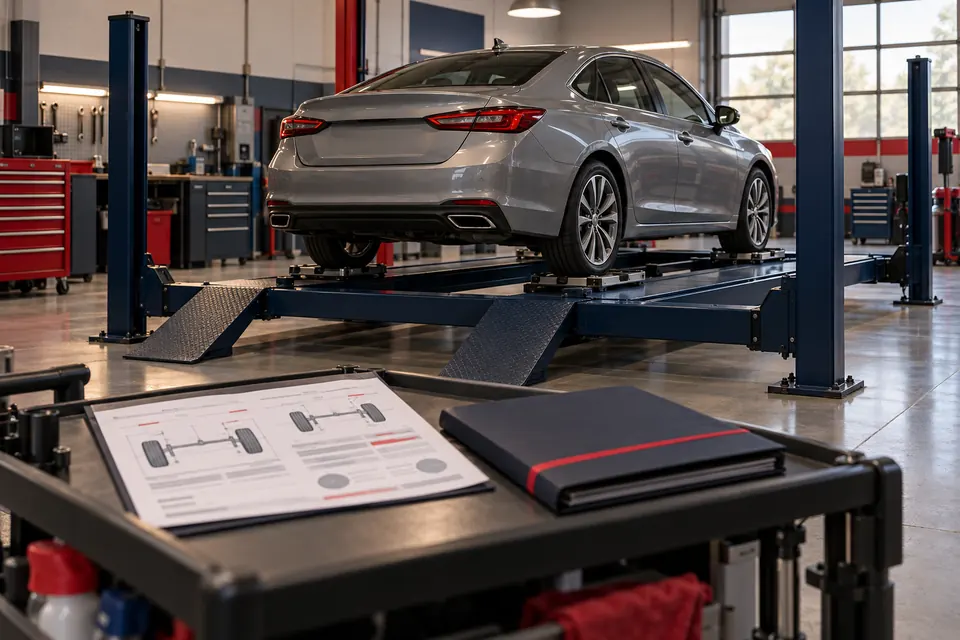
Generated educational illustration: alignment assistance records context. Not an actual customer repair, diagnostic result, staff member or Boudreaux’s facility.
Does wheel alignment automatically calibrate ADAS?
Some ADAS procedures rely on vehicle geometry as a reference. Where the manufacturer requires alignment or related checks first, that work should be completed in the specified sequence.
An alignment and a calibration measure or establish different things. Completing one does not automatically complete the other. Ask whether the repair altered suspension, ride height or alignment and which prerequisites apply to the affected system.
How This Fits Into the Repair Plan
Connect the completed mechanical scope with its alignment result and any separately required assistance operation. The vehicle-specific plan determines prerequisites and sequence.
Related Repair Guidance
Ask what each operation establishes
Wheel alignment concerns relevant wheel geometry; an assistance-system calibration addresses a different vehicle-specific requirement. The operations can be related without being interchangeable. Ask what each proposed line is intended to establish for the actual vehicle.
Describe new pulling, wheel position changes, rubbing or assistance warnings after the event. Mention known tire, wheel or suspension changes. Those facts help identify relevant assessment questions without proving a single cause or universal calibration requirement.
The applicable information can connect alignment or suspension work with assistance operations on particular vehicles. Ask which instruction applies to your fitted system and actual repair. Do not assume that every alignment needs identical additional work or that alignment never affects the assistance plan.
If the vehicle’s driving condition is uncertain, discuss appropriate transport before moving it. Do not deliberately drive to collect a pulling symptom or trigger a system response. A supported plan can start with the observation without an improvised test.
Related reading: Wheel Alignment vs Structural Damage and Suspension Work and ADAS Requirements.
Understand prerequisites rather than imposing one sequence
Ask which relevant repairs and prerequisites must be completed before alignment, calibration or verification. The order should follow the actual vehicle-specific plan. A generic diagram showing one fixed sequence does not explain every operation or fitted system.
A wheel-angle report should not be treated as documentation of every assistance operation. Likewise, a calibration result does not independently establish every structural dimension or mechanical component condition. Ask which relevant evidence supports each separate question.
Scanning provides another kind of information. A no-code summary is not a substitute for an applicable alignment-related calibration requirement. Ask what systems were accessed and which separate operations follow from the work.
If additional findings change the proposal, request the dated revision and explanation. Ask whether it changes the mechanical component, alignment, prerequisite, assistance task or relevant check. Clear operation names help distinguish related scope from an assumed duplicate charge.
Keep geometry and assistance records understandable
At pickup, ask which alignment and assistance operations were completed and which relevant records are supplied. Vehicle identity, stage and purpose should be clear enough to connect each result to the final scope.
If work was performed or coordinated separately, ask how its result is included in the repair record. A general completion statement should not leave you guessing whether a required operation or unresolved prerequisite was addressed.
For a later pulling concern or assistance message, record the conditions and timing and contact Boudreaux’s before continued testing. Keep the relevant records with the observation. A new symptom needs assessment rather than a universal explanation based only on the word alignment.
Where insurance is involved, separate the technical requirement from claim review. Ask the shop about the supported work and the insurer about its actual decision. A payment line does not identify the applicable prerequisite or calibration method.
Questions About Wheel Alignment and ADAS Calibration
Technical Reference
I-CAR: wheel alignment and ADAS considerations. Manufacturer requirements for the exact vehicle control the repair method. A reference link does not imply Boudreaux’s certification or affiliation.