
BOUDREAUX’S COLLISION · REPAIR EDUCATION
Frame Rail Damage: Measuring Before Repair Decisions
Frame rails are structural members that help establish vehicle geometry and manage loads. Rail damage must be assessed by location, material and manufacturer repair limits; an exterior panel lining up is not proof that a rail is correct.
From the Boudreaux’s archive
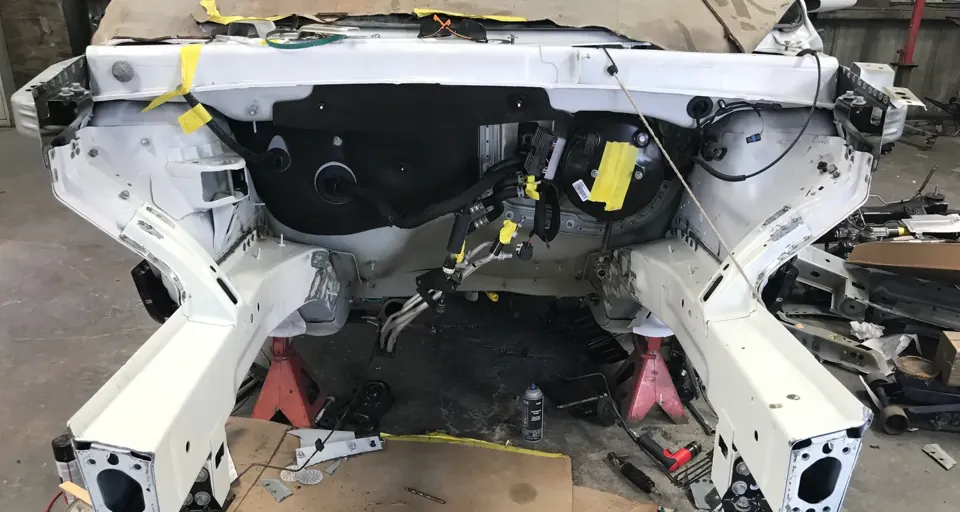
Owner-supplied GMC archive view of exposed front structural members. Visible access does not supply dimensional values, establish rail repairability or document final structural verification.
Can a damaged frame rail always be straightened?
Frame rails are structural members that help establish vehicle geometry and manage loads. Rail damage must be assessed by location, material and manufacturer repair limits; an exterior panel lining up is not proof that a rail is correct.
Kinks, displaced mounting points and affected crush areas can lead to different repair decisions. Measuring helps compare reference points with specifications. Some areas may be repairable while others require replacement; heat or sectioning should never be assumed acceptable for every rail.
How This Fits Into the Repair Plan
Identify the actual rail and vehicle construction, then distinguish dimensional position from component repairability. Ask which record explains the stage of assessment and which applicable limits support the operation.
Related Repair Guidance
Identify the rail and the question being measured
The phrase frame rail can describe different components depending on vehicle construction. Ask whether the discussion concerns a front or rear rail, a full-frame component or a rail within a unibody structure. The exact part and vehicle identity are needed before a method is assumed.
Visible rail deformation is one finding; its position relative to the vehicle’s reference information is another. Ask what measurements are relevant and what their results establish. A panel gap, a straight-looking exterior edge or the way the vehicle rolls cannot replace a supported geometry assessment.
The impact location helps the shop plan inspection. Tell the estimator about a front or rear hit, towing history, earlier rail-area repairs and any new handling concern. Separate what you observed from what someone inferred so the assessment starts with identifiable information.
A wheel-alignment result is not automatically a complete structural report. Ask which question each test answers. The relationship between wheel angles and body or frame reference points needs explanation rather than an assumption that one acceptable result proves every rail is correctly positioned.
Related reading: Can a Bent Frame Be Repaired? and Why Vehicle-Specific Repair Procedures Matter.
Separate geometry from rail repairability
Boudreaux’s uses OEM parts for structural and suspension components. Clarify the identified structural lines and any separate insurer review or payment responsibility.
Measuring position does not, by itself, authorize straightening a damaged rail. Ask which material, damage findings and applicable vehicle instructions support repair or replacement. A dimensional correction and restoration of a damaged component are different parts of the technical decision.
If replacement of part of a rail is proposed, ask which permitted method and location apply. Sectioning and partial replacement at factory seams are different operations. The decision should follow the actual component and instruction, not a generic idea that the damaged portion can always be removed.
Related attachments and adjoining components may need their own assessment. Ask which findings are established and what remains provisional until access. A rail line on an estimate does not automatically explain every mounting point or nearby component affected by the impact.
Protection, joining requirements and relevant checks should be included in the supported scope. Ask how the plan accounts for disturbed areas as well as the visible finish. A new part or straight exterior line cannot independently document every concealed operation.
Ask for records with a clear purpose
A useful measurement explanation identifies the vehicle, reference information and relevant points or findings. Ask the shop what the record shows and what it does not establish. Avoid judging a report simply by the number of printed values or by an unexplained label such as within specification.
Where additional access changes the rail proposal, request the dated revised estimate and the finding behind it. Ask whether the change concerns geometry, component condition, permitted replacement or related operations. Keep those questions distinct so the new scope can be followed.
At handover, ask how the completed work was assessed and which relevant measurement or verification records are available. A finished exterior photograph is context, not a substitute for the explanation. Raise any remaining handling, warning or closure concern with the shop.
Boudreaux’s confirmed New Orleans capabilities include structural measuring and alignment work. Discuss the actual vehicle and receiving plan with the chosen team. Equipment availability is useful context, but the supported vehicle-specific method and documented findings still determine the repair scope.
Questions About Frame Rail Damage: Measuring Before Repair Decisions
Technical Reference
I-CAR: sectioning and partial replacement terminology. Manufacturer requirements for the exact vehicle control the repair method. A reference link does not imply Boudreaux’s certification or affiliation.