
Illustration: Structural Rocker Damage vs Outer Rocker Dents
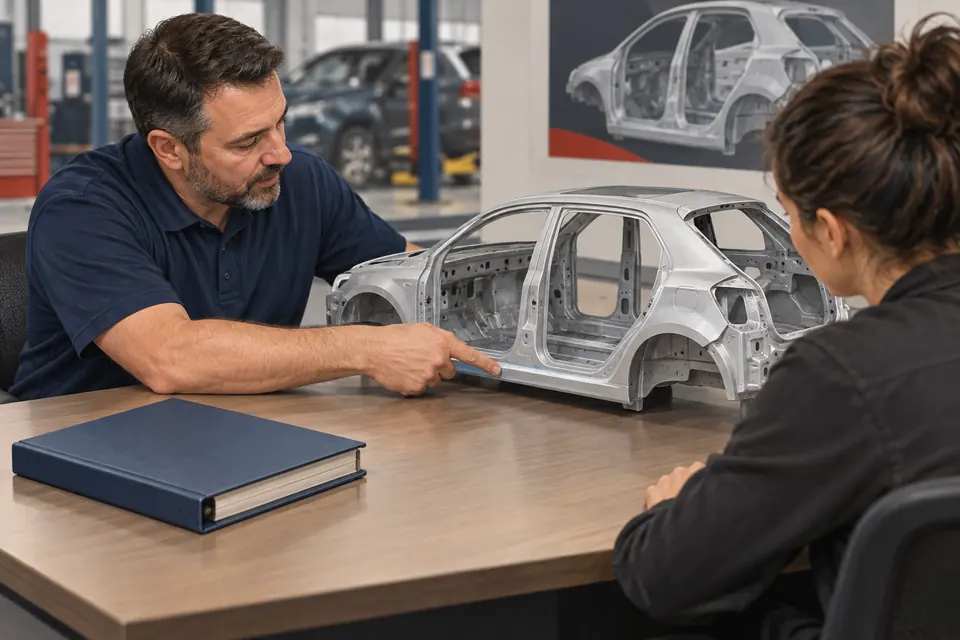
Generated educational illustration: rocker component identification discussion. Not an actual customer repair, diagnostic result, staff member or Boudreaux’s facility.
How is inner-rocker damage different from a cosmetic dent?
A structural rocker is a layered assembly that can include reinforcements linking the floor and pillars. Damage to these layers is different from a dent in the outer skin or a plastic sill cover.
The repair should identify which layer is damaged before selecting a method. Material restrictions, replacement boundaries and joining procedures may differ between layers. Door fit can be a useful symptom, but measurements and access may be necessary to evaluate the underlying assembly.
How This Fits Into the Repair Plan
Keep the cover, outer rocker and structural reinforcement distinct. Match each finding to its applicable method and clarify access, joining, protection and relevant geometry questions.
Related Repair Guidance
Do not confuse the outer dent with the structural finding
Boudreaux’s uses OEM parts for structural and suspension components. Clarify the actual structural or suspension lines and any separate insurer review or payment responsibility.
A rocker-area impact can affect an outer panel, a reinforcement or adjoining floor and pillar components. Ask which part is being called structural rocker damage. The visible outer dent does not, by itself, establish the condition of the concealed layers.
Describe the impact position and any changed door operation or gap. These observations help identify inspection questions, but a door that closes is not proof of reinforcement condition. Ask what access or measurement is needed to distinguish the outer surface from the affected structure.
Earlier corrosion or rocker repairs should be disclosed. The assessment needs to separate the new collision from pre-existing conditions and explain how each affects the supported plan. Do not remove coatings or attempt to pull the dent before that history and condition are documented.
If the damage extends across a lower door opening or toward a pillar, identify the entire visible area. A close-up of one dent can omit context needed for the initial assessment. Take photographs only from a safe position and tell the shop about areas that cannot be viewed.
Related reading: Rocker Panel Repair: Outer Damage and Hidden Structure and Structural Sectioning: When a Partial Replacement Is Allowed.
Ask which method is permitted for the reinforcement
The repairability of an outer panel should not be assumed to establish the repairability of a reinforcement beneath it. Ask which material, damage findings and applicable instructions support the proposed structural operation. Similar location and shape do not make the components interchangeable.
If partial replacement is proposed, ask which component and method the instruction covers. Sectioning and partial replacement at factory seams are different operations. Permission for a visible outer rocker does not automatically authorize the same joining location on the structural layer.
The supplied replacement assembly can affect parts planning, but its configuration alone does not determine the permitted installed scope. Ask what is supplied and what the applicable instruction supports. Clarify adjoining components and any item that remains provisional until further access.
Access, attachments, restored protection, refinishing and relevant measurement belong in the supported scope. Ask how they connect to the structural rocker operation rather than comparing only the main part price. Visible paint cannot show every concealed joint or protective treatment.
Use records that identify the affected layer
If inspection changes the scope from outer-panel work to a structural operation, request the dated revision and the finding behind it. Ask which layer is now involved and what changes in the method, related work, verification or timing. Keep the component descriptions consistent through the repair record.
Where insurance is involved, ask the shop about the supported structural operation and the insurer about its claim decision. A payment review does not determine the material or permitted joining location. Clarify any remaining authorization or responsibility before proceeding with a changed scope.
At pickup, ask what rocker and adjoining work was completed and which relevant records are available. Discuss any unresolved door-operation, trim-fit or visible-finish concern. A before-and-after photo is visual context, not independent documentation of every reinforcement operation.
If a later issue appears, record the location, timing and circumstances. Contact Boudreaux’s before altering trim or seams so the concern can be assessed against the actual work. An online description cannot establish whether the cause is a structural, closure, protection or unrelated issue.
Questions About Structural Rocker Damage vs Outer Rocker Dents
Technical Reference
I-CAR Repairability Technical Support. Manufacturer requirements for the exact vehicle control the repair method. A reference link does not imply Boudreaux’s certification or affiliation.