
BOUDREAUX’S COLLISION · REPAIR EDUCATION
Structural Reference Points and Repair Planning
Reference points provide locations for comparing a vehicle with its specified dimensions. Some points are hidden or require access. Their selection should relate to the impact, the vehicle’s construction and the measuring procedure rather than whatever points are easiest to reach.
From the Boudreaux’s archive
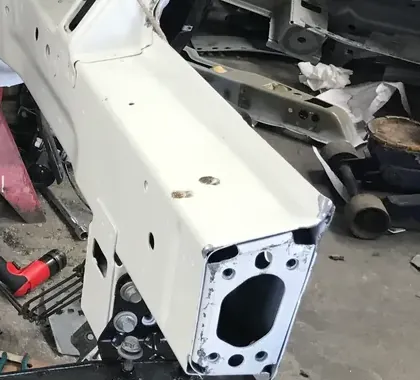
Owner-supplied GMC-project archive detail of an exposed component area. Visible holes are context for identifying a location; this photo does not designate approved measuring points, supply reference data or document dimensional results.
What to Clarify for Your Vehicle
Ask how the selected points establish the condition of the affected area. A few acceptable readings do not independently exclude damage elsewhere. Measuring is one part of assessment alongside material condition, joining areas, component inspections and the manufacturer’s instructions.
Reference points make a comparison meaningful
A measurement becomes useful when it is tied to an identified point and appropriate reference. A distance between arbitrary visible features is not the same thing as checking the specified locations relevant to the vehicle’s structure. Ask which point is being discussed and what comparison supports the finding.
The point selection depends on the vehicle and assessment question. The impact location can guide investigation, but the outside mark does not describe every affected reference. Relevant vehicle information and the measurement plan establish what should be checked.
For an owner, the goal is not to choose points or calculate tolerances. It is to understand how the reported finding connects to the damaged area and proposed work.
Separate access limits from established results
Some points may require access before they can be evaluated appropriately. Ask whether a finding is confirmed or whether the current explanation identifies a measurement that still needs to be completed. Those are different stages of knowledge.
Imagine an initial assessment identifying a question about a concealed reference location. Once access is available, the measured condition may clarify the repair plan. That example explains why a measurement-related operation can appear during planning; it does not establish that every concealed point is damaged.
Keep the point description and stage with your records. A later update should answer the same question rather than switch from one reference to another without explanation.
How to connect reference information to the estimate
- Ask which identified reference is relevant to the impact.
- Clarify what access is needed before assessment.
- Ask what the measured condition establishes.
- Connect the finding to the proposed correction.
- Keep the report with the estimate version it supports.
Do not infer structural condition from panel gaps alone or assume a wheel-alignment result answers every body-dimension question. The value of a reference-point assessment is its defined question, documented comparison and relationship to the actual vehicle.
Further repair information
General background and product examples do not replace the applicable requirements for the actual vehicle and operation.
Related Guidance
Use side-to-side comparisons with the appropriate context
A vehicle is not necessarily symmetrical at every measuring point. I-CAR’s comparative-measuring guidance notes that some locations differ from one side to the other and that further measurements may be needed to distinguish that design from damage. Do not treat any unequal pair in a photograph or informal measurement as proof of collision distortion.
Ask which vehicle-specific reference or additional comparison supports the interpretation. The repairer’s explanation should distinguish a known design feature, a confirmed damage finding and a question still under review. Keep the reference-point labels with the report so later discussion refers to the same locations. If a concern about panel operation, steering or another function remains, discuss that observation separately. A measurement record can help explain the structural assessment without replacing every other inspection or providing an online safe-driving conclusion.