
BOUDREAUX’S COLLISION · REPAIR EDUCATION
Distinguishing Collision Distortion from Factory Shape
Body structures include intentional curves, reinforcements, seams and changes in thickness. Not every irregular-looking area is collision distortion. Assessment should compare the actual condition with relevant vehicle information and evidence from the impact.
From the Boudreaux’s archive
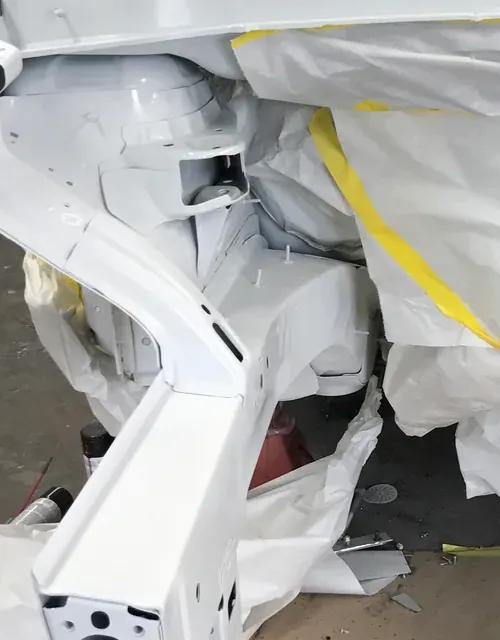
Owner-supplied GMC-project archive detail showing formed metal in an exposed front area. It does not establish that any pictured contour is factory-original, collision-distorted or acceptable; the actual condition requires relevant vehicle information and assessment.
What to Clarify for Your Vehicle
Ask which observations establish that the area is damaged rather than factory-formed. Photographs, measurements and comparison with specified construction can support the explanation. Repair decisions should not be based solely on an unfamiliar shape or on assumptions drawn from another model.
Designed contours and damage need to be distinguished
A stamped panel or structural component can have bends, offsets or contours that are part of its intended shape. A feature appearing uneven to an owner is an observation, not automatic proof of collision distortion. The assessment needs a relevant comparison and vehicle-specific context.
That does not mean a questionable feature should simply be dismissed as factory shape. Ask what information supports the conclusion. The explanation should identify the component, location and basis for treating it as intended shape or an impact-related condition.
Exterior photographs can be helpful for the initial discussion, but perspective and limited access can make them a poor basis for judging concealed geometry.
How a comparison should be explained
A useful comparison concerns the correct vehicle and area. An image of an unrelated model or a different construction may not establish what your component should look like. Ask whether the conclusion is based on relevant repair information, measurement or an appropriate assessment of the actual vehicle.
For an illustration, an owner might notice an offset after a nearby panel is removed. It could be a designed feature, or it could require further assessment. The shop’s explanation should resolve that question rather than rely on either an owner’s initial impression or a broad statement that everything looks normal.
Record the identified location so a follow-up refers to the same feature. That avoids comparing different points without realizing it.
What to clarify before a repair decision
- Which component and feature are being discussed?
- What comparison establishes its intended condition?
- Was access or measurement needed?
- Is collision-related change confirmed or still uncertain?
- What finding supports repair, replacement or no additional work?
The aim is a supported conclusion. Do not bend, grind or alter a questionable feature yourself to see whether it can be corrected. Such an experiment is not an assessment and can complicate the repair conversation.
Further repair information
I-CAR: comparative measuring and asymmetry
General background and product examples do not replace the applicable requirements for the actual vehicle and operation.
Related Guidance
Ask how the finding affects the actual repair decision
If the assessment identifies distortion, ask which component is affected and what current procedure supports the proposed operation. If the location is identified as a factory feature, ask what comparison or reference supports that explanation. Both answers should relate to the actual vehicle rather than a universal rule that every unequal shape is damaged or every unusual-looking area is normal.
Keep the point labels, reference explanation and dated report with the repair scope. An owner can ask for a plain-language explanation without deciding the tolerance or repair method. If a separate gap, closure or control concern remains, describe it independently; identifying a design feature in one location does not answer every other observation. A later concern should be reviewed against the vehicle and relevant record, not resolved by trying to bend or adjust the area yourself.