
Illustration: Parking-Lot Door Hit: What to Check Beyond the Dent
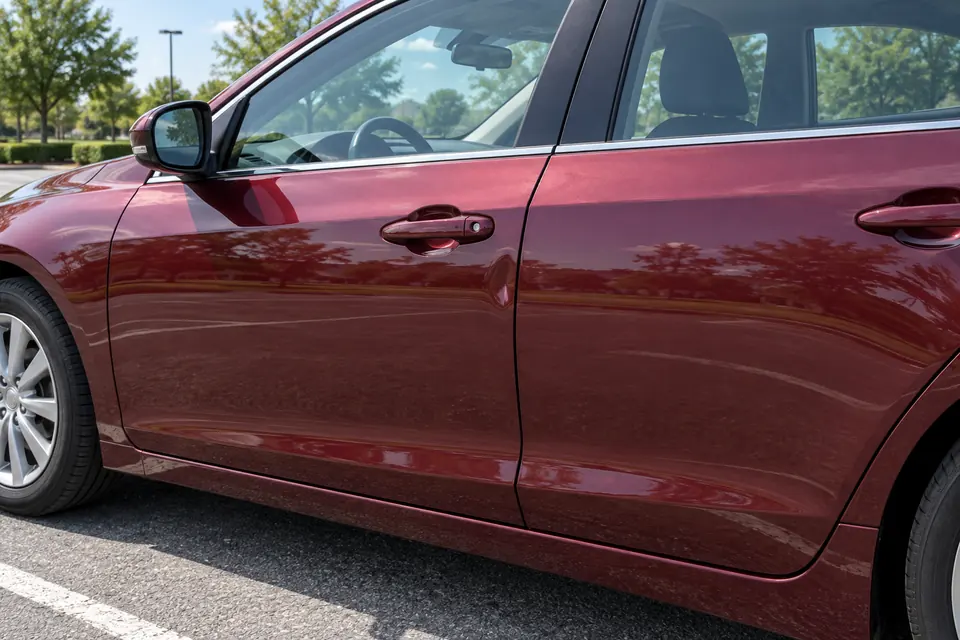
Generated educational illustration: parking lot door edge impact. Not an actual customer repair, diagnostic result, staff member or Boudreaux’s facility.
Owner checklist
By Boudreaux’s Collision · · 8 minute read
After a parking-lot impact, check whether the door opens, closes and seals normally before treating the damage as a dent-only job. The location of the hit matters: damage near an edge, hinge, latch or window opening can require a different assessment from a shallow dent in the middle of a panel.
What the symptom does—and does not—tell you
The door skin is only one part of the assembly. Behind it are attachments, a window mechanism, wiring and reinforcement. A shallow-looking mark beside a latch or hinge does not answer whether the opening moved. A changed window sound or a door that catches can also be relevant. The repairability of the outer skin depends on the material, damage location and permitted method. A dent-removal approach suitable for one accessible area may be inappropriate near a folded edge or an affected safety component.
Three useful details to collect
- Record new catching, rattling or changes in ordinary door-closing effort.
- Take a wide side photograph plus a close view that shows the panel edge.
- Note whether the mirror, window, lock or warning display changed after the impact.
How to discuss the next step
Tell the estimator where the other object contacted the door and what you noticed on the first normal opening afterward. Do not demonstrate the problem by repeatedly forcing the door or glass. Ask the shop to distinguish skin damage, attachment damage and damage to the opening. If there is prior body work or a wrap, disclose it because the surface and earlier repairs can affect the assessment. Ask how window operation, seals, lock function and any door-mounted electronics will be checked after the work.
Describe where the door was contacted
- Panel center: Show the dent with enough surrounding area to identify the affected door.
- Panel edge: Include the nearest folded edge and adjacent panel so the location is understandable.
- Attached equipment: Record separate mirror, window or lock changes instead of treating them as part of the dent description.
For the underlying process, read Door assembly and opening assessment.
Compare the proposed work with the original observation
When the estimate is explained, reference the affected area in your wide photograph. Ask which operation addresses the dent and which addresses an attachment, finish area or related function. This makes an added operation understandable without assuming that every door component was damaged.
Keep the original symptom as the handoff reference. If the glass rattled before work, ask how that reported behavior was addressed; if it operated normally, avoid describing a new pickup concern as part of the original symptom without saying when it changed.
Choose New Orleans or Luling
New Orleans shop · 2150 Earhart Boulevard, New Orleans, LA 70113 · (504) 309-3092
Luling shop · 101 4th Street, Luling, LA 70070 · (985) 331-0707
Request an estimate conversation or contact your preferred shop. Confirm the vehicle-specific service arrangement and any transport needs directly.
Related services and detailed guides
Vehicle-specific information
Repair requirements should follow the applicable manufacturer information. For technical context, consult I-CAR’s Repairability Technical Support resources. These resources support informed questions; they are not a substitute for a qualified assessment of your vehicle.
Describe the door as an assembly, not only a dent
A helpful request identifies the affected door and where the contact occurred: the middle of the outer skin, a lower edge, the mirror area or close to the hinge or latch. Add what changed during ordinary use. The door may look dented while still opening normally, or a small visible mark may be accompanied by a new catch, rattle or window problem. Those are separate observations for the repair team.
Keep the first photos and any existing estimate together. Tell the shop about earlier damage or repairs you know about, and whether a wrap or protective film covers the area. You do not need to remove the trim or test the window repeatedly to make the request useful. A safe, clear account of the condition helps the team decide what access and assessment are appropriate.
Before approving work, ask the team to identify the damaged component and explain the method proposed for it. Repairing an outer skin, replacing a component and addressing an affected opening are different decisions. Ask what related operations and final checks apply, how additional findings will be communicated, and which items remain conditional until the vehicle is inspected.