
From the Boudreaux’s archive
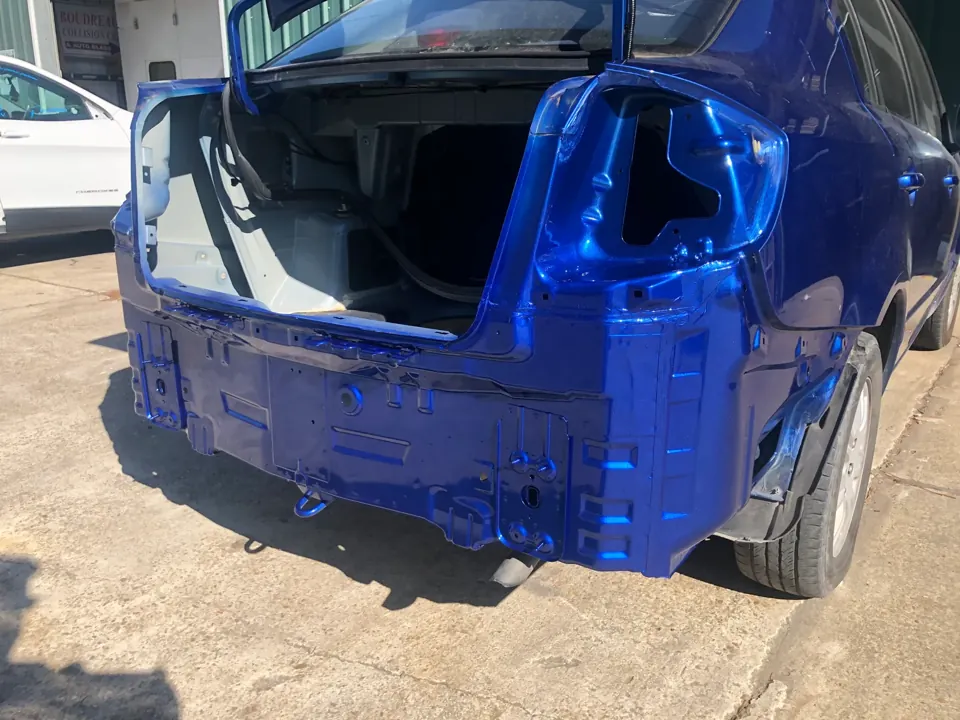
Owner-supplied archive view showing the rear opening and exposed adjoining areas with the closure absent. It does not prove latch, seal, geometry or fitted-equipment verification.
What needs checking besides the liftgate skin?
A damaged rear closure can affect its hinges, latch, seals, glass, wiring and the surrounding opening. Repairing the visible panel does not by itself confirm that the closure fits and operates correctly.
Rear-impact inspection may include the rear body panel and inner cargo-area structure. Power liftgates, cameras and electrical connections add vehicle-specific checks. Before delivery, ask about closing, latching, water sealing and the functions disturbed by the repair.
How This Fits Into the Repair Plan
Keep closure, opening, attachment and fitted-equipment questions distinct. Ask which relevant checks and records explain the completed work and any concern that remains.
Related Repair Guidance
Separate the closure from the opening
A liftgate or trunk lid is the moving closure; the rear opening and surrounding body are separate areas. A damaged outer skin does not describe the hinges, latch attachments or opening geometry. Ask which of these areas were inspected and which questions remain open after the first estimate.
Describe whether the closure opened, closed or latched differently after the collision. Mention new rubbing, a changed gap, an unusual noise or water entering the cargo area. These observations help the assessment without proving which component caused the change. Do not repeatedly force a closure that binds.
Photographs from a safe position can show the overall rear area and a closer view of visible damage. Include the relationship between the closure and adjoining panels if you can do so without moving unsafe parts. A closed-lid photograph cannot establish the condition of every attachment or concealed component.
Tell the shop about a powered liftgate, rear camera, rear wiper, heated glass or other equipment fitted to the vehicle. Equipment varies. Ask which functions and attachments are relevant to this repair instead of assuming that every rear closure has the same construction.
Related reading: Rear-End Collision Repair and What Happens When Your Vehicle Arrives at the Body Shop?.
Read the scope beyond the outer panel
The plan may distinguish outer-panel work, complete closure replacement and work on adjoining body components. Ask for the actual part descriptions. Replacing a lid should not be treated as proof that the rear opening is correct, while an opening repair should not be confused with simply adjusting the closure.
A latch complaint calls for an explanation of the supported inspection and operation. Ask whether the concern relates to the latch itself, its attachment, the striker or the alignment of the surrounding area. A new adjustment alone does not explain why the closure changed after impact.
Related operations may include removing and reinstalling fitted equipment, addressing disturbed protection and refinishing the appropriate surfaces. Ask which items are included and which depend on access or parts identification. Avoid comparing two estimates only by the price of the main lid or liftgate.
If a camera or another driver-assistance component is affected, ask which applicable requirements follow from the actual work. A rear camera image and a successful latch test answer different questions. The repair plan should identify the relevant checks rather than assume one visible function proves everything.
Review closure operation at handover
Before pickup, ask whether the final scope changed from the initial estimate and why. Keep any revised estimate together with the explanation of additional damage or vehicle requirements. Where a part source changed, clarify compatibility, attachments and the approved operations rather than treating availability as the only consideration.
At handover, discuss the normal operation of the repaired closure and any instructions supplied by the shop. Ask about relevant latch, powered-operation, fitted-equipment and sealing checks. Do not perform an improvised water test or force the gate through resistance to prove that the repair is complete.
A weather-related concern should be reported with useful detail: when it occurs, the area where moisture appears and whether the vehicle was parked or moving. Water visible in a cargo area does not identify its entry point. Preserve the observation and arrange assessment instead of applying sealant across unfamiliar seams.
If a new powered-liftgate message or rear-camera concern appears, record the circumstances and contact the repairing shop. Avoid repeatedly clearing messages or altering settings before the concern is documented. Boudreaux’s can use the vehicle identity and final repair record to discuss the next appropriate step.