
Illustration: Corrosion Protection After Collision Repair
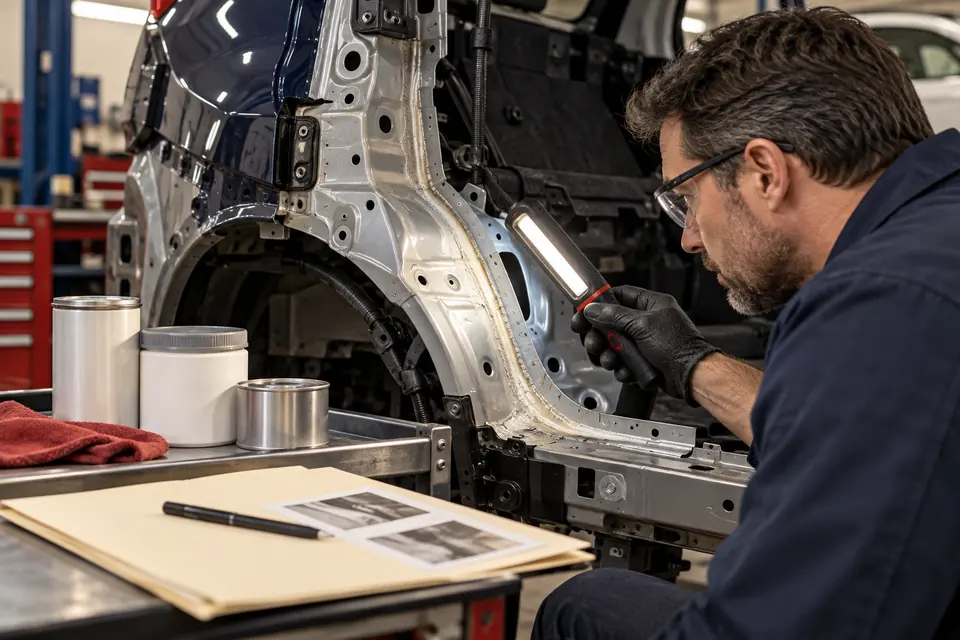
Generated educational illustration: concealed seam protection plan. Not an actual customer repair, diagnostic result, staff member or Boudreaux’s facility.
Does exterior paint restore every corrosion-protection layer?
Removing, cutting, joining or repairing panels can disturb original corrosion protection. Restoring the specified coatings, sealers or cavity protection is part of the repair process where required.
Protection can involve areas not visible once the vehicle is assembled. Material compatibility and access affect the process. Ask what was disturbed and how it is restored under the vehicle procedure. A new exterior paint finish does not independently demonstrate that concealed seams and cavities received the required protection.
How This Fits Into the Repair Plan
Ask which protected locations are disturbed by the work, how the specified materials fit into the sequence and what access changes after reassembly. Keep an explanation of concealed protection alongside the visible refinishing scope.
Related Repair Guidance
The visible finish is only one part of protection
A collision repair can disturb protective materials in areas that are hidden after reassembly. Exterior paint provides a visible finish, while seams, adjoining surfaces and enclosed areas can have their own specified protection. Ask the estimator which layers or locations are affected by the proposed work.
The vehicle’s repair information and the relevant product instructions guide the restoration process. There is no single material that an owner should assume replaces every coating, sealer or cavity treatment. A product’s purpose and where it is specified matter to the plan.
I-CAR’s corrosion-protection guidance discusses protection throughout the repair process, while its Ford/Lincoln overview illustrates vehicle-specific locations and material information. Those references explain why the component and procedure matter; they do not announce which product is being used on your vehicle.
Disclose known earlier corrosion, repairs or coating treatments in the affected area. Share the records you have and identify uncertain history accurately. This helps keep a current repair finding distinct from an assumption about what was present before the collision.
Access and sequence affect work you may not see later
Ask how required protection fits into the repair sequence. Some surfaces or cavities are more accessible before an assembly is closed. The relevant instructions determine the materials and timing, so the plan should address access rather than postpone every protection question until the finished exterior is visible.
For a hypothetical panel replacement, an owner may see the finished outer surface at pickup while adjoining seams or internal areas are concealed. The appropriate discussion concerns which locations were affected and how the specified protection was addressed. A glossy exterior photograph alone cannot supply that information.
Ask the shop to distinguish coating, seam treatment and other specified products where they appear on the estimate. Their names may describe different purposes. An unfamiliar materials line should be explained in relation to the affected area rather than assumed to be a duplicate of exterior refinishing.
If an instruction or product requirement is still being researched, ask what decision remains open and which next stage depends on it. The shop should establish the relevant information before treating that part of the plan as settled. A general internet recommendation is not a substitute for the actual component and material requirements.
Ask for an explanation tied to the repair record
Request a plain-language summary of the locations disturbed and the protection included in the plan. If photos or other records are supplied, keep their dates and stage with them. A picture taken while access was available can provide different context from a finished-vehicle image.
Discuss any scope change with the dated estimate. Ask whether a newly identified protection operation follows from access, a component requirement or another finding. Keep that explanation with the revision so the reason for the work remains understandable when several parties review the job.
Do not interpret this education page as a promise that every future corrosion concern has the same cause or that a particular warranty applies. If you have a concern after repair, identify the location and timing and contact the repairing shop for assessment and the applicable terms of any follow-up.
Avoid covering a new concern with an additional treatment before discussing it with the shop. Describe what you have observed and ask about the next assessment step. An owner does not need to remove trim or enter an unsafe position to create more photographs of a concealed area.
For Boudreaux’s, contact the New Orleans or Luling location handling the vehicle with the current estimate and your questions. Both shops offer body and refinishing work. The selected team can discuss the actual proposed operations and receiving arrangements; this page does not prescribe one product or method for every vehicle.
Questions About Corrosion Protection After Collision Repair
Technical Reference
I-CAR Repairability Technical Support. Manufacturer requirements for the exact vehicle control the repair method. A reference link does not imply Boudreaux’s certification or affiliation.