
From the Boudreaux’s archive
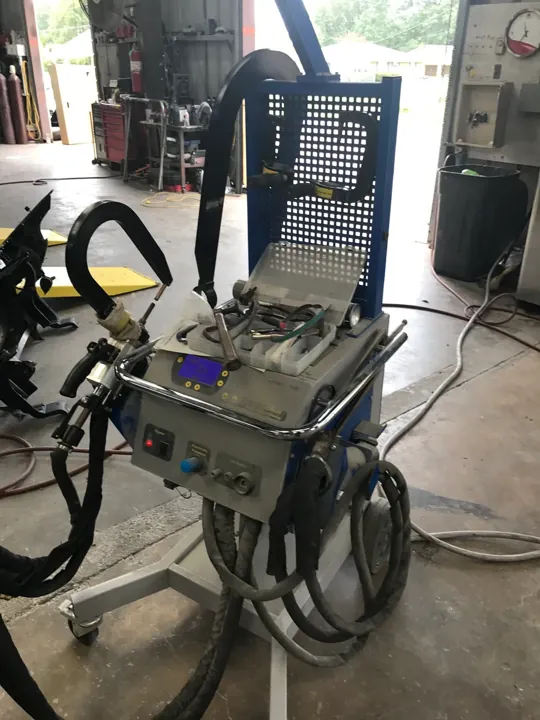
Owner-supplied GMC-project archive view of spot-welding equipment. It provides equipment context only; it does not establish settings, a performed weld, the required method for another vehicle or inventory at both shops.
Why does the original attachment method matter?
Resistance spot welding joins overlapping panels at localized weld points. Where a vehicle procedure specifies it, equipment access, material and the required attachment pattern are important.
Replacing a factory-welded assembly can require separating joints and restoring the specified connections. A different joining method should not be chosen solely because access is easier. Ask how the replacement’s attachments and corrosion protection are addressed under the applicable procedure.
How This Fits Into the Repair Plan
Connect the actual component and attachment arrangement to the applicable instruction. Keep access, preparation, related products and protection clear alongside the relevant joining result.
Related Repair Guidance
Understand the method and the identified component
Resistance spot welding is a joining process involving electrical resistance and pressure at the relevant joint. The process name does not establish where it is permitted or required on every vehicle. Ask which actual component and applicable instruction support the proposed operation.
The material, layers and replacement scope need clear identification. An outer panel and reinforcement can have different requirements. A similar-looking factory joint or another vehicle’s repair example is not the complete procedure for the component in your estimate.
Ask whether the proposal concerns a complete replacement, permitted partial operation or another task. Supplied part configuration and the installed method are different questions. A catalog listing does not independently authorize every separation or attachment location.
Do not select pressure, electrical settings or joint placement from a general education page. The supported technical operation follows the actual instruction. The owner’s useful question is what requirement applies and how the relevant result is assessed.
For a broader comparison of attachment processes, read Collision Welding and Vehicle-Specific Joining Methods. Where the joining arrangement includes related materials and attachments, use Adhesives and Rivets in Collision Repair. These guides help distinguish method and component questions within the actual supported scope.
Distinguish spot welding from assumed substitutes
Resistance spot welding and other weld or attachment methods should not be treated as universally interchangeable. Ask which applicable information permits the proposed operation and any alternative. Convenience or access difficulty alone does not explain permission to change the method.
If adhesives or other specified attachments are part of the joining arrangement, ask how the complete method is represented. One process label should not silently make related requirements optional. The supported scope should connect preparation, installation and relevant materials to the actual operation.
Access and disturbed protection are additional questions. Ask which adjoining components or treatments need attention and what remains provisional until assessment. A main replacement or welding line may not describe all the related work needed to complete the supported scope.
If identification or research changes the method, request the dated revision and reason. Ask whether the change concerns the component, replacement scope, attachment arrangement or verification. Keep that explanation with the current estimate instead of relying only on a new total.
Ask what the completed spot-welding record establishes
Discuss the actual operation and capability arrangement with the selected Boudreaux’s team. Process education is different from confirmation of every tool or method at both shops. Ask which team will perform or coordinate the relevant work for the identified vehicle.
At pickup, ask which joining operations and relevant checks were completed and what records or explanation are available. A smooth exterior cannot independently document every concealed attachment. A general welded-panel statement should be connected to the actual supported scope.
Where insurance is involved, clarify technical requirements with the shop and the actual claim decision with the insurer. A payment line does not identify the permitted attachment location, method or verification requirement.
For a later concern, record the area and circumstances and contact the repairing team before alterations. A process name alone does not diagnose a symptom. Keep the final estimate and relevant explanation together for a useful follow-up conversation.
Questions About Resistance Spot Welding in Collision Repair
Technical Reference
I-CAR: resistance spot-welding process background. Manufacturer requirements for the exact vehicle control the repair method. A reference link does not imply Boudreaux’s certification or affiliation.