
Illustration: Post-Repair Scans and Final Verification
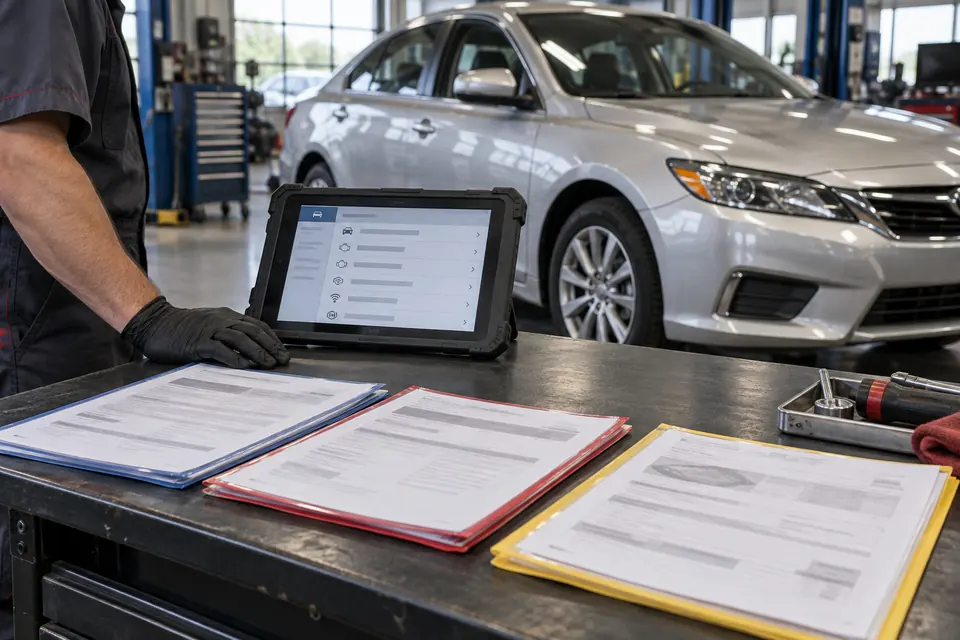
Generated educational illustration: post repair scan record handoff. Not an actual customer repair, diagnostic result, staff member or Boudreaux’s facility.
Does a clear post-scan prove the entire repair is complete?
A post-repair scan reviews electronic system information after repairs and reassembly. It can help identify faults remaining from the collision or introduced by disconnected components during the work.
The scan should be interpreted alongside required calibrations and other checks. Some faults depend on specific operating conditions, and a report with no codes does not certify every physical repair. Ask what findings were addressed, what limitations remain and which separate inspections were completed.
Match the final record to the operation it describes
- Stage: identify which repair and reassembly work was complete when the scan record was made.
- Finding: ask how a remaining entry or an earlier reported concern was addressed, including any assessment beyond scanning.
- Separate completion record: keep any required calibration, setup or physical verification explanation tied to its own operation.
If a relevant task follows the scan, ask which later record explains its completion. The goal is a traceable sequence, with an identified next action for anything still open.
Related Repair Guidance
Understand which repair stage the report represents
Ask when the post-repair scan was performed and what work had been completed at that point. The stage matters when interpreting a record. A report made before another relevant operation is not necessarily the final record for that operation. Keep the date and vehicle identity with the documentation supplied at pickup.
If an earlier scan identified concerns, ask how those findings were addressed. The explanation should connect the starting record, the diagnostic decisions and the later findings. This is more useful than comparing the number of codes on two pages without knowing what changed between them.
Ask whether all relevant systems were reached and whether any limitations remain. A report with fewer entries can reflect a different scope as well as a different vehicle condition. If something could not be evaluated, request an explanation of the remaining question and the next action.
You do not need to operate the scan tool yourself. The owner-facing goal is to understand what the record establishes, which concerns required additional work and how that work is documented. Keep questions focused on your vehicle and the current repair plan rather than general claims about every electronic system.
Separate scan results from the rest of final verification
A post-scan is one part of the information used after repair. Physical reassembly, fit, required setup operations and other inspections can each have their own purpose. Ask what separate checks were included in your plan and what evidence documents them. A scan report should not be presented as a substitute for every other check.
For a hypothetical example, a vehicle may have a scan report and a separate calibration record associated with a camera operation. The first record and the second record answer different questions. Asking which requirement each addresses makes the documentation clearer than assuming a single tool use covers both tasks.
If an unfamiliar line remains on the invoice, ask for a plain-language explanation of its purpose and completion. Was it diagnostic investigation, a setup operation or a verification step? Keep those meanings distinct so you can follow the sequence from finding to action to check.
Also ask about any unresolved concern you reported at intake. If a symptom required investigation beyond the scan, the response should address that investigation. The absence of a code alone may not explain a physical noise or another concern you described. Refer to your original written observations so neither side has to rely on memory.
Use pickup to clarify records and follow-up
Before collecting the vehicle, ask the shop to explain the current status of the work and any follow-up arrangements. If something remains open, identify the concern, the plan to address it and the person to contact. Do not assume a document you have not discussed settles an unanswered question.
Keep the final estimate or invoice, supplied diagnostic information and separate verification records together. Dates and operation names make these documents easier to use if a question arises later. Avoid separating a screenshot from the page that identifies the vehicle and the stage it represents.
After pickup, document any new warning or concern with its wording and timing and contact the shop promptly. Ask about safe handling before driving further when the concern affects vehicle operation. Do not clear the message simply to see whether it returns or attempt an unsafe test to prove the symptom.
For Boudreaux’s, use the New Orleans or Luling location that handled the repair. Reference your vehicle and the repair date when discussing documentation or follow-up. Keep the final records with your follow-up contact so a later question can be discussed against the completed scope.
Questions About Post-Repair Scans and Final Verification
Technical Reference
I-CAR Repairability Technical Support. Manufacturer requirements for the exact vehicle control the repair method. A reference link does not imply Boudreaux’s certification or affiliation.