
Illustration: Pre-Repair Scans After a Collision
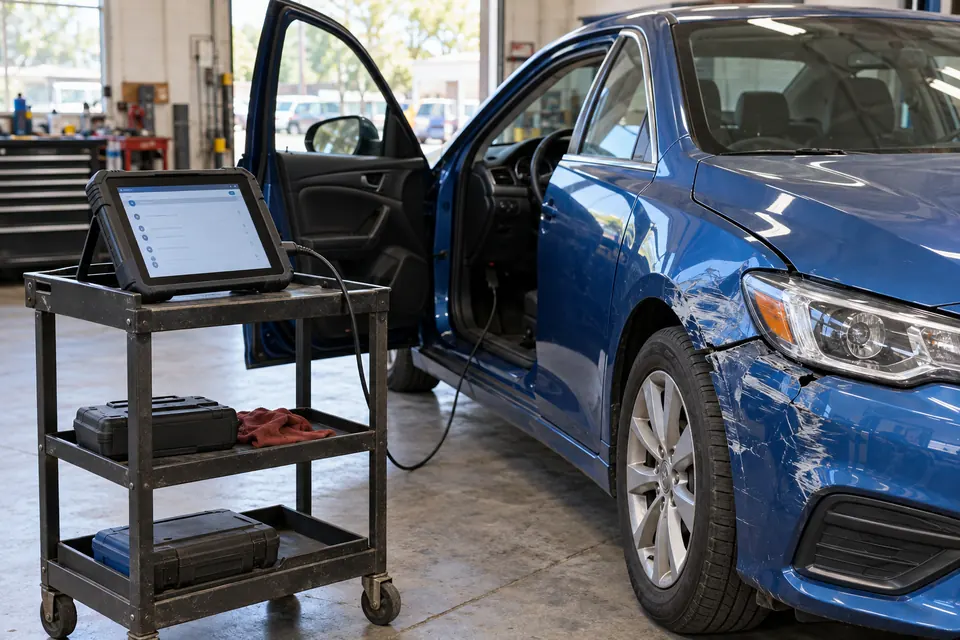
Generated educational illustration: pre repair scan starting record. Not an actual customer repair, diagnostic result, staff member or Boudreaux’s facility.
What does a pre-repair scan tell the shop?
A pre-repair scan retrieves available diagnostic information before repair progresses. It can help document existing faults and identify systems needing further investigation.
Damage can prevent safe or complete communication with the vehicle; any limitation matters. Codes must be interpreted with inspection and vehicle-specific test information rather than treated as a parts list. Ask which systems were covered and what findings affected planning. A pre-scan is a starting record, not a complete damage assessment.
Keep coverage limits with the starting record
When a pre-repair scan is discussed, keep three details together: the vehicle and date, the systems or coverage described in the report, and any reason part of the assessment could not be completed. A later reader should be able to see both what the record covers and what remains open.
Ask which finding needs diagnosis before a repair decision and which limitation needs another assessment stage. Keep an owner’s warning history beside the report as a separate observation. That makes the starting file useful without turning a code list into an owner-selected parts order.
Related Repair Guidance
Give the scan a useful starting history
Before the inspection, tell the shop about warning messages and symptoms you noticed after the collision. Include anything similar that existed before it. If you have a photograph of a dashboard message, share it with its approximate date. An accurate history helps distinguish your observations from the information retrieved during the scan.
Use the vehicle year, make, model and VIN in the request. Diagnostic coverage concerns the actual vehicle and installed systems, not simply whether a device can be connected. Ask which systems were reached and whether the condition of the vehicle limited the work. An incomplete connection is a limitation to explain, not a reason to assume the systems that could not be reached are unaffected.
A pre-repair scan is an information-gathering stage. Ask how it fits into the current inspection and whether particular findings require additional diagnosis. Keep the report supplied by the shop with the initial estimate. Recording the stage and date makes it easier to compare that information with later checks.
Do not disconnect components or clear messages to prepare the vehicle for an appointment. Describe what you know and let the shop confirm the handling appropriate to its condition. If safe movement is uncertain, arrange receiving and transport before trying to drive it to obtain a scan.
Read fault information as a question to investigate
A diagnostic code is not an automatic order for a replacement part. Ask what the reported information means in context and which tests or inspections support the proposed action. The difference between a retrieved observation and an established cause is important when you review a repair plan.
For a hypothetical example, a report may contain a communication-related entry. The useful next question is how the shop will investigate it, not which module an owner should buy from the code description. The report alone does not settle every possible explanation. This example illustrates a diagnostic decision and is not a finding from a Boudreaux’s customer vehicle.
Ask whether the explanation distinguishes a currently observed concern from other stored information. Avoid interpreting a list of entries as a list of equally urgent collision failures. Provide the timeline of earlier warnings so the shop can consider it alongside the report and physical inspection.
If the vehicle condition prevents a complete assessment, ask what needs to change before the remaining systems can be evaluated. That might be a later inspection stage rather than an immediate conclusion. Keep the limitation in your notes so the later record can address the question instead of silently dropping it.
Connect the initial record to the next repair decision
Ask which scan findings affect the current plan and which require separate follow-up. If diagnostic work is proposed, request an explanation of the concern being investigated. This is more useful than treating an estimate line labeled scan as proof that all electronic questions have already been answered.
Keep scanning distinct from calibration, programming and other setup operations. Ask what each listed operation is intended to accomplish and which vehicle-specific requirement makes it relevant. The fact that similar equipment may participate in several tasks does not make those tasks interchangeable.
Discuss the expected next update. The shop may need inspection findings or another repair stage before it can explain the full electronic scope. Ask who will contact you, what decision may need approval and whether the initial schedule remains provisional. This keeps the report connected to the repair conversation.
At Boudreaux’s, confirm diagnostic arrangements with the New Orleans or Luling location handling your vehicle. Do not assume every vehicle brand, system and operation has identical coverage at both shops. An online estimate request starts the discussion; the selected location must confirm the receiving plan and the appropriate next step.
Questions About Pre-Repair Scans After a Collision
Technical Reference
I-CAR Repairability Technical Support. Manufacturer requirements for the exact vehicle control the repair method. A reference link does not imply Boudreaux’s certification or affiliation.