
BOUDREAUX’S COLLISION · REPAIR EDUCATION
Wiring Harness Damage Near Collision Repairs
Wiring in an impact or disassembly area may be cut, pinched, displaced or otherwise affected. A working function does not independently establish that every wire and connector is intact. Inspection and electrical diagnosis can address different aspects of the concern.
From the Boudreaux’s archive
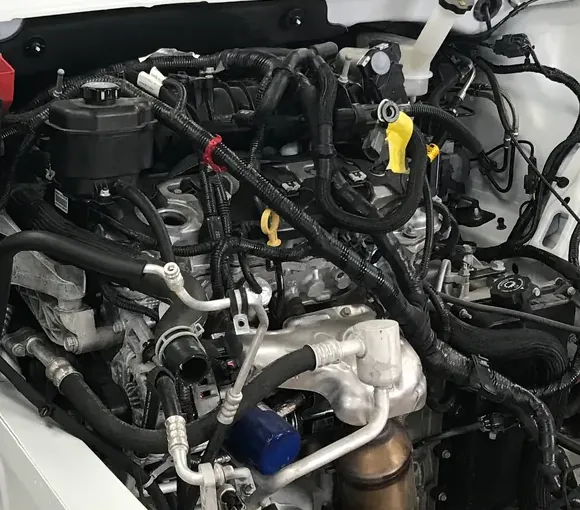
Owner-supplied GMC project archive detail showing wiring and connector access during disassembly. It supplies routing and access context, not a damaged-wire diagnosis, permitted splice method, completed connection or verified circuit result.
What to Clarify for Your Vehicle
Ask which harness areas were exposed or disturbed and whether the relevant repair information permits a particular repair. Do not assume a universal splice method applies to every circuit. Connector sealing and routing may matter alongside continuity.
Wiring damage can be local while symptoms appear elsewhere
A harness contains multiple electrical circuits. Impact, pinching, abrasion or disturbance during repairs can make an affected area relevant to diagnosis. A warning on the dashboard does not necessarily identify where the physical problem lies.
Repairability depends on the vehicle, circuit and applicable instructions. A generic splice method should not be assumed suitable for every harness, especially for systems with specific restrictions.
Connect physical findings with diagnostic information
Ask whether the concern is damaged insulation, a conductor, a connector or another condition, and what supports the proposed repair or replacement. Scanning may help identify symptoms, but is not a physical harness inspection.
Share the timing of warning messages and any previous electrical work. Do not reconnect loose wires or clear faults before assessment. The final record should identify the work and relevant checks without presenting every electrical concern as a confirmed collision-related failure.
Example: a warning after work near a harness
A warning appears during a repair involving a panel near wiring. The repairer needs to establish the vehicle’s condition at that stage: whether a component is deliberately disconnected, whether physical damage was found and what the diagnostic information shows. A fault entry alone does not prove that the harness requires replacement.
If damage is confirmed, ask what part of the circuit or assembly is affected and what vehicle-specific repair information applies. Different circuits can have different restrictions. A familiar general-purpose splice technique should not be assumed suitable simply because it restored continuity on another vehicle.
At delivery, the final scope should identify the corrective work and relevant checks. Retain the reports where provided. If a warning remains or returns, give the exact message and timing. Do not reconnect or probe unfamiliar wiring yourself. A clear record distinguishes diagnosis, physical repair and completion verification without turning a dashboard message into a presumed component failure.
Related Guidance
A harness carries more than the function you can see
A wiring harness groups circuits through different areas of the vehicle. Near an impact, its insulation, retainers, routing or connectors may be affected even when one nearby lamp still works. A single operating function is therefore not a complete assessment of the circuits or physical condition in that area.
Tell the repairer about new warning messages, intermittent functions and the point at which they appeared. Include known previous electrical repairs or accessories installed near the damage. Describe the observation rather than naming a failed wire or module. An intermittent symptom needs context, but an owner should not bend, pull or move a damaged harness to reproduce it.
Vehicle electrical systems differ, and a collision-damaged area may contain restraint or high-voltage components as well as ordinary wiring. Do not disconnect, probe or tape exposed wires yourself. Identify the location from a safe distance and allow a qualified technician to determine the appropriate access and assessment.
Repair permission is specific to the circuit and vehicle
Manufacturers do not treat all wiring repairs alike. The permitted method, materials and location can depend on the circuit and vehicle. Ask whether the relevant service information allows repair of the affected wiring or requires replacement of a larger harness or component. A universal promise that any wire can be spliced is not a sufficient repair basis.
The estimate should explain whether work concerns physical harness damage, a connector, a diagnosed circuit problem or removal for access. Ask the repairer to connect the proposed operation to the finding. If an approved repair part or pigtail is proposed, ask whether its application and procedure were checked for that particular circuit.
Routing and retention also belong in the discussion. A completed electrical connection does not establish that the harness is protected from sharp edges, moving parts or repaired panels. Ask what associated clips, retainers or protective components need attention and how the final routing follows the applicable procedure.
Use the records to distinguish diagnosis from verification
A diagnostic trouble code is information about a system’s reported condition. It is not, by itself, proof that a particular wire needs replacement. Ask what physical assessment or circuit diagnosis supports the harness operation and which checks are needed after the work. The explanation should describe the cause and the remedy in terms an owner can understand.
At pickup, ask how the reported symptom was addressed and whether any related electrical concern remains unresolved. If the repair involved a circuit with special requirements, ask whether the applicable procedure and verification were completed. Do not equate a cleared dashboard message with proof that physical insulation or routing damage was repaired.
Keep the invoice and any supplied diagnostic explanation together. When arranging intake with Boudreaux’s New Orleans or Luling, identify the electrical symptoms in the collision request and confirm the assessment arrangements. If an intermittent concern returns after delivery, record the wording and circumstances safely, then contact the shop without attempting to manipulate the harness.
I-CAR: approved connector and pigtail research
General background does not replace applicable vehicle and product instructions for the actual operation.