
BOUDREAUX’S COLLISION · REPAIR EDUCATION
Collision Damage Near Brake Components
An impact at a wheel or underbody area can prompt assessment of nearby brake components and routing. Brake warning lights, leakage or changed operation require appropriate attention. General online guidance cannot establish that the vehicle is safe to drive.
From the Boudreaux’s archive
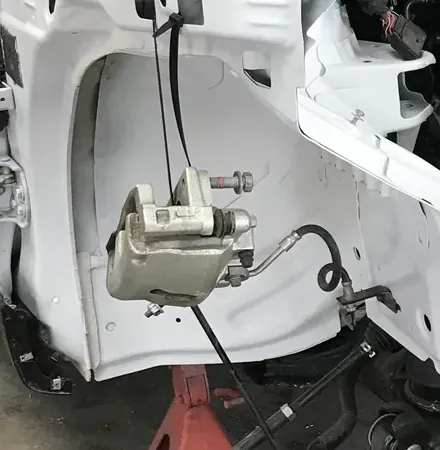
Owner-supplied GMC project archive detail showing a brake caliper in a disassembled wheel area. It supplies component-access context, not a brake inspection finding, installed routing specification, completed repair or clearance to drive.
What to Clarify for Your Vehicle
Arrange assessment or suitable transport when brake condition is uncertain. Ask which affected components were inspected and how the findings shape the plan. Do not use a test drive or the absence of a warning light as a substitute for evaluating suspected physical damage.
Damage near a wheel can make brake inspection relevant
Brake components, hoses, wiring and attachments may be near an impact area. Visible body damage alone cannot establish their condition. A changed pedal feel, warning, leak or braking concern requires prompt professional assessment.
Do not road-test a vehicle with suspected brake damage to demonstrate the symptom. Arrange assistance and appropriate transport. An exterior photo or a scan result cannot certify that the brake assembly is safe.
Make the inspection and findings explicit
Tell the shop exactly what changed and when you noticed it. Avoid diagnosing the concern as a particular part failure; the repairer needs to inspect the actual assembly and follow the vehicle-specific information.
Ask whether the impact area includes relevant brake components and what checks apply after the repair. If additional mechanical work is proposed, request its basis and authorization separately. At handoff, understand any unresolved concern before using the vehicle.
Example: a changed pedal feel after a wheel-area impact
A driver notices a changed brake pedal feel after an impact near a wheel. That is a safety concern to report, not an invitation to drive farther to diagnose it. The shop or appropriate assistance provider needs to advise on assessment and transport.
The repairer should inspect relevant components and use the applicable procedures. A scan may provide supporting information, but cannot independently establish the physical condition of a hose, attachment or other brake component. An exterior estimate photograph also has a limited scope.
Give a factual history of when the change appeared and any warning or visible leak. Avoid naming a particular failed part unless it has been diagnosed. If additional work is proposed, ask what finding supports it and which completion checks apply. Keep the mechanical records with the collision scope. This example explains why an observed braking concern needs prompt professional assessment; it does not provide a driving test or a do-it-yourself repair method.
Related Guidance
Report changes in braking as a transport concern
An impact near a wheel can affect more than the visible panel. Brake components, lines, hoses, attachments and neighboring suspension areas may need assessment, depending on the vehicle and damage. A repairer should determine what requires examination rather than relying on the absence of a dashboard warning or the appearance of the bumper.
Tell the receiving shop about a new brake warning, fluid leakage, unusual pedal feel or an observed change in braking. Explain what happened during necessary movement after the collision; do not take another drive or perform a hard stop to reproduce it. If the vehicle may have a braking problem, arrange professional assistance and discuss transport.
Do not touch an unknown fluid, reach behind a damaged wheel or loosen a brake connection to investigate. An online photograph or message cannot establish braking safety. This guide helps you describe the concern and understand a proposal; it is not a clearance to drive a collision-damaged vehicle.
Keep brake, wheel and suspension findings distinct
A wheel-area impact can produce several related estimate lines. Ask which findings concern the brakes, which concern the tire or wheel, and which concern suspension or mounting damage. Replacing a wheel does not by itself resolve a damaged brake hose, and an alignment adjustment cannot repair a brake component.
The vehicle manufacturer’s information determines the required inspection and repair procedures. Ask whether the proposal addresses the specific affected component and its attachments. A line for diagnostic assessment is different from a line for replacement, and a general description such as mechanical work should be explained before you compare estimates.
Also disclose earlier brake symptoms or recent brake service. Accurate history helps the repairer understand what changed after the event without assuming every concern is collision-related. If additional damage is found during access, request a revised scope that connects the new operation to the finding and makes any pending assessment clear.
Ask how the concern was resolved before handoff
At delivery, ask which brake-related components were assessed and which were repaired or replaced. Ask what applicable checks were completed under the repair procedure and whether any related warning or symptom remains unresolved. A warning that has disappeared is not a complete explanation of a physical repair.
Keep the final invoice and any supplied explanation of brake-related findings with the collision records. If the pedal feel, warning status or braking behavior changes after pickup, contact the repairer promptly and seek appropriate assistance. Do not assume that driving farther will settle a braking concern, and do not perform an owner road test to decide whether the repair is acceptable.
When making a Boudreaux’s request, choose New Orleans or Luling and flag the concern before scheduling an arrival. Confirm how collision-related mechanical assessment will be arranged with that facility. The two shop locations do not establish a promise of every general brake-maintenance service at both sites. The accident help page provides the next step for discussing movement and receiving arrangements.