
BOUDREAUX’S COLLISION · REPAIR EDUCATION
Diagnostic Reports and Repair Authorization
A diagnostic report can identify information requiring follow-up, but it does not itself authorize every recommended operation. Owners should understand what is proposed, what remains uncertain and whether additional assessment has been approved. Payment arrangements are a separate discussion.
Illustration: Diagnostic Reports and Repair Authorization
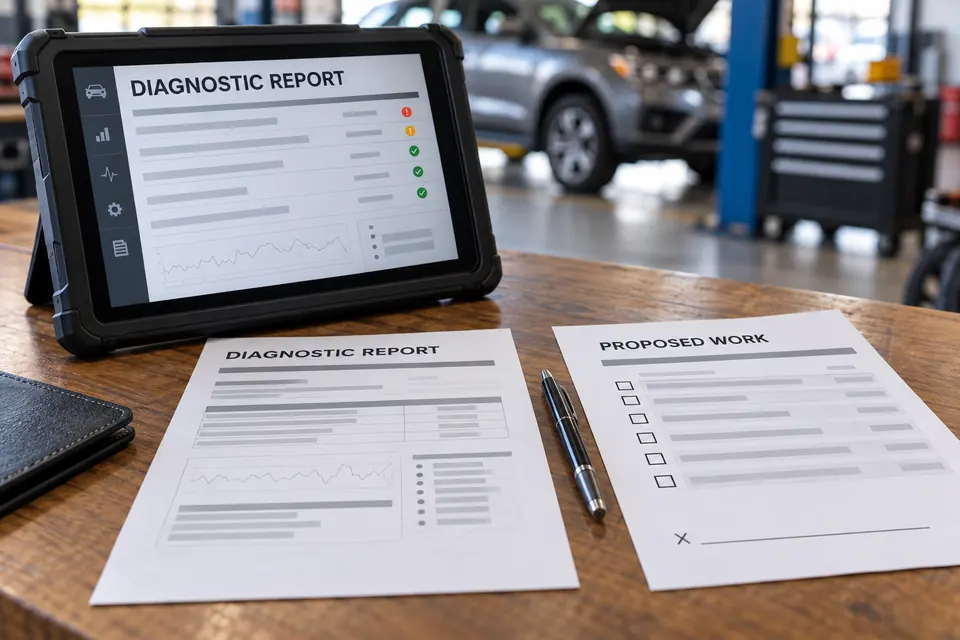
Generated educational illustration: diagnostic report authorization. Not an actual customer repair, diagnostic result, staff member or Boudreaux’s facility.
Connect each report finding to one clear proposed decision
Identify the report’s vehicle, date, system and repair stage before reading the code list. Next, ask which finding supports an actual proposal. A useful explanation connects the observation to the next operation without turning every stored code into a replacement part. If the available report is incomplete, identify the missing information instead of treating an early check as final verification.
For each added item, keep a short decision record: the proposed operation, the reason, the estimate revision being discussed, the person giving instructions and the current decision. A separate diagnostic investigation can be proposed before the correct repair is known. Clarify whether your response authorizes that investigation or a defined repair so the team and owner are discussing the same scope.
If further findings change the proposal, use the new dated revision and retain the earlier one as history. At handoff, compare the final completed-work description with the agreed scope. Ask which item changed, which was not needed and which remains unresolved. If another provider performed an electronic operation, ask how its result is included in the repair file. This keeps technical evidence, proposed work and the owner’s recorded decision traceable.
A report supports a decision; it is not the decision itself
A diagnostic report documents information obtained during a defined check. Its findings may support further diagnosis, a repair or another procedure. The report alone does not authorize work and should not be interpreted as a complete repair proposal.
The owner needs an explanation of what the findings mean for the scope: which issue requires attention, what operation is proposed and what remains uncertain. A list of codes without that connection can create confusion.
Make additional work traceable
When diagnostic findings change the repair plan, the revised estimate or authorization record should identify the proposed operations. A scan, diagnostic labor, a replacement part, programming and calibration are different items, even when they concern the same system.
If a condition cannot yet be diagnosed because the vehicle is disassembled or another repair must happen first, that dependency should be explained. An incomplete stage should not be described as a completed verification.
Questions before approving a revised scope
Ask what the report established, what it did not establish and what work is needed next. Confirm how the proposed work will be authorized and paid for rather than assuming that a claim submission is the same as owner approval.
At pickup, retain the final estimate and relevant diagnostic records together. If a finding remains open, request a clear explanation of its status and next step. Complete records make it easier to understand the repair without relying on a remembered conversation.
Further repair information
Related Guidance
Read a report as evidence, then ask for a proposal
Start by identifying which vehicle, date and repair stage the report concerns. Ask whether it was obtained before repair, during work or as part of completion checks. These records answer different questions. A document from an early disassembled condition should not silently be presented as final verification of the finished vehicle.
Ask the team to explain the finding in ordinary language and connect it to a proposed next step. A report may support more diagnosis, a physical inspection or a specified procedure. It does not automatically authorize a replacement part. The owner needs to understand what is known, what remains uncertain and why the proposed work is relevant.
If several operations concern one system, ask for their separate purposes. Retrieving information, investigating a fault, replacing a component and completing required setup can be distinct items. A long code list should not make those distinctions disappear. Conversely, an owner should not assume separate operations are duplicates solely because they concern the same system.
Use dated decisions to prevent mixed instructions
When the scope changes, identify the revised estimate and the decision awaiting your response. Keep earlier versions as history, not as competing current proposals. If another owner, fleet manager or claim contact is involved, agree on who communicates the authorization. Receiving a report or being copied on an email should not automatically be treated as permission to begin every listed operation.
Ask how the proposed work and payment arrangement relate. The shop can explain technical scope, while a claim representative may need separate documentation for a coverage decision. Do not assume either conversation settles the other. Record what you have approved and ask about any stage that remains paused while a decision or prerequisite is unresolved.
At delivery, keep the final invoice and relevant diagnostic records together. Ask which proposed operations were completed, which changed and whether any finding remains open. A complete file should allow a later reader to understand the sequence without relying on a remembered phone call. If a new symptom appears, identify the circumstances and ask for follow-up rather than treating an old report as a universal diagnosis.
Questions when diagnostic findings change the plan
Example: a report arrives before a revised estimate
Imagine the shop sends a diagnostic report while it is preparing an updated proposal. Receiving that attachment does not make every possible operation an approved repair. Ask which findings are still being interpreted and when the actual proposed scope will be ready. Identify the person who can make the decision and the private channel the team should use.
When the proposal arrives, compare the operation descriptions with the explanation rather than treat the report as a parts shopping list. Ask whether any dependency remains and what your response authorizes next. Retain the report, dated proposal and recorded decision together. At pickup, use the completed-scope documents to understand what actually happened, including any item that was changed or left unresolved. This hypothetical sequence illustrates document handling; it does not claim that a particular scan finding always requires one repair.