
BOUDREAUX’S COLLISION · REPAIR EDUCATION
Trim Clips and Retainers in Collision Repairs
Small clips and retainers help locate trim, liners, covers and seals. A damaged retainer can produce rattles, loose edges or improper fit. Some retainers are designated for replacement after removal, while others require inspection under the applicable procedure.
Illustration: Trim Clips and Retainers in Collision Repairs
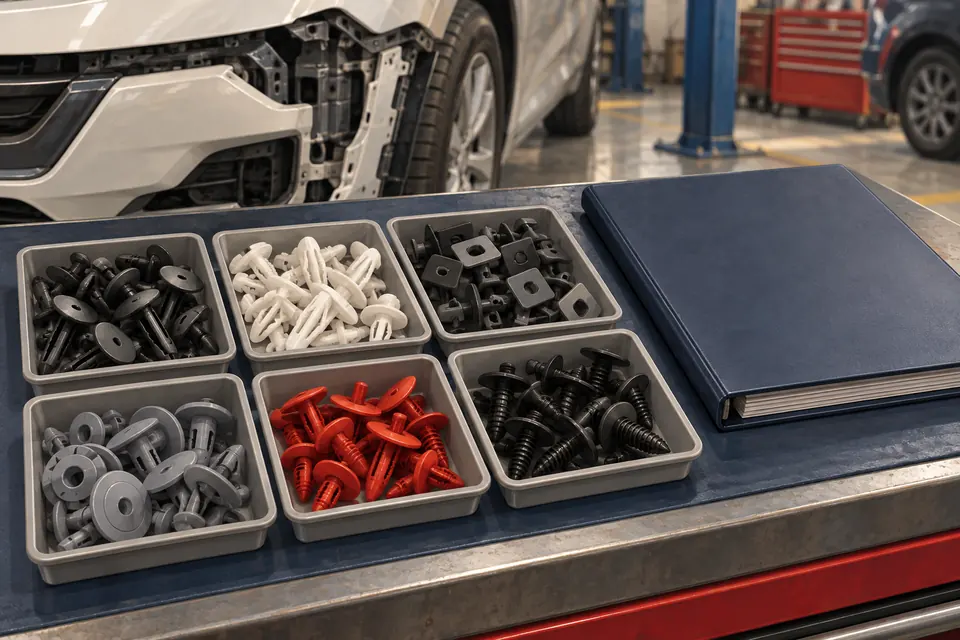
Generated educational illustration: component specific clips and retainers. Not an actual customer repair, diagnostic result, staff member or Boudreaux’s facility.
What to Clarify for Your Vehicle
Ask whether the estimate accounts for required clips and attachment pieces rather than only the large panel. Reusing a damaged clip to avoid a small parts charge can affect the finished assembly. The correct decision comes from the part condition and repair information, not its size or visibility.
A small attachment can explain a visible fit problem
Clips, retainers and fasteners hold trim and other components in their intended positions. Their small size does not make them interchangeable or unnecessary. A damaged attachment can create a separate question from the condition of the visible trim piece.
Tell the shop whether you noticed looseness, a displaced edge or a new noise after the collision. The correct assessment identifies the actual attachment and mounting location rather than assuming one generic clip fits every position.
Do not push trim repeatedly to test whether it will stay in place. That can alter the observation and does not establish that the underlying attachment is appropriate for reuse.
Understand what a part or hardware line includes
An estimate can list the trim piece and its attachment hardware separately. Ask whether the replacement component includes the needed retainers or whether those are supplied independently. That helps distinguish a complete installation plan from a part description alone.
Reuse depends on the component and applicable requirement. A piece looking intact from outside does not explain how it behaved during removal or whether its attachment is still suitable. Ask what was found rather than assuming all removed clips are reusable or all must be replaced.
If a mounting location is damaged, identify that issue separately. A new clip cannot be treated as an explanation of an affected hole, bracket or supporting area.
An illustrative fit concern after reassembly
Imagine a trim edge that sits away from an adjoining panel. The cause could involve a retainer, the trim itself or its mounting area. The observation points the assessment to a location; it does not choose the repair in advance.
A useful report names the piece, location and timing. If there is also a rattle, describe when you already heard it without driving specifically to reproduce it. Let the shop review the attachment and surrounding condition.
That approach makes the follow-up more precise than asking for all trim to be replaced. The repair decision should address the actual finding and applicable parts.
What to clarify before calling the installation complete
- Which attachment type and location are involved?
- Is the retainer supplied with the new component?
- Was the mounting area also assessed?
- What supports reuse or replacement of removed hardware?
- Which fit and operation checks apply to this piece?
Keep the specific component name in your repair notes. If an estimate revision adds hardware, ask whether it was identified during access or required by the installation procedure.
For a related hidden component, see wheelhouse liners and splash shields.
Related Guidance
Make a noise or loose-edge report specific
If a rattle or loose edge appears after delivery, name the part and where the observation occurs. State whether it was present before the collision, during intake or only after handoff, using the history you actually know. If you do not know the exact trim name, a wider photograph and location are enough to start the discussion. Avoid declaring that every noise in the area comes from a clip.
Keep the final hardware and trim scope with your follow-up. Ask who will review the condition and whether the assembly needs an appointment before further use. A displaced piece near a tire or another moving part deserves a discussion about assessment, not an improvised roadside attachment. This owner guide helps communicate the concern; it does not provide a fastening method or a decision about reuse for your vehicle’s particular retainers.