
BOUDREAUX’S COLLISION · REPAIR EDUCATION
Wheelhouse Liners and Splash Shields After a Crash
Plastic wheelhouse liners and underbody shields protect areas from road splash and can guide airflow. Broken clips, missing sections or a shield contacting a tire can matter even though these pieces are not painted body panels. Their condition is often obscured in exterior photographs.
Illustration: Wheelhouse Liners and Splash Shields After a Crash
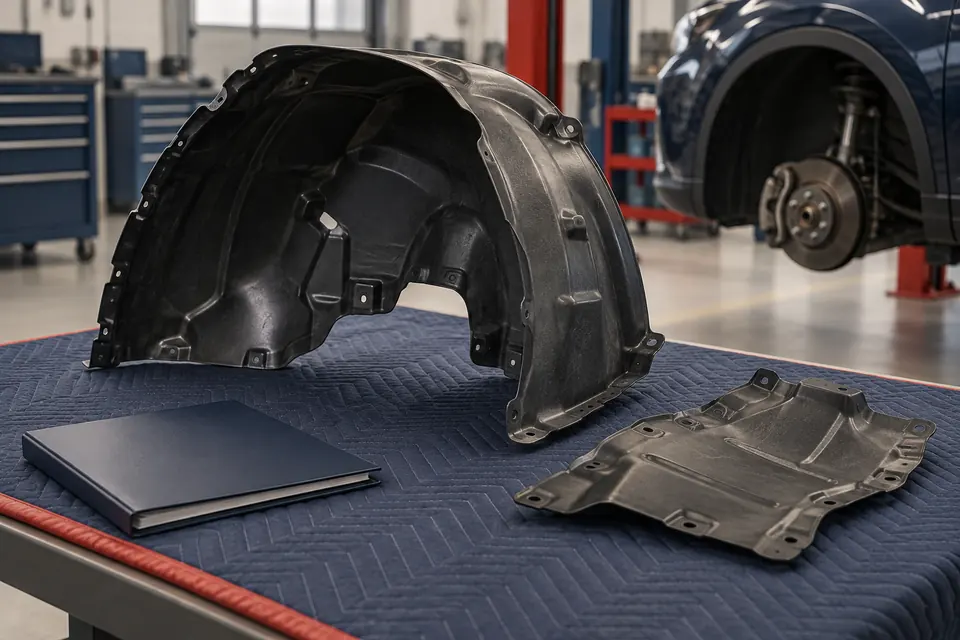
Generated educational illustration: wheel liner and splash shield assessment. Not an actual customer repair, diagnostic result, staff member or Boudreaux’s facility.
What to Clarify for Your Vehicle
Ask whether damaged liners, retainers and shields are included in the parts list and whether the mounting points are intact. Do not reach under a damaged vehicle to pull off a dragging shield. Report rubbing or hanging material and arrange assessment rather than relying on appearance alone.
The hidden liner is more than the outside panel
A wheelhouse liner or splash shield is distinct from the painted outer panel. The assembly may include clips, fasteners and adjoining pieces. A loose or displaced shield deserves its own description because it can be difficult to judge from a full-vehicle photograph.
Tell the shop where you noticed the piece and whether it appeared after the collision. Report hanging material, a newly visible opening or rubbing you already observed. Do not drive again to reproduce rubbing or reach into a wheel area to inspect it yourself.
The assessment should identify the affected shield and attachments rather than assume that every underside piece is one generic panel.
An attachment issue and a damaged shield are different findings
A part can be displaced because its fastener is affected, because the shield is torn or because an adjoining mounting area moved. Those possibilities can lead to different scope descriptions. Ask what was found and which component is being repaired, replaced or reattached.
If a replacement piece is listed, check what hardware is included. A shield and the clips holding it can appear on separate lines without necessarily being duplicate items. The explanation should identify the work around the part.
Also ask whether the nearby damaged area raised another assessment question. The liner can be one part of a larger impact area, but its condition alone does not prove damage to every adjoining system.
How to describe the concern from a safe position
An illustrative useful report is: “After the impact, there is a piece hanging near the right front wheel that was not there before.” That gives the shop a location and timing. It is more useful than naming a specific broken part without knowing which piece it is.
If it can be photographed from a safe standing position, include the wider area and a closer view without placing yourself under the vehicle. Explain whether the vehicle has already been moved and whether you noticed any contact.
If safe driving or transport is uncertain, discuss the condition before trying to reach the shop. An image cannot establish tire clearance or the security of the part.
What to ask before treating the area as finished
- Which liner or shield is affected?
- Were its attachments and mounting locations assessed?
- What hardware accompanies the replacement?
- Does the adjoining impact area require further review?
- What remains before the vehicle is ready for the next stage?
Keep the identified part name with your estimate so a later update refers to the same piece. If you notice a new noise after handoff, report when and where it occurred rather than crawling underneath to locate it.
Use clips and retainers for the related attachment question.
Further repair information
I-CAR: wheel liner repairability
General background does not replace the applicable information or assessment for your vehicle.
Related Guidance
Keep the underside work visible in the repair explanation
Unpainted pieces can be easy to overlook when owners focus on the exterior finish. Ask the shop to explain the identified liner, shield and hardware work in the final scope. If the plan changed after access, retain the supplement and the finding that produced it. A polished bumper photograph does not describe the condition of every component beneath it.
If a new noise or displaced edge appears after delivery, identify the location and circumstances already observed. Avoid crawling underneath or pulling the part to prove the concern. The shop can review the repair record and determine the next assessment. Keep shield observations separate from guesses about suspension or structural damage; the presence of a loose liner is a reason to assess the affected area, not proof that every adjacent system has the same fault.