
BOUDREAUX’S COLLISION · REPAIR EDUCATION
Strut Tower Damage and Structural Assessment
A strut tower is connected with suspension mounting and surrounding body structure. Damage near this area can affect geometry and the condition of adjacent attachments. An alignment reading alone does not describe every structural or material concern.
Illustration: Strut Tower Damage and Structural Assessment
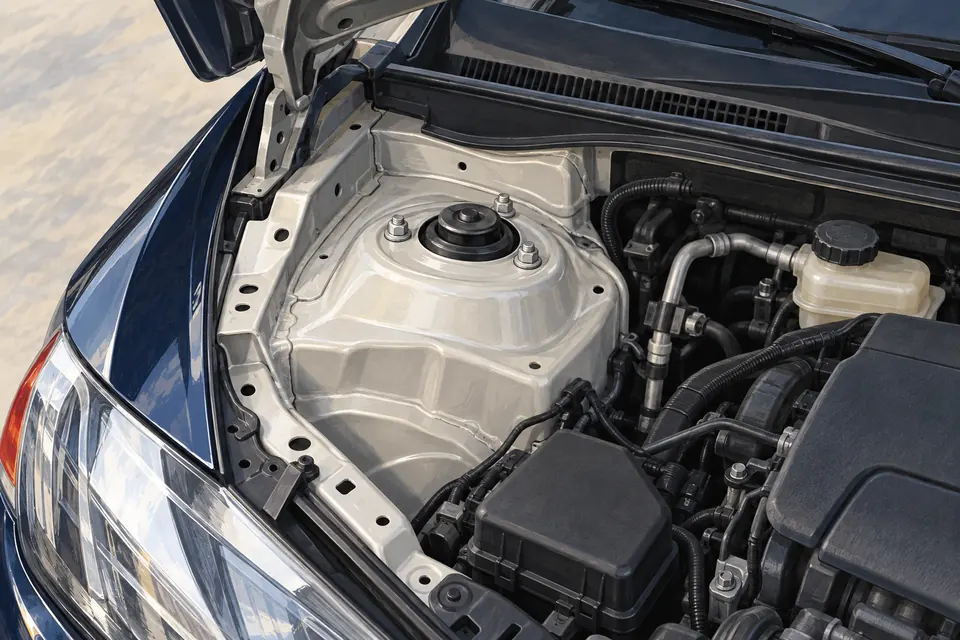
Generated educational illustration: strut mounting area assessment. Not an actual customer repair, diagnostic result, staff member or Boudreaux’s facility.
What to Clarify for Your Vehicle
Ask which tower, surrounding apron and mounting areas need measurement or inspection and how the findings affect repair versus replacement. Do not interpret an acceptable alignment adjustment as proof that all mounting structure is intact. The correct vehicle-specific procedure governs permitted work.
The tower, mounting location and suspension part are separate questions
A concern near a strut tower may involve the surrounding structure, a mounting location or a suspension component. Those are not interchangeable descriptions. Ask which condition has been confirmed and what assessment supports it.
Boudreaux’s uses OEM parts for structural and suspension components. Ask which identified replacements fall within that policy and clarify any separate claim review or payment responsibility.
The vehicle’s construction and current repair information matter. A repair method applicable to one component or model should not be assumed appropriate for another. The location’s role in the vehicle is more important than a general impression that the metal can be moved back.
A wheel-alignment result can provide relevant information without independently describing every condition in the adjoining body structure. Ask which dimensional or component questions remain.
Why an estimate needs a specific finding
Suppose an impact changes the position of a wheel and raises a concern near the tower. The plan should distinguish what is observed, what the assessment establishes and what treatment is permitted for the affected part. A broad line saying “repair suspension area” leaves those decisions unclear.
Ask whether access, measuring or another assessment is still needed. If the proposal involves structural work, request the relevant component description and explanation of the method. Do not assume that a cosmetic repair to an adjoining panel addresses the tower concern.
The example explains planning, not the condition of your vehicle. Avoid test driving to reproduce symptoms when safe operation is uncertain.
Questions for the vehicle-specific plan
- Is the confirmed concern in structure, a mount or a suspension part?
- What reference or procedure applies to that component?
- Which access or measurement remains?
- What supports the proposed repair or replacement?
- Which dimensional, alignment or other applicable checks follow?
Keep the explanation with the current estimate and any reports. The repair conversation should connect the affected location to the actual requirement, rather than use a general label as a substitute for the plan.
Related Guidance
Ask how the proposed operation is supported and verified
If the scope includes work on the tower or adjoining structure, ask which finding supports it and which current vehicle procedure determines the operation. Do not assume a universal straightening, sectioning or replacement method applies. Materials and vehicle-specific restrictions matter to the decision, and the name of structural equipment does not independently authorize work on every component.
Keep the relevant report, scope revisions and repair explanation together. At delivery, ask what relevant checks were completed and how a later concern should be reported. An owner should be able to distinguish the structural work, mechanical assessment and any applicable alignment or electronic operations in the record. If control, noise or fit changes are noticed afterward, describe the location and timing without attempting another driving test. The selected shop can discuss the appropriate review for that observation; this page does not clear a vehicle for operation.