
Illustration: Collision Damage Near the Fuel Door: What to Report
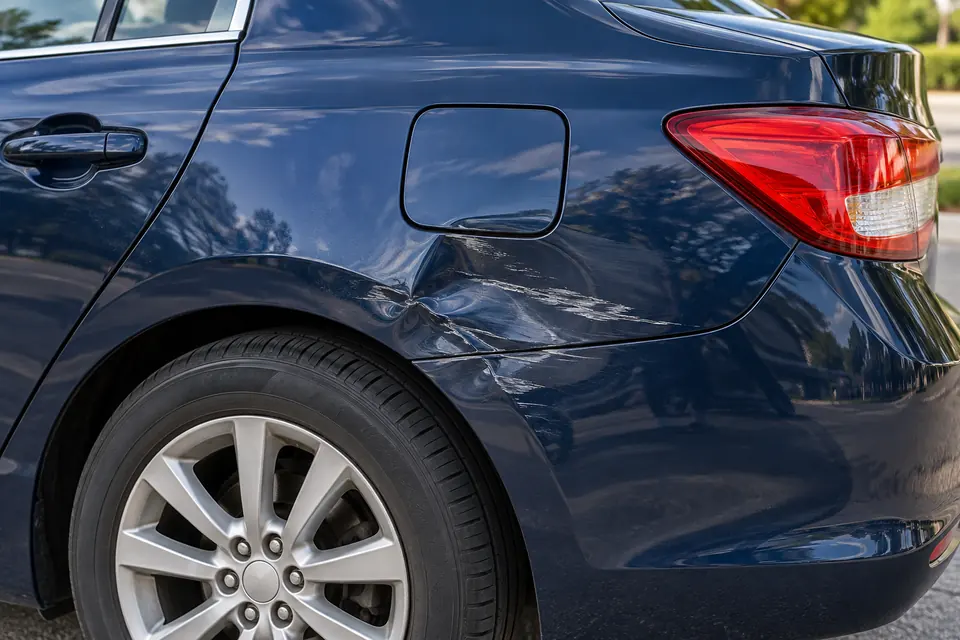
Generated educational illustration: fuel door quarter impact. Not an actual customer repair, diagnostic result, staff member or Boudreaux’s facility.
Owner checklist
By Boudreaux’s Collision · · 5 minute read
A dent near the fuel door should be assessed as an area of damage, not only as an exterior blemish. Report changes in filler-door fit and any fuel odor or leakage. If there is an active leak or other immediate hazard, move away and arrange emergency assistance rather than continuing a repair-photo session.
What the symptom does—and does not—tell you
The outer quarter panel, filler opening, attachments and nearby components have different roles. Damage that changes the opening may affect how the fuel door fits without explaining the condition of everything behind it. The visible dent cannot establish whether the filler assembly or surrounding structure is unaffected. Repair planning also needs to consider access, the selected repair method and the manufacturer's precautions for the affected area. An online image cannot provide clearance to use a damaged fuel system.
Three useful details to collect
- Record the location of the impact in relation to the closed fuel door.
- Report new odor, visible wetness or an opening that no longer fits normally.
- Ask for transport guidance before driving a vehicle with a suspected leak.
How to discuss the next step
Tell the shop which side was struck, whether the fuel door opened normally before the event and whether you noticed an odor while the vehicle was stationary. Do not remove or manipulate filler components to take photographs. Ask whether the opening and adjoining attachments require assessment and how any safety concern changes transport arrangements. If the vehicle also has a charging port or alternative propulsion equipment, identify that equipment at intake. Keep appearance questions separate from the decision about safe handling.
Keep the three fuel-door questions visible
- Panel appearance: Where is the dent or scrape relative to the closed fuel door and wheel opening?
- Opening behavior: Did the fuel door’s fit or normal operation change after the impact?
- Handling concern: Was there new odor, wetness or another suspected leak? Report this before discussing an ordinary estimate visit.
For the underlying process, read Transport and accident-recovery arrangements.
Disclose the concern before a transport is dispatched
Give the selected shop and transport provider the vehicle identification, struck side and known condition. Identify a suspected leak or odor explicitly; the request should not arrive as a paint-only appointment while the provider is unaware of the concern. Confirm the receiving shop address and the handling arrangement directly.
If the timing of an observation is uncertain, say so. Keep an earlier fuel-door problem in the history rather than silently attributing every condition to this impact. Do not investigate a possible fuel leak yourself to make the report more detailed; use appropriate assistance for an immediate hazard.
Choose New Orleans or Luling
New Orleans shop · 2150 Earhart Boulevard, New Orleans, LA 70113 · (504) 309-3092
Luling shop · 101 4th Street, Luling, LA 70070 · (985) 331-0707
Request an estimate conversation or contact your preferred shop. Confirm the vehicle-specific service arrangement and any transport needs directly.
Related services and detailed guides
Questions about this situation
Vehicle-specific information
Repair requirements should follow the applicable manufacturer information. For technical context, consult I-CAR’s Repairability Technical Support resources. These resources support informed questions; they are not a substitute for a qualified assessment of your vehicle.
Prepare a clear account of the fuel-door impact
Begin with the side of the vehicle, the direction of the impact and what you noticed afterward. A report such as “the left rear quarter was hit, the fuel door sits higher at its back edge, and I noticed a new odor while parked” is more useful than assuming the problem is only paint damage. Record whether these changes appeared immediately or later. Identify the vehicle accurately, including alternative-fuel or charging equipment when applicable.
Keep the safety concern separate from the cosmetic request. A damaged opening, an odor and a visible dent are different findings; no photograph can clear the fuel system for use. Do not pry the opening, remove the cap to investigate or continue a photo session around an active leak. Ask for appropriate assistance and transport before arranging the body-repair visit.
During the estimate conversation, ask which parts of the opening and adjacent assembly can be assessed initially, whether additional access is required and how changes to the scope will be explained. The proposed refinish area should be documented separately from any component replacement. At pickup, discuss the work performed and any operating instructions rather than treating the restored appearance as proof that every nearby component was unaffected.