
Illustration: Frame vs Unibody Construction
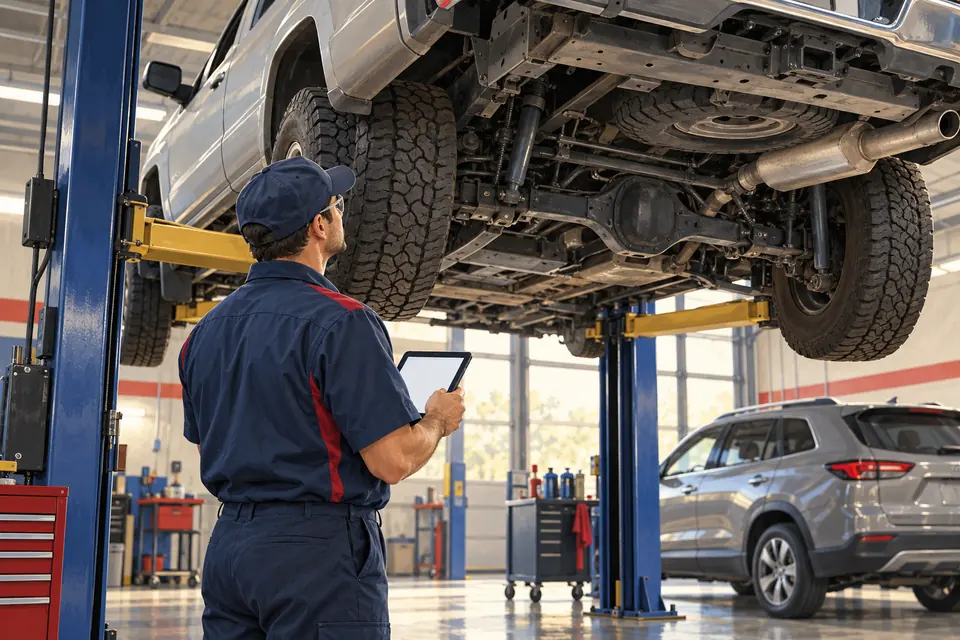
Generated educational illustration: frame unibody vehicle identification review. Not an actual customer repair, diagnostic result, staff member or Boudreaux’s facility.
Does every car have a separate frame?
A body-on-frame vehicle uses a separate frame, while a unibody integrates important load-carrying structure into the body. Both can have structural collision damage, but their repair requirements are not identical.
The phrase “frame damage” can therefore be imprecise. Ask which actual component is affected, how its material and geometry are assessed and what repair method is permitted. An outer panel lining up does not establish that every underlying structural reference is correct.
How This Fits Into the Repair Plan
An estimate is easier to follow when its component names match the explanation. Ask the shop to identify the actual member or body area before discussing a method, rather than treating frame or unibody as the whole scope.
Related Repair Guidance
Use the component name instead of a broad label
When an estimate mentions structural damage, ask which component is affected and where it sits on the vehicle. A broad phrase such as frame damage can refer to different concerns in everyday conversation. The component name and location give you a clearer basis for understanding the findings than trying to interpret the label alone.
Body-on-frame construction uses a separate frame and body. Unibody construction incorporates important load-carrying structure into the body assembly. Those basic descriptions help explain the layout, but they do not identify the condition of a particular vehicle after an impact. Both the vehicle’s construction and the actual damaged component need to be established before discussing the proposed repair.
A replaceable exterior panel, an inner reinforcement and an adjoining structural member can occupy the same general area while serving different roles. Ask the estimator to distinguish them in the explanation. A photo or diagram with the relevant area identified can make the estimate easier to follow without requiring you to memorize the names of every part.
Use the year, make, model and VIN when requesting information. A familiar model name does not guarantee the same construction across all generations or configurations. The purpose is to identify your vehicle accurately before comparing it with an example from another repair.
Construction does not decide the repair method by itself
Knowing the vehicle is unibody or body-on-frame is a starting point. The next questions concern the affected component, its material, the observed damage and the manufacturer’s information for that component. Ask what supports a proposed repair or replacement rather than assuming that the construction category settles the decision.
For a hypothetical comparison, two vehicles may both be described as having rail damage while their component layouts and permitted procedures differ. The shared phrase does not establish that the same approach is appropriate for both. This is why a recommendation for another year or model is not enough to explain your own estimate.
Ask the shop to separate dimensional assessment from material and attachment assessment. A structural part’s position is one question; whether its condition permits a particular operation is another. Good panel fit can be useful information while still leaving questions about underlying references and joints.
If the estimate includes work in adjoining areas, ask how those operations relate to the damaged component. Access, attachment and finishing requirements can make the scope larger than the single part name suggests. The answer should connect the work to the actual repair plan rather than a generic description of how every frame or unibody is repaired.
Review the plan without turning terminology into a verdict
Ask for a plain-language summary of the finding, the proposed operation and how the result will be checked. Keep that explanation with the current estimate. If a later revision changes the approach, ask which new information changed the decision and compare the dated versions.
Do not treat the phrase structural damage as a complete answer about repairability, cost or scheduling. Those require assessment of the vehicle and the proposed work. Ask which questions have been resolved and which remain open. This gives you a practical path forward without relying on a conclusion drawn from a single exterior photograph.
If you have records of an earlier repair, provide them and identify the area involved. If the previous work is uncertain, state that uncertainty. Accurate history is more useful than guessing whether an older mark or part belongs to the current collision.
Discuss transport and handling with your selected Boudreaux’s shop when the vehicle’s condition is uncertain. The terminology in an estimate is not permission to drive it. New Orleans and Luling are the two real locations; confirm where the inspection and any proposed operations will be arranged before dropping off or sending a tow.
Questions About Frame vs Unibody Construction
Technical Reference
I-CAR Repairability Technical Support. Manufacturer requirements for the exact vehicle control the repair method. A reference link does not imply Boudreaux’s certification or affiliation.