
BOUDREAUX’S COLLISION · REPAIR EDUCATION
Bumper Absorber Inspection After an Impact
Foam or other energy-absorbing material between a bumper cover and reinforcement can be crushed without leaving a dramatic exterior dent. An absorber is a functional part of the bumper assembly, not merely packing material. Its condition should be evaluated alongside the reinforcement and attachments.
Illustration: Bumper Absorber Inspection After an Impact
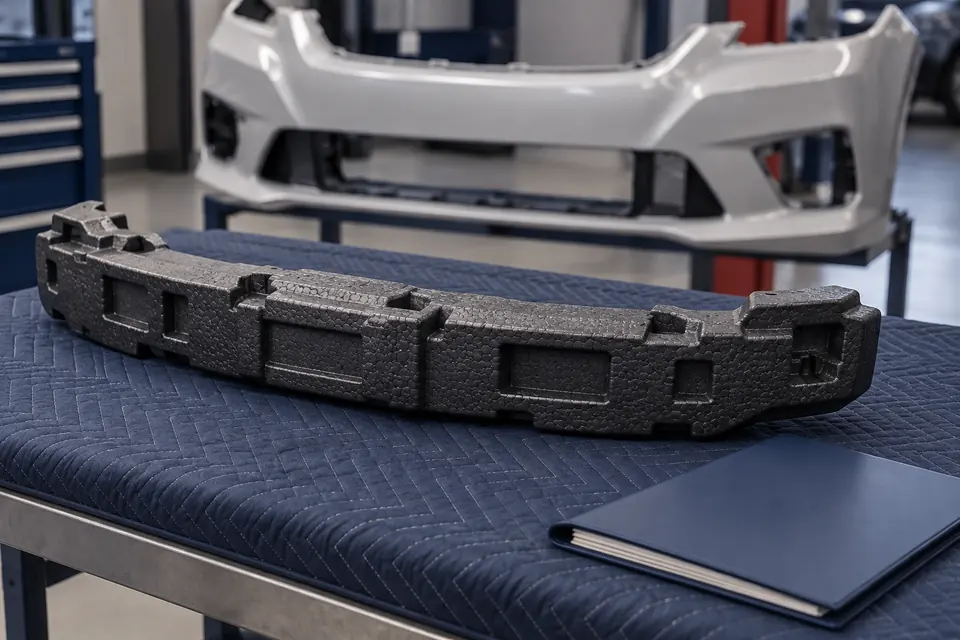
Generated educational illustration: bumper energy absorber review. Not an actual customer repair, diagnostic result, staff member or Boudreaux’s facility.
What to Clarify for Your Vehicle
A photograph of the installed cover cannot establish whether the absorber is intact. Ask whether access revealed compression, cracks or displaced pieces and whether the correct replacement is specified. Do not assume an undamaged-looking cover means every underlying part is reusable.
An absorber cannot be judged from the cover alone
An energy absorber sits within the bumper assembly and may be hidden from an exterior photograph. Its condition is a separate question from the finish and shape of the cover. A cover that springs back does not demonstrate that the concealed material has done the same.
The absorber’s exact material, configuration and relationship to nearby parts depend on the vehicle. Identifying the correct part matters more than assuming every piece of foam or plastic behind a bumper has the same role. Ask the shop to identify the component in the repair explanation.
I-CAR describes damaged energy absorbers as replacement concerns rather than cosmetic pieces to ignore. The vehicle’s current repair information governs the actual approach; appearance alone is not a reuse decision.
What a useful inspection explanation should tell you
Ask whether access revealed a change to the absorber and whether adjoining reinforcement, brackets or mounting areas were also assessed. The explanation should identify what is confirmed rather than imply that every concealed part is damaged because one part is affected.
It is also useful to distinguish “not yet inspected” from “inspected and undamaged.” Those statements can lead to different estimate stages. If access is still needed, the shop can explain why a final decision remains conditional.
A photograph taken after access can help you understand the finding when the shop provides one. It should be discussed in context: which part is shown, where it fits and what condition supports the proposed operation.
How absorber replacement differs from a cover repair
An illustrative estimate might contain refinishing of an exterior cover and replacement of an absorber beneath it. Those lines address different components. Replacing one does not automatically mean the other must also be replaced, and repairing the outside does not establish that the hidden piece is reusable.
Compare the part description and location before treating the two operations as alternatives. Ask whether the replacement assembly includes the absorber or whether it is supplied separately. That can explain why two proposals describe parts differently.
The cost discussion should follow the identified scope. A general statement that “the bumper is repaired” leaves too much ambiguity about what was checked and which piece was treated.
Keep an owner’s record focused on the finding
- Record the exact absorber or assembly description shown on the estimate.
- Ask when its condition was established.
- Keep any explanation of related mounting or reinforcement damage.
- Save the revised estimate if a concealed finding changed the plan.
- Ask which next step remains before reassembly.
Do not try to compress, glue or reshape material yourself to test whether it is usable. This guide is for understanding a professional repair conversation, not for performing a bumper repair.
For the difference between the visible and underlying pieces, use bumper reinforcement versus cover. For your actual vehicle, start with safe photos and an estimate request.
Further repair information
I-CAR: bumper absorbers and reinforcements
General background does not replace the applicable information or assessment for your vehicle.
Related Guidance
Ask what the replacement includes and what remains to be checked
If an absorber is listed, ask whether its attachments or related components are separate parts and whether the proposed assembly includes them. This can explain line-item differences without treating all small hardware as duplicate charges. If a mounting area is affected, ask how that condition is addressed; installing a new absorber does not explain the treatment of every part around it.
At delivery, keep the final scope and any revised findings with the vehicle record. A repair photograph can illustrate work, but it is not a substitute for the inspection and vehicle-specific requirements. If a new exterior fit problem or noise appears, report the location and timing to the shop. Do not remove the cover to check the absorber, and do not drive to reproduce a condition that raises a safety concern.