
THE FULL REPAIR JOURNEY
Where Vehicle Reassembly Fits
- Assessment and any required access
- Repair planning and authorization
- Relevant structural and body work
- Refinishing where needed
- Reassembly
- Applicable diagnostic and setup operations
- Relevant verification
- Delivery and owner handoff
A repair can involve these stages. The actual plan and vehicle-specific requirements determine which are needed and their sequence.
BEFORE, DURING & AFTER
What Happens at This Stage
1
BEFORE
What Comes Before
Body, structural and refinishing operations that required parts to be removed should be completed before final reassembly begins.
2
DURING
What Happens Here
Removed components, trim and connected systems are returned to their proper positions according to the repair plan and applicable vehicle information.
3
AFTER
What Comes Next
After reassembly, the vehicle can proceed to applicable diagnostic checks, calibration, quality control and final delivery preparation.
WHAT INFORMATION CAN CHANGE
Identify the attachment or installation dependency
If reassembly is waiting on an item, ask which assembly it belongs to, whether the item has arrived and what operation depends on it. Separate parts availability, physical installation and any later setup so an almost-done update has a clear meaning.
TECHNICAL & MANUFACTURER CONSIDERATIONS
Following the Vehicle’s Own Repair Information
Where applicable, this stage is carried out with reference to the vehicle manufacturer’s repair information, not a one-size-fits-all shortcut.
Illustration: Vehicle Reassembly
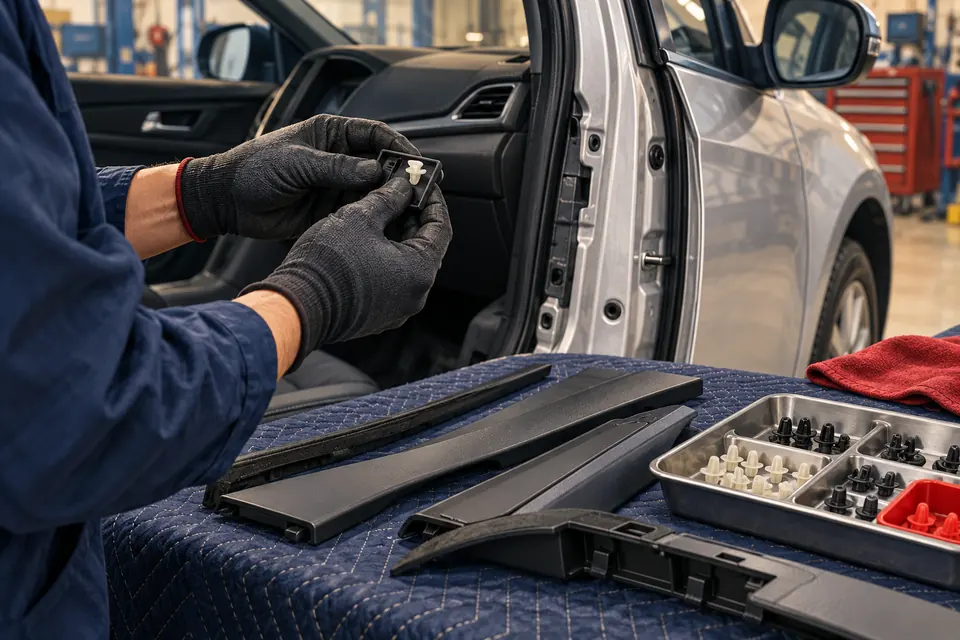
Generated educational illustration: vehicle reassembly trim attachment review. Not an actual customer repair, diagnostic result, staff member or Boudreaux’s facility.
Reassembly follows the requirements of the affected components
Reassembly returns removed components and related systems to the positions and condition required by the repair plan. Ask which assemblies were involved and what relevant installation information applies. Visible pieces being back on the vehicle is one observation, not a complete explanation of every operation.
Part identification and attachment requirements are separate questions. A main replacement component can need related items or specified installation operations. Ask the estimator to connect those lines with the assembly rather than assuming the largest part description contains every detail.
Some fasteners, clips or other items are specified for one-time use. I-CAR’s one-time-use parts guidance explains why an item can require replacement even when it appears intact. The actual vehicle information identifies which items apply to the work.
For a hypothetical assembly, a large visible part may be ready while a required attachment remains outstanding. The size of that item does not establish whether it matters to completing the assembly. Ask which operation depends on it and what milestone comes next.
The sequence can affect access, protection and setup
Ask what relevant work must be complete before an area is closed or reinstalled. Protection of disturbed surfaces, attachment work and checks of an accessible area can depend on the procedure and sequence. The plan should address those requirements while the necessary access is available.
Components near wiring, cameras or sensors can create separate inspection or setup questions. Ask which system was affected and which operation is required after the physical work. A scan, a calibration and a fit check should not be described as one interchangeable task.
If an item or requirement remains unresolved, ask how it affects progress. A useful update identifies whether the issue concerns parts identification, arrival, physical installation or a later check. It is more informative than simply saying reassembly is almost done.
Tell the shop about a known modification or earlier repair in an area being reassembled. Share records you have and identify uncertainty. That history gives the team context without asking an owner to prescribe an installation method.
Reassembly leads to relevant verification and handoff
Ask how the completed assembly and any separate checks relate to the final plan. Relevant fit, finish and affected function should be discussed in their own context. A report can support a particular operation while still leaving another inspection question to answer.
At pickup, refer to any opening, trim, warning or operating concern you described at intake. Ask how it was investigated and whether a follow-up remains. Keeping the original observations with the final repair documents makes that conversation easier to follow.
If a task could not be completed, ask about its status and the next action before assuming the vehicle is ready for ordinary use. Discuss handling directly with the shop rather than treating the presence of the visible panels as clearance.
Keep the final estimate or invoice, supplied records and agreed follow-up together. When a question arises later, identify the vehicle and repair date and explain the specific area or operation you want discussed.
For Boudreaux’s, confirm the receiving, repair and pickup arrangements with the New Orleans or Luling location handling the vehicle. This page explains how to ask about the work; it does not prescribe fastener values, setup steps or an identical specialist-service arrangement for every vehicle at both shops.
FREQUENTLY ASKED QUESTIONS
Vehicle Reassembly FAQs
Why Order and Documentation Matter
Components may have specific fasteners, clips, torque requirements or installation procedures. Some parts can be one-time-use or require inspection before reuse, depending on the vehicle and repair procedure.
Electronics and Sensors During Reassembly
Bumpers, mirrors, lamps, windshields and other areas can contain wiring, cameras or sensors. Reassembly therefore may intersect with diagnostic checks or calibration requirements when those systems were affected.
Reassembly Leads Into Final Verification
The vehicle is not finished simply because all visible pieces are installed. Fit, function, warning indicators and any repair-specific diagnostic, alignment or calibration requirements still need to be considered.
How This Fits the Larger Repair
The correct next step depends on the vehicle and documented damage. Learn more about collision quality control, review our Repair Education resources, or start an estimate request with clear photos and vehicle information.
This guide explains general collision-repair concepts and does not claim that every vehicle requires the same procedures or that every capability is performed at every Boudreaux’s location.