
BOUDREAUX’S COLLISION · REPAIR EDUCATION
Used Parts: Fit, Condition and Included Components
A recycled assembly can vary in condition and in the components included with it. The source label does not establish whether brackets, wiring, seals or small parts are present and usable. Suitability also depends on the exact vehicle and the allowed repair requirements.
Illustration: Used Parts: Fit, Condition and Included Components
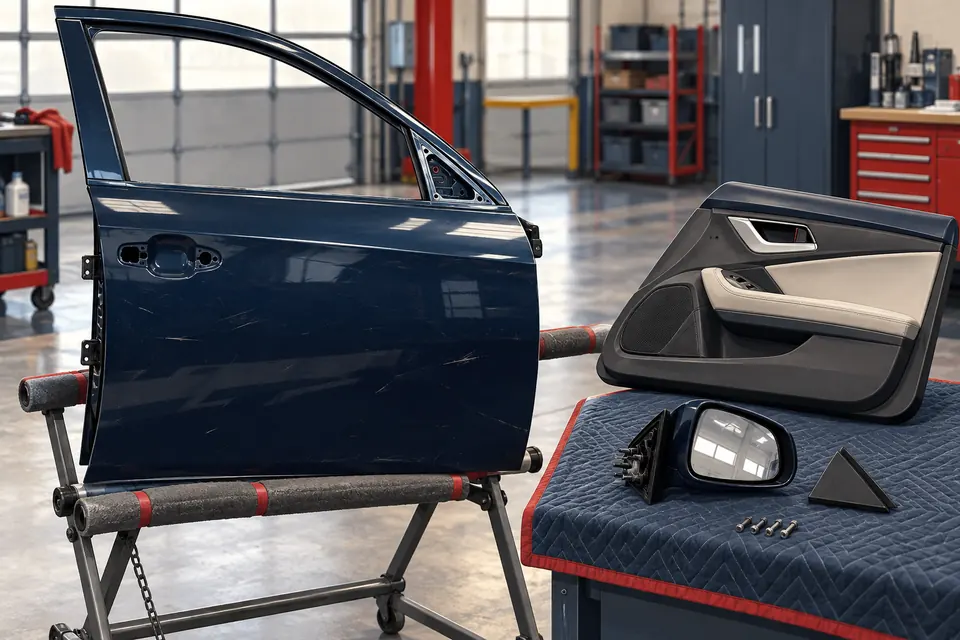
Generated educational illustration: assembly contents and condition review. Not an actual customer repair, diagnostic result, staff member or Boudreaux’s facility.
What to Clarify for Your Vehicle
Ask what condition checks are being performed, which pieces are included and whether any required new items remain separate. A used assembly should not be described as complete merely because its large outer component is present. Policy payment and technical suitability are separate questions.
Boudreaux’s uses OEM parts for structural and suspension components. Clarify the identified part, source, condition and applicable requirements, together with any separate claim review or payment question.
A used part description needs condition and configuration
A recycled or used component should be discussed as a specific part with an applicable configuration and assessed condition. The term “used” alone does not identify what equipment is included, which prior condition is known or whether the component is appropriate for the repair.
Ask what the proposed assembly contains and how it relates to the actual vehicle. A low price is not a substitute for matching the required part and explaining its condition. Likewise, a new-versus-used label does not answer every repair-method question.
The applicable vehicle requirements still matter. Do not assume that every component category can be reused merely because a supplier lists one.
Compare the complete proposed scope
An illustrative door assembly might be supplied with some components and without others. Comparing it with a different assembly requires understanding the included content, relevant condition and work needed to prepare or install it.
Ask which additional operations remain. A supplied assembly is not necessarily a finished, color-matched installation. If a different part source is proposed during planning, clarify whether it changes the component description or another part of the scope.
Keep the revised description and explanation with your estimate. It should be possible to understand what was proposed without relying on a broad statement that the entire used assembly is equivalent in every respect.
Questions for a recycled-part proposal
- What exact component and configuration are proposed?
- What relevant condition has been assessed?
- Which pieces are included or excluded?
- What vehicle-specific requirements affect reuse?
- Which preparation, finishing and installation operations remain?
If the proposal is part of an insurance discussion, keep repair suitability and the insurer’s payment decision distinct. Ask each party to address the specific item rather than assuming that a payment allowance establishes every technical condition.
Related Guidance
Keep repair, coverage and any supplier terms distinct
Ask the repairer to explain the proposed application and any operations needed around the supplied component. If insurance is involved, ask the insurer to explain its claim decision under the policy. A parts source label or approved payment amount is not a substitute for the vehicle-specific repair explanation. Those discussions should remain connected without being treated as the same decision.
Confirm any supplier or repair terms actually provided rather than assuming a universal warranty for all recycled assemblies. Retain the final description, relevant revisions and written terms with the vehicle record. If a fit or function concern appears after delivery, report the specific observation and timing without selecting the source category as the cause. Do not dismantle the repaired assembly to investigate it yourself. A clear record supports review of the actual condition and arrangement.