
Illustration: Parts Authorization and Insurance Repair Planning
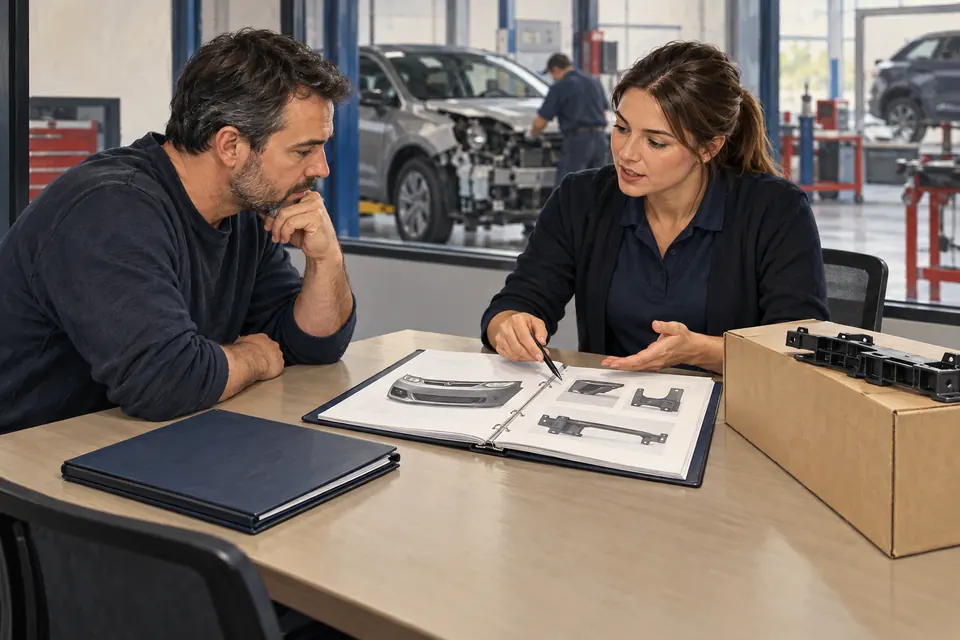
Generated educational illustration: parts authorization current scope review. Not an actual customer repair, diagnostic result, staff member or Boudreaux’s facility.
Does an initial estimate authorize every later repair item?
Parts authorization concerns approval to proceed and who will pay for the proposed parts. It is separate from the technical decision about what the vehicle requires.
Ask the shop and insurer which parts are documented, which approvals are outstanding and whether availability changes the plan. Record the answers in writing. Choosing a shop or receiving an initial estimate does not by itself resolve every coverage, payment or authorization question.
How This Fits Into the Repair Plan
Name the part, source and supplied configuration in the current dated proposal. Keep technical requirements, permission to proceed and the actual claim-payment decision clear when the description changes.
Related Repair Guidance
Identify what is being authorized
Boudreaux’s uses OEM parts for structural and suspension components. Clarify the actual structural or suspension lines and any separate insurer review or payment responsibility.
A parts proposal should name the actual component, source and supplied configuration clearly enough to review. Ask what is included and what related pieces remain separate. A broad panel or assembly label does not explain every item in the installed scope.
Technical suitability, claim review and owner authorization are different questions. Ask which findings and applicable requirements support the part and operation, what the insurer has actually decided and what agreement is being requested from you.
A main part price is not the complete repair total. Supported access, attachments, protection, finish and relevant checks may belong to the operation. Ask how the proposal accounts for the actual installed work rather than comparing only the component line.
If a requirement remains provisional until access or identification, keep that status explicit. A preliminary part description should not silently become a final authorization for an unconfirmed configuration or method.
Related reading: OEM and Aftermarket Parts in Insurance Repairs and Claim Information a Body Shop Needs.
Discuss a changed part before treating the scope as unchanged
If availability or assessment changes the proposal, request the revised description and reason. Ask whether the change concerns source, condition, compatibility, supplied pieces or related operations. A readily available alternative is not automatically an identical scope.
The actual vehicle and applicable information should govern the supported operation. A familiar source category does not replace component-level requirements, and a similar shape does not establish every compatibility or setup question.
Where insurance is involved, ask the insurer about its actual review and any unresolved payment question. Ask the shop about the supported work and authorization. Clarify unresolved payment responsibility without treating an insurer line as the complete technical decision.
Keep the dated estimate and relevant explanation together. If different people are discussing the proposal, identify which version and component each message concerns. A short approval label may need clarification if the source or installed scope changed.
Follow the approved description through completion
At pickup, ask how the final parts description matches the agreed scope and which relevant records or terms are available. An exterior image cannot identify every source, condition or concealed attachment associated with an installed component.
If warranty or follow-up is a concern, ask for the applicable terms for the actual part and repair. A broad source label or another supplier’s promise does not establish a universal guarantee for every operation.
For a later concern, record the component, location and circumstances and contact Boudreaux’s before alterations. The observation requires assessment rather than an assumption that a source category alone caused the issue.
For policy or claim-review information, use the responsible insurer and current Louisiana Department of Insurance resources where needed. Keep the technical proposal and actual decision clear so authorization follows an understandable scope.
Use the Louisiana Department of Insurance auto resources for current consumer information.