
Touch equipment from the repair archive
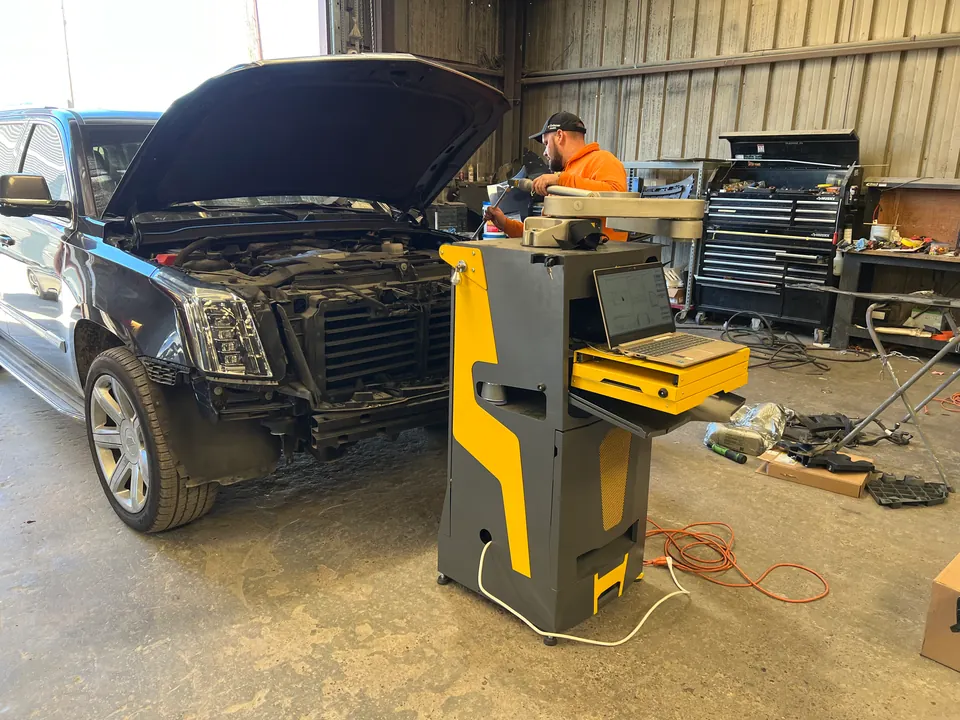
Owner-supplied archive photograph of Touch measuring equipment beside a vehicle with front exterior parts removed. This is equipment context, not a dimensional report or proof of a particular repair result.
Can a vehicle look straight and still measure out of specification?
Structural measuring compares vehicle reference points with the applicable dimensional information. It helps answer questions that exterior appearance and panel gaps alone cannot settle.
Measurements can support initial assessment, repair decisions and later checks. They do not replace inspection of every material, joint or system. At Boudreaux’s New Orleans shop, Spanesi Touch 3D measuring is available; confirm the appropriate location and operation before arranging a visit.
How This Fits Into the Repair Plan
Visual fit, structural dimensions and material condition answer different questions. The repair plan should identify affected reference points, the allowed method and the attachments disturbed by the work. Structural measuring supports this assessment; it does not replace every inspection or procedure.
Ask the shop: Which reference points and comparison information were used? Keep the answer connected to your vehicle and the findings, rather than assuming the same operation is appropriate for every collision.
Related Repair Guidance
What to look for in a measurement explanation
A useful explanation connects the measurement to an actual question about the vehicle. Ask which area is being evaluated and which reference points were compared. Three-dimensional measuring considers length, width and height; a single gap or distance between two visible panels is a different observation. The shop should be able to describe what the selected points tell it about the concern under inspection.
Ask how the vehicle is identified in the comparison information. The relevant model, body configuration and dimensional references matter more than a generic statement that a machine was used. You do not need to operate the system or interpret every number yourself. You should understand which vehicle the comparison applies to and why the measured area is part of the repair assessment.
If a report is supplied, keep the vehicle identification, date and inspection stage with it. A before-repair record and a later verification record answer different questions. Confirm which one you are reading. If a point could not be evaluated, ask whether access is still needed or whether another method will address that area; an omitted result should not be mistaken for a passing result.
Geometry, material condition and system checks are separate
Measurements help evaluate position. They do not independently describe the condition of every material or attachment at that position. Ask the estimator how dimensional findings are considered alongside the visible damage, the affected joints and the applicable repair information. A report is more meaningful when it is explained as part of that larger assessment.
For a hypothetical example, a panel can appear to fit while the shop still needs to evaluate reference points in the adjoining structure. Conversely, an acceptable reading at a particular point does not answer a separate question about a damaged attachment nearby. These examples explain the limits of evidence rather than predicting damage or prescribing a repair for your vehicle.
Keep wheel alignment and structural measurements distinct in the conversation. If both appear in the plan, ask what each is evaluating and how their findings affect the sequence. Do the same with scan reports and calibration records. A collection of different reports is useful when each has a stated purpose; it should not be described as several interchangeable ways of declaring a whole vehicle finished.
When a proposed operation changes, ask which finding changed the decision. Was it the dimensional information, a newly exposed component or a procedure requirement? This question keeps the explanation specific and helps you compare the current repair plan with an earlier exterior estimate.
Questions to settle before accepting the next milestone
Ask what happens after the assessment. The answer may be a repair decision, further access, procedure research or a later verification step. Request an update point and identify which decision requires your approval. A measurement appointment does not automatically establish the entire repair scope or confirm a delivery date.
If the plan includes structural work, discuss what information will document the result of that work. Ask which areas are expected to be checked later and whether the final explanation will distinguish the initial findings from the later verification. Keep the records together so a later question can be answered from the actual repair documents.
Do not use a screenshot of a report as your own driving-safety clearance. Ask the shop about the vehicle’s current condition and receiving or pickup arrangements. Unresolved components, disassembly and other systems can affect the next action even when a particular dimension has been established.
At Boudreaux’s, the confirmed Spanesi Touch 3D measuring capability is associated with New Orleans. Contact the location handling your vehicle to confirm the needed operation and arrangements rather than assuming the same equipment inventory at Luling. Bring the vehicle identification, existing estimate and your questions to the discussion.
Questions About 3D Structural Measuring: What It Can Establish
Technical Reference
I-CAR Repairability Technical Support. Manufacturer requirements for the exact vehicle control the repair method. A reference link does not imply Boudreaux’s certification or affiliation.
Equipment background: Spanesi’s official Touch measuring-system information. Product information is general background; confirm the operation and arrangements for your vehicle with the selected shop.